
Why Understanding Backyard Pond Installation Costs Matters
Backyard pond installation cost typically ranges from $3,680 to $14,500 for most homeowners, with a national average of $7,400. Here’s what you can expect to pay:
Quick Cost Breakdown:
– Small garden pond (4×6 ft): $2,350 – $5,000
– Medium koi pond (10×15 ft): $8,670 – $14,500
– Large recreational pond (20×25 ft): $22,000 – $65,000
– Natural swimming pool: $50,000 – $80,000
Cost per square foot: $2.50 – $9.00
Annual maintenance: $400 – $2,900
The final price depends on size, depth, materials, features like waterfalls, and whether you hire a professional or go DIY.
Nothing transforms a backyard quite like the sight and sound of flowing water. But before you start digging, understanding the true costs involved will help you budget properly and avoid expensive surprises.
Whether you’re dreaming of a simple garden pond or an elaborate koi paradise, the investment can vary dramatically based on your choices. From excavation and liners to pumps and permits, each decision impacts your bottom line.
I’m Kyle Nix, owner of Nix Landscaping here in Fishers, Indiana, and I’ve helped countless homeowners steer backyard pond installation cost decisions over the years. My hands-on experience with everything from small water features to large recreational ponds has taught me exactly what drives costs up or down – and how to maximize your investment.
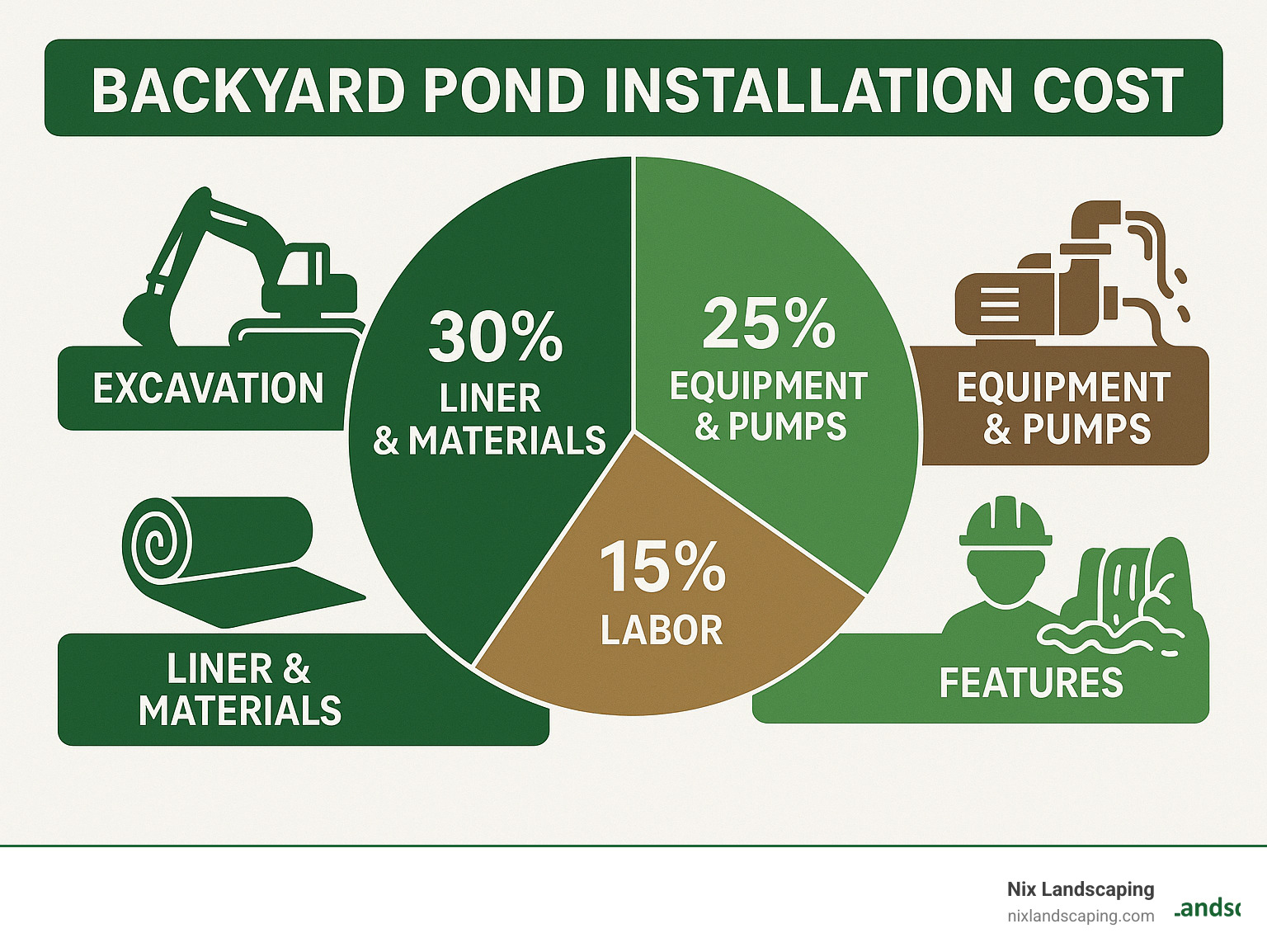
Backyard pond installation cost terms you need:
– build pond with waterfall
– garden pond build
– water features installation
Backyard Pond Installation Cost Breakdown for 2025
Backyard pond installation cost has been climbing steadily, with increases of about 5-8% annually. The national average sits at $7,400, with most homeowners spending between $3,680 and $14,500.
Cost per square foot typically runs $2.50 to $9.00, while excavation costs $1.50 to $4.00 per cubic yard.
Budget tiers for 2025: Budget-friendly projects start around $500 to $1,300 for DIY kits covering 150-200 square feet. Mid-range installations ($3,400 to $5,500) give you 500-1,000 square feet with basic features. Premium projects ($10,000+) bring custom designs and multiple water features. Luxury installations ($50,000+) include natural swimming pools and elaborate water features.
| Installation Type | DIY Kit Cost | Professional Install |
|---|---|---|
| Small garden pond (4×6 ft) | $550 – $1,300 | $2,350 – $5,000 |
| Medium pond (10×12 ft) | $1,200 – $2,500 | $8,670 – $14,500 |
| Large pond (16×21 ft) | $2,000 – $4,000 | $25,000 – $35,000 |
| Natural swimming pool | Not recommended | $50,000 – $80,000 |
Average Costs by Size & Type: backyard pond installation cost
Small ponds (4×6 feet to 8×11 feet): A basic garden pond runs $1,900 to $6,500, while a koi pond with proper filtration costs $3,500 to $5,000. Above-ground options cost $800 to $3,000.
Medium-sized ponds (10×15 feet to 11×16 feet): A decorative pond with waterfall typically costs $8,670 to $14,500. Koi ponds with serious filtration run $5,100 to $15,875, while swimming ponds start around $15,000 to $25,000.
Large ponds (16×21 feet and up): Recreational ponds cost $22,000 to $65,000, and natural swimming pools range $50,000 to $80,000. Farm ponds typically run $3,000 to $15,000 per acre under 10 acres.
Component Price List: backyard pond installation cost
EPDM rubber liner costs $0.35 to $2.50 per square foot. HDPE runs $0.35 to $0.70, while PVC varies from $0.50 to $7.50. Bentonite clay offers a natural option at $0.30 to $0.50 per square foot, though concrete jumps to $60 to $120.
Equipment costs: A quality pond pump runs $100 to $1,500+, while filtration systems range $100 to $2,000+. Skimmers cost $150 to $500, UV sterilizers $100 to $800, and bottom drains $200 to $600.
Labor and materials: Excavation costs $60 to $200 per cubic yard. Gravel and boulders run $100 to $385 per ton, edging materials cost $1 to $15 per square foot, and electrical hookup typically runs $200 to $800. Professional labor rates vary from $50 to $200 per hour.
Factors That Drive Your Pond Price Tag
Backyard pond installation cost depends on several key factors that can make or break your budget.
Excavation costs are often the biggest surprise. What looks like a simple hole can quickly become your largest expense. Rocky soil requiring jackhammering, thick tree roots, or surprise underground utilities can easily double digging costs. I’ve seen excavation go from $800 to over $2,500 when we hit unexpected bedrock.
Clay soil holds water naturally but is tough to dig. Sandy soil drains well and digs easily but often needs extra liner reinforcement.
Location makes a huge difference. Pond installation averages around $3,800 in San Francisco, $2,300 in Chicago, and $2,000 in Kansas City. Here in Fishers, Indiana, we typically see costs in the middle range.
Scientific research on soil suitability shows that loamy soil is ideal for pond construction. Areas with heavy rocks or extensive root systems can add $1,000 or more to excavation costs.
Permits are required for most ponds, especially if you’re disturbing more than 5,000 square feet, going deeper than 24 inches, or building within setback areas. Permit fees typically run $150 to $485.
Liner Materials: Pros, Cons & Costs
EPDM rubber at $0.35 to $2.50 per square foot is my go-to recommendation. It comes with a 20-year warranty, stays flexible at -40°F, and is fish-safe. It costs more initially, but the longevity makes it worthwhile.
HDPE liner costs $0.35 to $0.70 per square foot and offers excellent puncture resistance with great UV stability. It becomes less flexible in cold weather, which can be problematic in Indiana winters.
PVC liner is the budget option at $0.50 to $7.50 per square foot. It’s easy to repair and wallet-friendly, but has a shorter lifespan and can become brittle. Good for small decorative ponds.
Bentonite clay costs $0.30 to $0.50 per square foot. It’s natural, self-sealing, and environmentally friendly, but requires specific soil conditions. We use it mainly for large farm ponds.
Concrete installation runs $60 to $120 per square foot. It’s permanent and allows custom shapes, but can crack over time and requires professional installation.
Feature Upgrades & Their Impact
Add-ons can easily double your backyard pond installation cost, but dramatically increase enjoyment and property value.
Waterfalls range from $500 to $5,000, depending on complexity. Pro tip: calculate pump needs using the “200 GPH per inch of waterfall width” rule.
Fountains are budget-friendly at $100 to $2,000 but provide crucial water movement and aeration. Solar-powered options eliminate ongoing electricity costs.
Lighting transforms everything for $200 to $1,500. Underwater LED lights turn your pond into an evening showpiece with minimal electricity use.
Bridges work beautifully for ponds over 8 feet wide, typically costing $500 to $3,000.
UV sterilizers at $100 to $800 are essential for ponds in full sun to control algae.
For more inspiration on combining features effectively, check out our Water Features Installation services.
DIY vs. Professional Installation – What Will You Really Spend?
The choice between DIY and professional installation significantly impacts your backyard pond installation cost budget.
DIY pond kits start attractively low. Small kits covering 9 square feet cost $70 to $500, while medium kits handling up to 300 square feet run $550 to $1,300. Larger DIY kits covering up to 1,000 square feet cost $1,200 to $6,100.
But kit prices are just the beginning. Tool rental can shock you – that mini excavator costs $150 to $400 per day. Permit applications add $150 to $485, and soil disposal fees hit $200 to $600. Electrical work must be done by licensed professionals anyway, adding $300 to $800.
The big one: mistakes and do-overs. I’ve seen DIY projects cost an extra $500 to $2,000 fixing punctured liners, undersized pumps, or drainage issues.
Professional installation includes design expertise, proper sizing, licensed electrical work, warranties, proper permits, and insurance coverage. For current pricing, check See Pricing In Your Area.
True DIY Budget Worksheet
Hand digging versus equipment rental: You can spend 2-4 weeks digging a medium pond by hand for free (not counting your time). Mini excavator rental costs $300 to $400 per day but completes the job in 1-2 days. Professional excavation runs $60 to $200 per cubic yard with operator expertise.
Permits and paperwork: Researching local codes takes 4-8 hours, application fees cost $150 to $485, and inspection scheduling can delay projects 2-4 weeks.
Disposal and cleanup: Soil disposal runs $30 to $50 per cubic yard, debris removal costs $200 to $400, and site restoration hits $300 to $800.
Hiring a Pro: Cost, Value & Peace of Mind
Professional installation typically costs 2-3 times more than DIY, but you’re buying more than labor.
Design consultation runs $80 to $450 and prevents costly mistakes. At Nix Landscaping, we assess your site, drainage patterns, and goals to create custom plans.
Build quality includes proper excavation with correct slopes, quality liner installation with protective underlayment, correctly sized pumps and filtration, code-compliant electrical work, and warranty coverage.
Timeline matters: We complete small ponds in 1-2 days, medium ponds in 3-4 days, large ponds in 1-2 weeks, and natural swimming pools in 2-4 weeks. Compare that to months many DIY projects require.
When something goes wrong with professional installation, you make one phone call. With DIY, you’re back to YouTube tutorials and hardware store runs.
Beyond Building: Annual Running & Maintenance Expenses
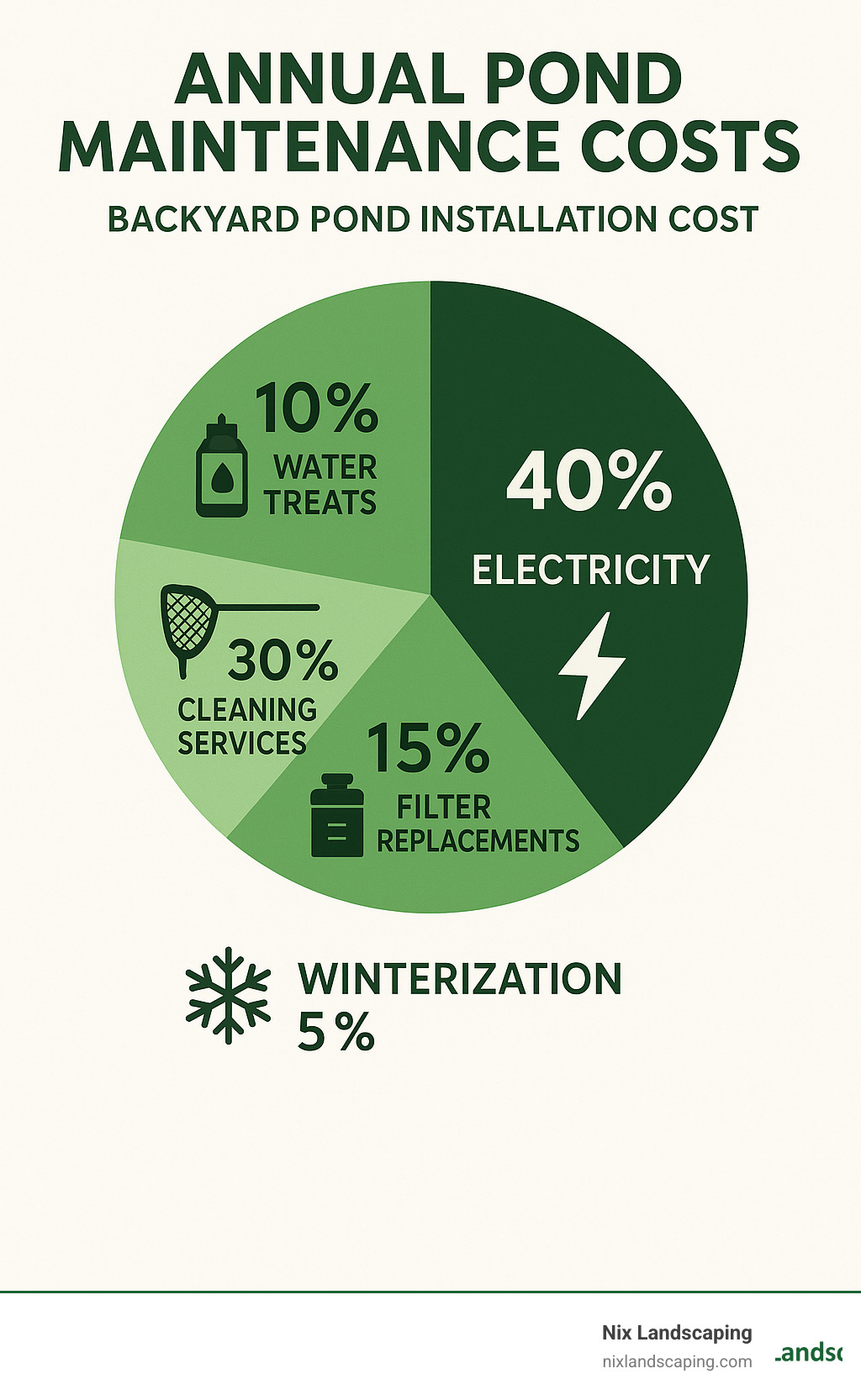
Many homeowners don’t factor ongoing expenses into their backyard pond installation cost planning. Annual maintenance typically runs $400 – $2,900 depending on size and complexity.
The biggest ongoing expense is electricity. A typical 176-square-foot pond costs about $260 annually just to run the pump. With UV sterilizers, heaters, or multiple pumps, expect $400-600+ yearly.
Professional maintenance services run $1,000 – $5,000 per year, handling seasonal cleanings, equipment maintenance, algae control, and fish health monitoring.
DIY maintenance costs around $20 – $40 monthly for supplies. Budget filter media replacements ($50 – $200 yearly), water treatments ($100 – $300 yearly), and winterization ($200 – $500 yearly).
Stocking Costs for Fish & Aquatic Plants
Basic goldfish cost $3 – $19 each. Standard koi run $10 – $60 each, while premium koi cost $100 – $1,000+ depending on size and bloodline.
The stocking rule is one inch of fish per 10 gallons of water. A 1,000-gallon pond supports about 10 inches of fish total.
Aquatic plants are essential for balance. Marginal plants like cattails cost $8 – $25 each. Floating plants such as water lilies run $15 – $50 each. Oxygenating plants cost $5 – $15 per bunch.
Plan for 50-70% plant coverage to maintain natural balance and prevent algae blooms.
Ongoing fish care costs include quality food ($50 – $200 yearly), water testing kits ($30 – $100 annually), and medications ($50 – $150 yearly).
Long-Term ROI & Property Value Boost
A well-maintained pond can increase property value by 5-10%. Professional installation and design adds the most value. Low-maintenance systems appeal to buyers who want beauty without hassle. Attractive landscaping integration makes the pond feel natural.
Safety features like fencing actually increase value by reducing liability concerns. Proper permits and code compliance give buyers confidence.
Value detractors include neglected, overgrown ponds, leaking or non-functional systems, and safety hazards or strong odors from poor maintenance.
Insurance considerations are worth discussing with your homeowner’s insurance company. Some insurers require safety fencing around ponds deeper than 18 inches.
A pond is an investment that pays dividends in daily enjoyment and can boost home value when properly installed and maintained.
For design ideas that maximize both enjoyment and property value, explore our Backyard Design Ideas portfolio.
Cost-Saving Tips, Grants & Mistakes to Avoid
Smart planning can significantly reduce your backyard pond installation cost without sacrificing quality.
Money-Saving Strategies:
– Reuse excavated soil for berms and landscaping
– Source rocks and gravel locally or from your property
– Choose energy-efficient pumps to reduce electricity costs
– Phase add-ons over multiple seasons
– Use natural edging materials like existing stone
Government Grants:
The USDA offers grants for ponds that provide environmental benefits like:
– Wildlife habitat creation
– Stormwater management
– Carbon sequestration
– Water conservation
Contact your local Natural Resources Conservation Service office to explore options.
Critical Mistakes to Avoid:
1. Limestone edging – Can alter pH and harm fish
2. Undersized pumps – Should circulate full volume every 1-2 hours
3. Skipping permits – Can result in fines and forced removal
4. Poor liner protection – Always use underlayment
5. Ignoring utilities – Call 811 before digging

Permits, Regulations & Environmental Benefits
Local Code Requirements:
– Setback distances (typically 50+ feet from house)
– Depth restrictions in residential areas
– Safety fencing requirements
– Electrical code compliance
Environmental Benefits:
– Carbon sequestration through aquatic plants
– Stormwater management reducing runoff
– Wildlife habitat for birds, butterflies, and beneficial insects
– Air cooling through evaporation
– Noise reduction from water sounds
Safety Regulations:
Any water deeper than 1 inch poses drowning risk. Many municipalities require:
– Fencing around ponds over 18 inches deep
– Self-closing, self-latching gates
– Alarm systems for larger water features
– Shallow safety shelves around pond perimeters
Frequently Asked Questions About Pond Pricing
How much does it cost to build a backyard pond in 2025?
The backyard pond installation cost in 2025 typically falls between $2,900 and $15,600, with most homeowners investing around $7,400 for their dream water feature. But honestly, that’s just the starting point for understanding what you’ll actually spend.
Size makes the biggest difference in your final bill. A cozy 4×6 foot garden pond might cost you $2,350 to $5,000, perfect for adding a peaceful corner to your yard. Step up to a proper koi pond, and you’re looking at $5,100 to $15,875. Want to go all out with a natural swimming pool? Be prepared for $50,000 to $80,000 – but imagine the summer parties!
Where you live matters more than you’d think. Here in Fishers, we see pretty reasonable costs compared to places like San Francisco, where the same pond might cost $3,800 versus $2,000 in Kansas City. Regional labor rates and material availability really add up.
Features are where costs can surprise you. A basic pond runs about $2.50 to $7.15 per square foot, but add a dramatic waterfall, custom lighting, and premium materials, and you could hit $100 to $200 per square foot. The good news? You can always start simple and add features later.
What’s the timeline to install a pond?
Timeline is one of the first questions I get from excited homeowners, and the answer is: it depends on your ambition level!
Small DIY kits can literally be installed in a single day if you’re handy and have a free weekend. We’re talking about those preformed pond shells that just need a hole and some leveling.
Professional small ponds typically take us 1 to 2 days to complete. Medium backyard ponds – the kind most families choose – usually require 3 to 4 days of work. This gives us time to excavate properly, install the liner carefully, and test all the systems.
Large recreational ponds are a different beast entirely, often taking 1 to 2 weeks to complete properly. Natural swimming pools can stretch to 2 to 4 weeks because of the complex filtration systems and safety requirements.
That weather, permit approvals, and surprise underground utilities can extend any timeline. That’s why we always build buffer time into our schedules – nobody wants their pond project dragging through the holidays!
Does a pond really increase property value?
This is the million-dollar question (sometimes literally!), and the honest answer is: it absolutely can, but only if you do it right.
Well-designed, professionally installed ponds typically boost home value by 5 to 10 percent. That’s real money when you’re talking about selling your home. But here’s the catch – it has to be done properly from the start.
What makes a pond add value? Professional design that integrates beautifully with your overall landscaping is key. Proper permits and code compliance matter too – buyers want to know everything was done legally. Low-maintenance systems are crucial because nobody wants to inherit a high-maintenance headache. And safety features? Non-negotiable if you want broad buyer appeal.
What kills pond value? DIY installations with visible problems are the biggest red flag for buyers. Strong odors, constant algae issues, or obvious safety hazards can actually decrease your home’s value. High maintenance requirements scare off potential buyers faster than anything.
The bottom line? A pond is like any major landscape investment – quality matters. Done right, it becomes a selling point that buyers remember long after they’ve forgotten the kitchen countertops.
Conclusion & Next Steps
Understanding backyard pond installation cost is your first step toward creating that dream water feature. Whether you’re planning a cozy garden pond for around $3,000 or dreaming big with a natural swimming pool that could run $60,000+, the secret is matching your budget to your vision while avoiding expensive surprises.
Here at Nix Landscaping in Fishers, Indiana, I’ve walked hundreds of homeowners through these decisions. Every property tells its own story, and cookie-cutter solutions rarely deliver the results people truly want. That’s why our personalized design approach focuses on making your pond investment bring maximum joy and add real value to your property for decades.
The numbers we’ve covered – from that $2,900 to $15,600 range for most projects to ongoing maintenance costs of $400 to $2,900 annually – give you a solid planning foundation. But every site is different. Your soil conditions, local permit requirements, and personal goals all play into the final equation.
Ready to move forward? The best next step is getting eyes on your actual property. We offer free consultations where we assess your specific site, discuss your vision, and provide accurate numbers based on real conditions. No guesswork, no generic estimates – just honest advice.
Before you call, define what you really want. Are you looking for a peaceful spot to unwind? A stunning focal point for entertaining? A natural habitat to attract wildlife? Your goals shape everything from size and depth to features and maintenance needs.
Set a realistic budget that includes both installation and ongoing costs. A beautiful pond that becomes a financial burden won’t bring the peace and joy you’re after.
Research your local codes early. Permits, setback requirements, and safety regulations vary by location, and it’s easier to plan around them than retrofit later.
Get multiple quotes if you decide to hire professionals. Compare not just pricing, but design approaches and long-term value. The cheapest option often isn’t the best value when you factor in quality, warranties, and peace of mind.
Your backyard pond should be a source of relaxation and pride, not stress and unexpected bills. With proper planning and the right guidance, you can create a water feature that improves both your property and daily life for years to come.
Contact us today to discuss your pond project and get a personalized quote. Let’s turn those backyard dreams into reality while keeping your budget exactly where it should be.
For more inspiration and design ideas, explore our Residential Backyard Design services.


