
Why Understanding Koi Pond Installation Costs Matters
The cost to install koi pond systems ranges from $3,500 to $95,000+, with most homeowners spending between $10,500 and $17,500 for a professionally installed medium-sized pond.
Quick Cost Breakdown:
- Small pond (7×8 ft): $3,500 – $13,000
- Medium pond (11×16 ft): $11,000 – $27,000
- Large pond (15×20 ft): $17,000 – $36,000
- Extra large (21×26+ ft): $30,000 – $95,000+
- Annual maintenance: $500 – $3,000
- Monthly running costs: $10 – $70
Building a koi pond is more than just digging a hole and adding water. It requires careful planning of filtration systems, proper depth for fish survival, quality materials, and often complex plumbing and electrical work. The investment goes beyond the initial installation – you’ll need to budget for ongoing maintenance, electricity costs, and fish care.
Many homeowners underestimate the true scope of a koi pond project. Understanding all the costs upfront helps you make informed decisions and avoid expensive surprises down the road.
I’m Kyle Nix, owner of Nix Landscaping in Fishers, Indiana, and I’ve helped dozens of homeowners steer the cost to install koi pond systems that fit their budgets and dreams. My years of experience in landscape design and water feature installation have taught me that proper planning and realistic budgeting are essential for creating a pond you’ll love for decades.
Explore more about cost to install koi pond:
Understanding the Average Cost to Install a Koi Pond
Homeowners are often surprised by the cost to install koi pond systems. While prices vary dramatically, understanding the typical ranges helps you plan realistically.
The national average for a professionally installed koi pond is around $10,500, but most homeowners spend between $5,100 and $15,875. Projects can range from a modest $3,500 to over $95,000 for spectacular custom builds. Costs vary based on size, complexity, and your vision.
Budget-friendly installations ($3,500 – $7,000) are typically smaller (around 7×8 feet) with basic equipment. They can be functional but may lack the depth and robust filtration needed for koi to thrive long-term.
Mid-range projects ($8,000 – $25,000) are the most popular. They include properly sized ponds with quality filtration, adequate depth for winter survival, and attractive features like waterfalls or lighting.
Premium custom installations ($30,000 – $95,000+) are backyard masterpieces. They can include multi-level waterfalls, sophisticated lighting, premium materials, and capacity for large koi collections.
The cost per square foot is typically $2.50 to $7.15 for smaller projects. This metric is less useful for larger, complex ponds where equipment and features are the main cost drivers.
| Pond Size (feet) | Approx. Gallons | Average Professional Installation Cost Range |
|---|---|---|
| Small (7′ x 8′) | 1,000 – 1,500 | $3,500 – $13,000 |
| Medium (11′ x 16′) | 2,500 – 3,500 | $11,000 – $27,000 |
| Large (15′ x 20′) | 4,000 – 5,000 | $17,000 – $36,000 |
| Extra Large (21′ x 26’+) | 7,000+ | $30,000 – $95,000+ |
These figures cover the complete installation. Remember to also budget for ongoing maintenance, electricity, and the koi themselves.
Key Factors That Influence Your Final Bill
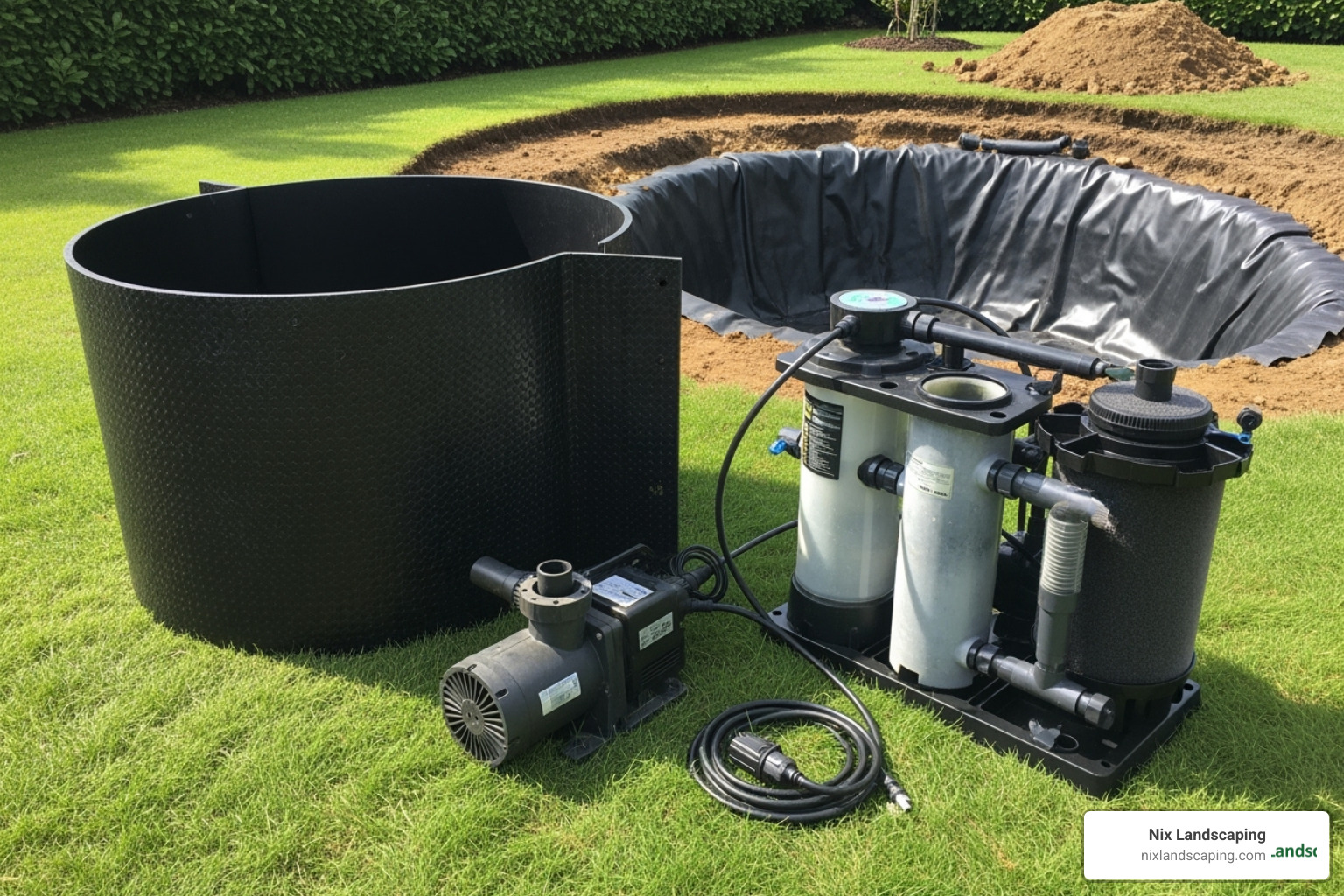
When clients ask me about the cost to install koi pond systems, I always explain that it’s not just about the hole in the ground. Six key factors shape your final investment: pond size and depth, material quality, labor complexity, equipment specifications, exciting add-on features, and your unique site conditions.
Think of these elements like ingredients in a recipe – they all work together to create your project’s unique cost profile. Sometimes a smaller pond with premium filtration costs more than a larger pond with basic equipment. Other times, tricky site conditions can double your excavation costs overnight.
Understanding these variables helps you make smart decisions about where to spend your hard-earned money for the best results.
Pond Size, Depth, and Design
Here’s something many homeowners don’t realize: depth matters more than size for koi health. In Indiana’s climate, I recommend 4-5 feet minimum depth to protect your fish during our harsh winters. If you’re planning for jumbo koi (those magnificent 36-inch beauties), you’ll need 6-8 feet depth to give them proper swimming space.
Most of our clients end up with what I call the “goldilocks pond” – around 10 feet by 15 feet with 3-4 feet depth. This holds roughly 3,000 gallons and comfortably houses 10-12 adult koi with room for natural behavior and growth.
Custom shapes and curved edges create stunning visual impact, but they also increase your costs significantly. Every curve requires more precise excavation and additional materials. Multiple levels, integrated seating areas, and artistic shapes can easily add $3,000-$8,000 to your project.
The sweet spot for pond proportions is 1.2 to 2 times longer than it is deep. This ratio ensures proper water circulation and gives your koi the space they need to thrive.
Essential Equipment and Materials
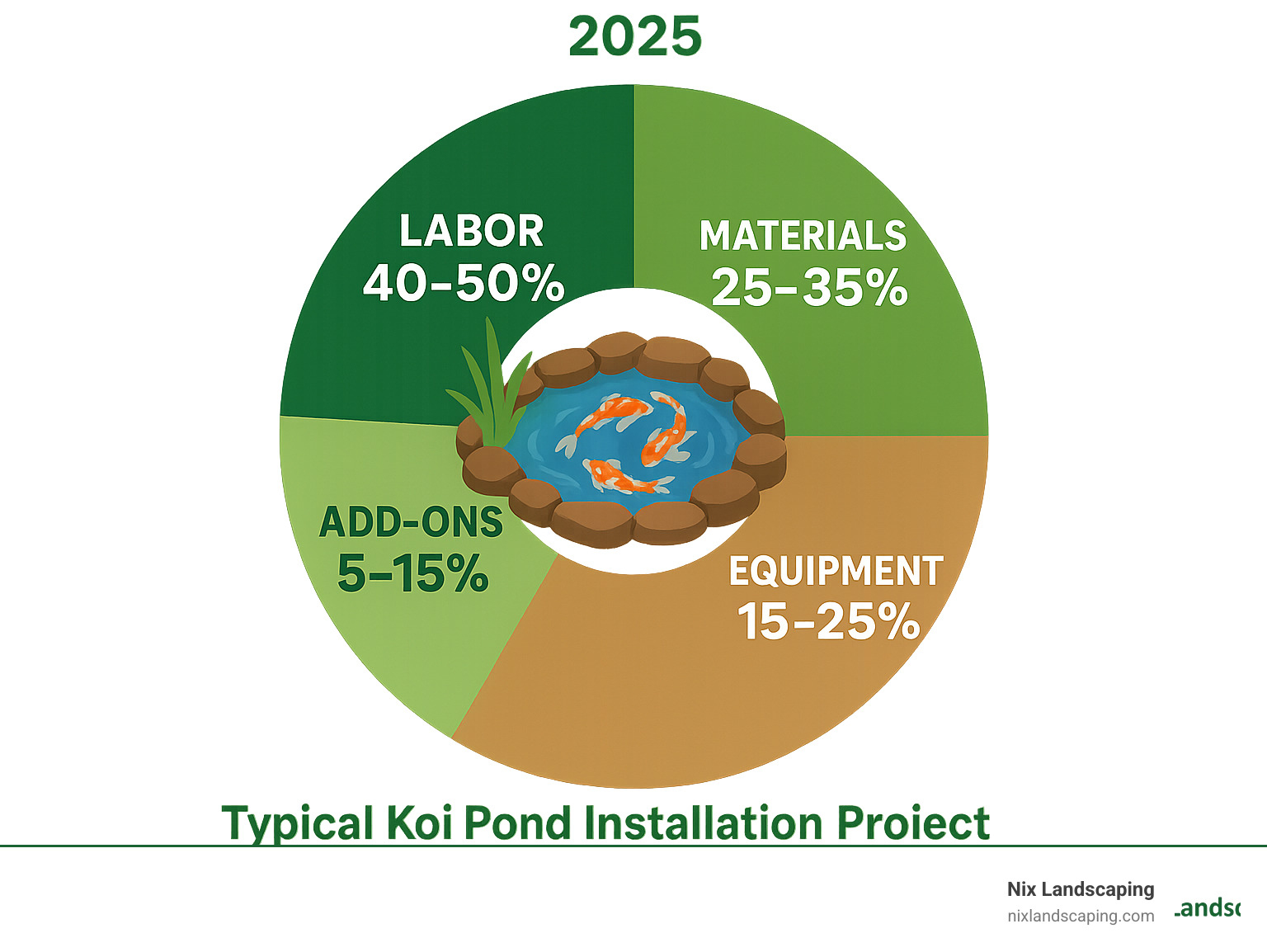
Quality equipment forms the backbone of every successful koi pond, and this is where many homeowners try to cut corners – often regretting it later. We typically allocate 25-35% of the total budget to materials and another 15-25% to equipment.
Pond liners are your pond’s foundation, ranging from $0.30 to $2.30 per square foot. I strongly recommend EPDM rubber liners at $0.65-$2.30 per square foot – they’re fish-safe and incredibly durable. RPE liners at $0.45-$1.65 per square foot offer good performance at moderate cost. We avoid PVC liners entirely due to potential toxicity concerns for koi.
Underlayment might seem like an unnecessary expense at $0.25-$0.40 per square foot, but it’s insurance against punctures from rocks and roots. I’ve seen too many beautiful ponds ruined by a single sharp stone.
Filtration systems are absolutely critical – they’re the life support system for your koi. Basic systems start at $150, while large pond installations can require $5,000+ in filtration equipment. Your filter needs to handle 1.5 times your pond volume for optimal koi health.
Water pumps keep everything moving, costing $50-$2,000 depending on capacity. The pump should circulate your entire pond volume at least once every three hours. For that 3,000-gallon pond, you’d need a pump rated for at least 1,000 gallons per hour.
Additional equipment includes UV sterilizers ($55-$600) for algae control, skimmers ($100-$700) for surface debris removal, and bottom drains ($170-$255) for easier cleaning.
Concrete koi ponds represent the premium option at $50-$130 per square foot installed. While expensive, they offer best durability and unlimited design possibilities.
What is the true cost to install a koi pond professionally?
Professional installation typically represents 40-50% of your total project cost, but this investment pays dividends in quality and longevity. In our area, skilled landscapers charge $50-$100 per hour, and the expertise they bring is invaluable.
Excavation costs range from $1,400-$5,700, depending on your pond size and what we find underground. Rocky soil, tight spaces, or proximity to utilities can significantly increase these costs. I always warn clients about potential surprises lurking beneath their lawn.
Specialized trades add to the investment: electricians charge $50-$130 per hour plus service fees, plumbers run $45-$150 per hour, and excavation contractors charge $2.50-$15.00 per cubic yard.
Professional installation brings peace of mind through expertise in proper construction, access to commercial-grade materials, established supplier relationships, comprehensive warranties, and knowledge of local building codes.
I’ve rescued too many DIY projects that looked beautiful initially but failed within a few years due to improper construction or inadequate filtration. Professional installation ensures your pond functions perfectly from day one and continues performing for decades.
Estimating the cost to install a koi pond with homeowner involvement
Many clients want to roll up their sleeves and save money through sweat equity. I love working with hands-on homeowners who want to learn about their pond system while reducing costs.
Site preparation and cleanup can save you $500-$1,500 in labor costs. Basic landscaping around the pond perimeter offers $1,000-$3,000 in potential savings. Decorative rock placement might save $300-$800, while painting or staining pond edges can reduce costs by $200-$500.
However, I strongly recommend leaving excavation, plumbing, electrical work, and filtration system installation to professionals. These elements require specialized knowledge and tools, and mistakes can be expensive to correct.
The key is finding the right balance between cost savings and quality results. I provide detailed guidance on which tasks you can safely handle and which require professional expertise.
Popular Add-Ons and Improvements

Add-on features transform a basic pond into a stunning landscape centerpiece that becomes the heart of your outdoor living space. While they increase costs, these elements often provide the greatest satisfaction and visual impact.
Waterfalls ranging from $500-$5,000 create more than just beauty – they provide crucial aeration and water circulation that your koi need to thrive. Streams can cost several thousand dollars for elaborate installations, but they create natural-looking water movement and additional filtration capacity.
Underwater lighting systems ($150-$2,000) create magical nighttime ambiance that extends your pond enjoyment well into the evening. LED lights are energy-efficient and long-lasting, making them a smart investment.
Aquatic plants at $4-$45 per plant are essential for balanced ecosystems. They provide oxygen, natural filtration, and habitat for your fish. Fish caves and tunnels ($100-$600 each) give your koi shelter and reduce stress levels.
Pond heaters ($38-$135 per unit) are necessary in our Indiana climate to maintain open water for gas exchange during winter months. Bridges ($100-$1,500) add functional beauty and create perfect viewing spots for watching your koi. Fountains ($100-$4,300) provide additional aeration while creating stunning focal points.
When planning add-ons, consider both initial costs and ongoing maintenance requirements. Some features like elaborate lighting systems may increase electricity costs and require periodic maintenance.
The Cost of the Koi
The fish themselves represent a significant and ongoing investment that many homeowners underestimate. Koi prices vary dramatically based on size, breed, color patterns, and quality.
Small domestic koi (3-6 inches) typically cost $15-$55 each, while medium koi (8-12 inches) range from $50-$200 each. Large koi (15+ inches) can cost $200-$1,000+ each, and show-quality specimens command $1,000-$10,000+ each.
For initial stocking, budget $500-$2,000 for a medium-sized pond. I recommend starting with fewer, smaller fish and allowing them to grow rather than overstocking immediately. Each adult koi requires approximately 250 gallons of water, so a 3,000-gallon pond comfortably houses 10-12 mature fish.
Consider purchasing from reputable local dealers who can provide healthy, quarantined fish and ongoing support. Imported koi often cost more but may offer superior genetics and stunning coloration that makes them worth the investment.
Beyond the Build: Ongoing Maintenance and Running Costs
The cost to install koi pond systems is just the beginning. Long-term ownership involves ongoing expenses for maintenance and operation. Understanding these costs upfront ensures you can properly care for your investment, preventing a beautiful pond from becoming an expensive headache. A well-maintained pond provides decades of enjoyment.
Annual Maintenance and Upkeep
Annual maintenance costs vary by your involvement and pond complexity. DIY maintenance typically costs $500-$1,000 per year, while professional maintenance ranges from $1,000-$3,000+ annually. DIY tasks include filter media replacement ($20-$90 per year), water treatments and testing supplies ($50-$500 annually), basic cleaning supplies ($30-$100 per year), and fish food ($50-$200 per year). Professional services can include spring startup and cleaning ($300-$1,200), fall preparation and netting ($300-$800), quarterly filter cleaning ($100-$300 per visit), and equipment inspection and minor repairs ($100-$500 annually).
Many pond owners choose a hybrid approach, handling daily care themselves while hiring professionals for major seasonal cleanouts. This balances cost savings with professional expertise.
Monthly Running Costs
Electricity is the largest ongoing expense, mainly for running pumps and filtration systems, costing $10-$70+ per month. Modern equipment is more energy-efficient. Water costs for top-offs and changes are typically $10-$30 monthly; in Indiana, these costs are relatively modest. Fish food expenses range from $10-$50 monthly during feeding season. Quality food promotes better fish health and water quality, saving money on potential issues.
Winterizing Your Pond
Proper winterization is crucial for koi survival in cold climates like Indiana. For ponds at least 3-4 feet deep, koi can safely hibernate. We recommend stopping pumps and waterfalls, installing a de-icer or aerator to maintain an opening for gas exchange, and ceasing feeding when water temperatures drop below 50°F. Shallow ponds or extreme cold may require relocating fish to indoor tanks, which involves additional equipment costs ($200-$800) and careful management.
Winterization services typically cost $200-$500 if you hire professionals, but many pond owners learn to handle this seasonal task themselves.
Is a Koi Pond a Good Investment?
When homeowners ask me about the cost to install koi pond systems, they’re really asking whether this investment makes sense for their family and their home. After installing dozens of ponds in the Fishers area, I can confidently say that a koi pond is more than just a landscape feature – it’s an investment in your property’s appeal and your family’s daily quality of life.
The returns on this investment come in many forms, some measurable and others deeply personal. While you might not see immediate dollar-for-dollar returns like you would with a kitchen renovation, the benefits compound over time in ways that often surprise pond owners.
Enhancing Property Value
A professionally designed and well-maintained koi pond typically adds significant value to residential properties. Real estate agents in our area consistently tell me that water features create strong emotional connections with potential buyers and help homes stand out in competitive markets.
The key word here is “well-maintained.” A beautiful, functioning pond with healthy fish and clear water becomes a major selling point that can justify premium pricing. However, a neglected pond with murky water and broken equipment can actually hurt your property value.
Professional installation and design matter tremendously for resale value. Buyers can easily spot DIY projects that look amateurish or don’t integrate well with the overall landscape. When we design a pond, we ensure it complements your home’s architectural style and improves the entire outdoor space rather than overwhelming it.
The aesthetic appeal extends beyond just the pond itself. A thoughtfully designed water feature often becomes the centerpiece that ties together your entire backyard landscape, creating cohesive outdoor living spaces that today’s buyers actively seek.
Creating a Sustainable Ecosystem
Modern pond design has evolved far beyond simple holes filled with water. Today’s ecosystem ponds use natural processes to create balanced, low-maintenance environments that largely care for themselves. This approach reduces your long-term costs while creating more beautiful, natural-looking features.
A properly balanced ecosystem includes adequate plant coverage (typically 30-70% of the surface area), appropriate fish stocking levels, and efficient circulation systems that work together harmoniously. The aquatic plants provide natural filtration, oxygen production, and fish habitat while reducing the need for chemical treatments.
We design these systems to establish natural bacterial colonies that process fish waste and maintain water quality. This biological approach means less frequent cleaning, fewer chemical additives, and more stable water conditions that keep your koi healthy and happy.
The sustainability aspect appeals to environmentally conscious homeowners who want beautiful features without excessive resource consumption. A well-designed ecosystem pond actually supports local wildlife, providing habitat for beneficial insects, birds, and other creatures that contribute to a healthy backyard environment.
The Hobby and Lifestyle
What surprises many new pond owners is how quickly koi keeping becomes a genuinely rewarding hobby. The stress relief and relaxation that comes from watching fish swim and listening to flowing water provides documented mental health benefits that busy families desperately need.
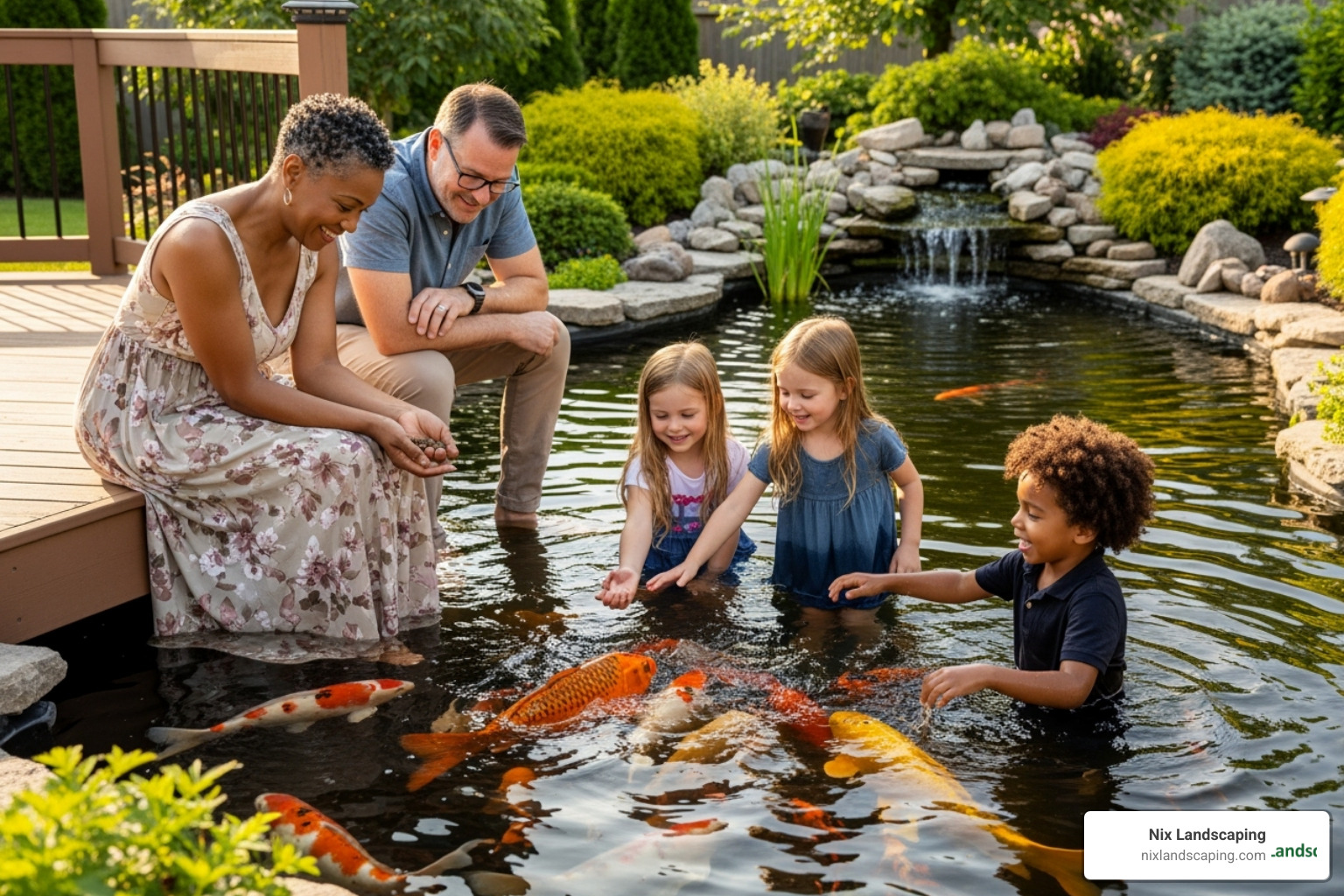
Koi can live 20+ years with proper care, which means you’re not just buying fish – you’re welcoming long-term companions into your family. Many of our clients develop genuine relationships with their koi, learning to recognize individual fish and their personalities. Kids especially love feeding time and watching the fish grow over the years.
The learning opportunities are endless. From understanding water chemistry to recognizing different koi varieties, pond ownership opens up a fascinating world of aquatic knowledge. Many enthusiasts find themselves attending koi shows, joining local pond societies, and connecting with fellow hobbyists who share their passion.
Creating your personal backyard sanctuary becomes one of the most valuable aspects of pond ownership. In our increasingly connected world, having a peaceful space where you can unwind and connect with nature provides immeasurable value. The gentle sound of water, the graceful movement of fish, and the beauty of aquatic plants create a meditative environment right outside your door.
For families, the pond becomes a natural gathering place where kids can learn responsibility through fish care, where friends want to spend time, and where you can escape daily stress without leaving home. This connection with nature in your own backyard offers benefits that extend far beyond the initial cost to install koi pond systems.
Frequently Asked Questions about Koi Pond Costs
After helping dozens of homeowners with their pond projects, I’ve noticed the same questions come up repeatedly. Let me address the most common concerns about cost to install koi pond systems and ongoing ownership.
How many koi can I have in a 1,000-gallon pond?
The magic number is one mature koi per 250 gallons of water. This means your 1,000-gallon pond can comfortably house about four adult koi without creating stress or water quality issues.
I always tell clients that overcrowding is one of the biggest mistakes new pond owners make. Those adorable 6-inch koi from the store will grow into 24-inch beauties over time. When you cram too many fish into a small space, you’re setting yourself up for poor water quality, increased disease risk, and unhappy fish.
If you’re planning for jumbo koi (the giants that can reach 36 inches), you’ll need even more space – about 500+ gallons per fish. My advice? Start with smaller fish and fewer of them. You can always add more later, but removing fish from an overcrowded pond is much more challenging.
Does a koi pond need a waterfall?
While not absolutely required if you have other aeration methods, a waterfall is one of the best investments you can make. It’s like getting multiple benefits for one feature – significant oxygen addition, improved water circulation, natural algae control, and that peaceful sound that makes your backyard feel like a retreat.
I’ve installed ponds with alternative aeration systems like air stones, fountains, or dedicated aerators, and they work fine functionally. But waterfalls provide the most natural-looking solution while serving multiple purposes.
The sound of flowing water also helps mask neighborhood noise, creating a more peaceful environment. Plus, waterfalls give you endless design possibilities – from dramatic multi-tier cascades to gentle streams that look like they’ve always been part of your landscape.
Are koi ponds difficult to maintain?
This is probably the question I hear most often, and I understand why people worry about it. The good news is that with proper setup – including effective filtration and a balanced ecosystem – koi ponds are surprisingly low-maintenance.
Most of my clients spend about 15-30 minutes per week on routine tasks like feeding fish, skimming surface debris, and doing a quick equipment check. It’s actually quite relaxing, and many pond owners tell me it becomes their favorite part of the day.
The key is getting the system right from the start. When we design ponds with appropriate filtration, proper fish stocking levels, and good circulation, they largely take care of themselves. You’ll need a more thorough cleaning once or twice a year – typically spring startup and fall preparation – but that’s about it.
I often joke that my pond clients become my biggest advocates because they’re amazed at how easy maintenance actually is compared to what they expected. The secret is starting with a well-designed system that works with nature rather than against it.
Transform Your Backyard with a Custom Koi Pond
A koi pond represents far more than just a landscape feature—it’s an investment in your home’s beauty, your family’s well-being, and your property’s long-term value. The cost to install koi pond systems varies dramatically based on your vision, from simple backyard retreats to elaborate water gardens that become the centerpiece of your outdoor living space.
Throughout this guide, we’ve explored how factors like pond size, depth requirements, equipment quality, and professional installation all contribute to your final investment. Whether you’re considering a modest 1,000-gallon starter pond or dreaming of a sprawling 7,000-gallon koi paradise, understanding these cost drivers helps you make informed decisions that align with your budget and lifestyle goals.
The beauty of koi pond ownership lies in its flexibility. You can start with essential features and gradually add waterfalls, lighting, or premium filtration as your budget allows. Many of our clients begin with a well-designed foundation and improve their ponds over several seasons, spreading costs while learning more about their preferences along the way.
Planning carefully from the beginning ensures your pond will provide decades of enjoyment rather than years of frustration. This means investing in proper depth for fish survival, adequate filtration capacity, and quality materials that withstand our Indiana weather extremes. Cutting corners on these fundamentals often leads to expensive repairs and unhappy fish.
For homeowners in the Fishers, IN area, we at Nix Landscaping understand that every property and family has unique needs. Our personalized approach means we listen to your vision, assess your space, and create solutions that work within your budget while exceeding your expectations. We’ve helped dozens of families steer the cost to install koi pond systems that bring them joy for years to come.
Ready to explore the possibilities for your own private oasis? Contact us to discuss your project and find how we can help transform your backyard into the tranquil retreat you’ve always imagined.

