
Why Understanding Paver Driveway Costs Matters for Your Home Investment
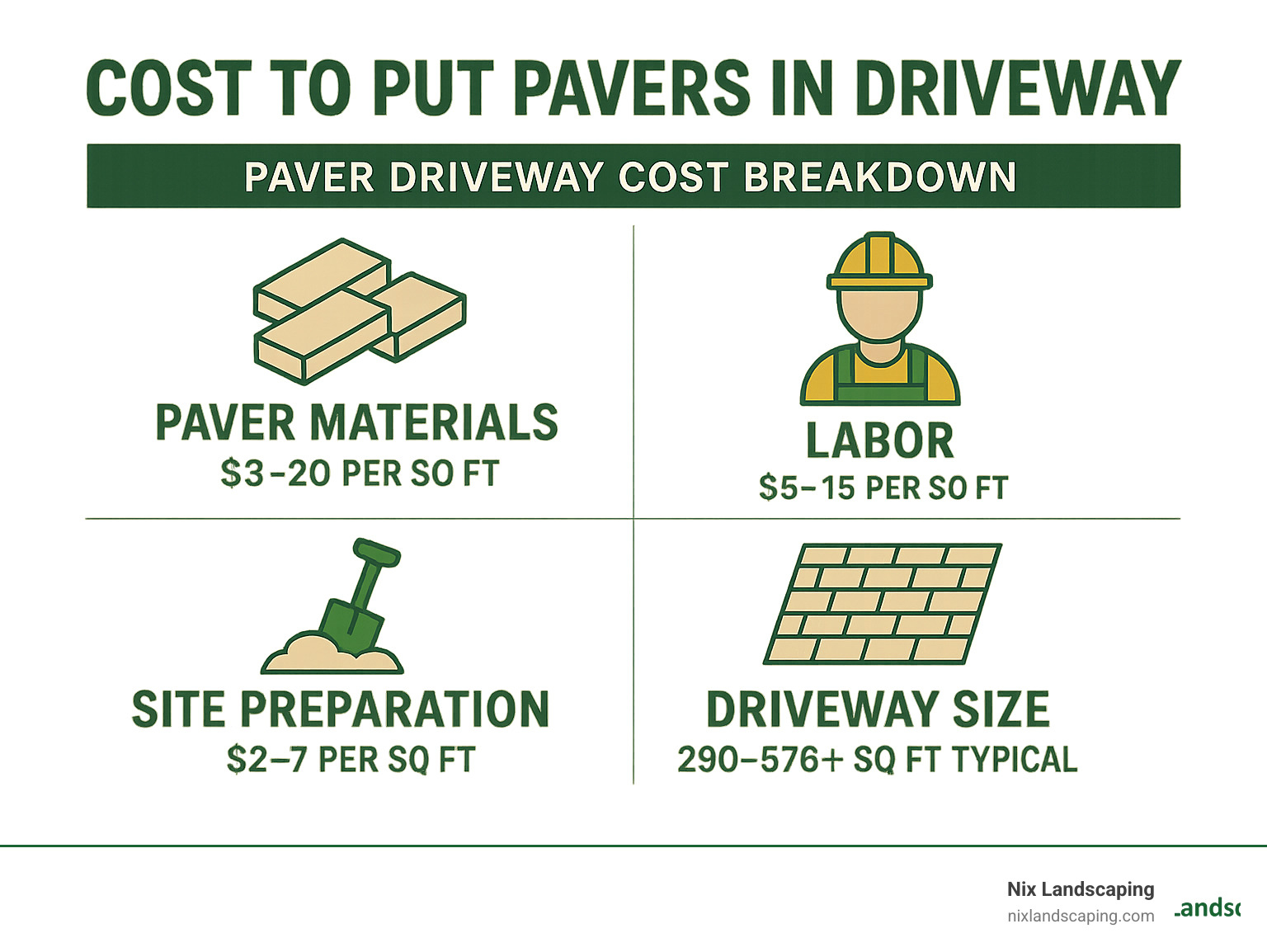
The cost to put pavers in driveway typically ranges from $10-$30 per square foot installed, with most homeowners spending $12,000-$18,000 for a standard two-car driveway. Here’s what you can expect:
Average Paver Driveway Costs:
- One-car driveway (290 sq ft): $2,900-$8,600
- Two-car driveway (576 sq ft): $5,700-$17,200
- Material costs: $3-$20 per square foot
- Labor costs: $5-$15 per square foot
- Total project timeline: 3-5 days
When you look at a beautifully installed paver driveway, what you’re seeing isn’t just stones set in a pattern – it’s an investment in your home’s curb appeal, functionality, and value. A well-designed paver driveway can boost your property value while creating that stunning first impression every homeowner wants.
But here’s the reality: understanding the true cost goes far beyond just the sticker price. Smart homeowners in Fishers know that factors like material choice, site preparation, and design complexity can dramatically impact your final investment.
Why consider pavers over concrete or asphalt? Paver driveways last 25-50 years compared to concrete’s 20-30 years, and when damage occurs, you can replace individual pavers instead of redoing the entire surface. Plus, they add serious curb appeal that plain concrete simply can’t match.
I’m Kyle Nix, owner of Nix Landscaping, and I’ve helped dozens of Fishers families steer the cost to put pavers in driveway projects over the past several years. From my experience installing everything from simple concrete pavers to elaborate natural stone designs, I’ll break down exactly what you can expect to invest and why it’s often worth every penny.
What is the Real Cost to Put Pavers in a Driveway?
Here’s where the rubber meets the road – or in this case, where your pavers meet your budget. The cost to put pavers in driveway typically ranges from $10 to $30 per square foot installed, though premium projects can reach $40 per square foot for complex designs with high-end materials.
For most homeowners, the national average hovers around $12,000 for a standard two-car driveway (roughly 20 feet by 24 feet). But here’s the thing – that number can swing dramatically based on your specific situation. I’ve seen projects range from $6,000 for a straightforward installation to $18,000 for something more elaborate. And if you’re dreaming of a luxury cobblestone driveway with intricate patterns? That could push costs well beyond $25,000.
On the flip side, if you’re considering a simple, smaller project – maybe grass pavers for a secondary driveway – you might start as low as $1,200. The key is understanding that there’s no cookie-cutter answer to paver driveway costs.
Regional pricing differences play a bigger role than many homeowners realize. Here in Fishers, Indiana, we’re fortunate to have competitive labor rates. But if you’re in coastal areas or major metropolitan regions, expect to pay 15-20% more for the same work. These variations come down to local labor costs, material availability, and general business expenses. The Bureau of Labor Statistics offers helpful insights into regional labor cost trends if you’re curious about your area.
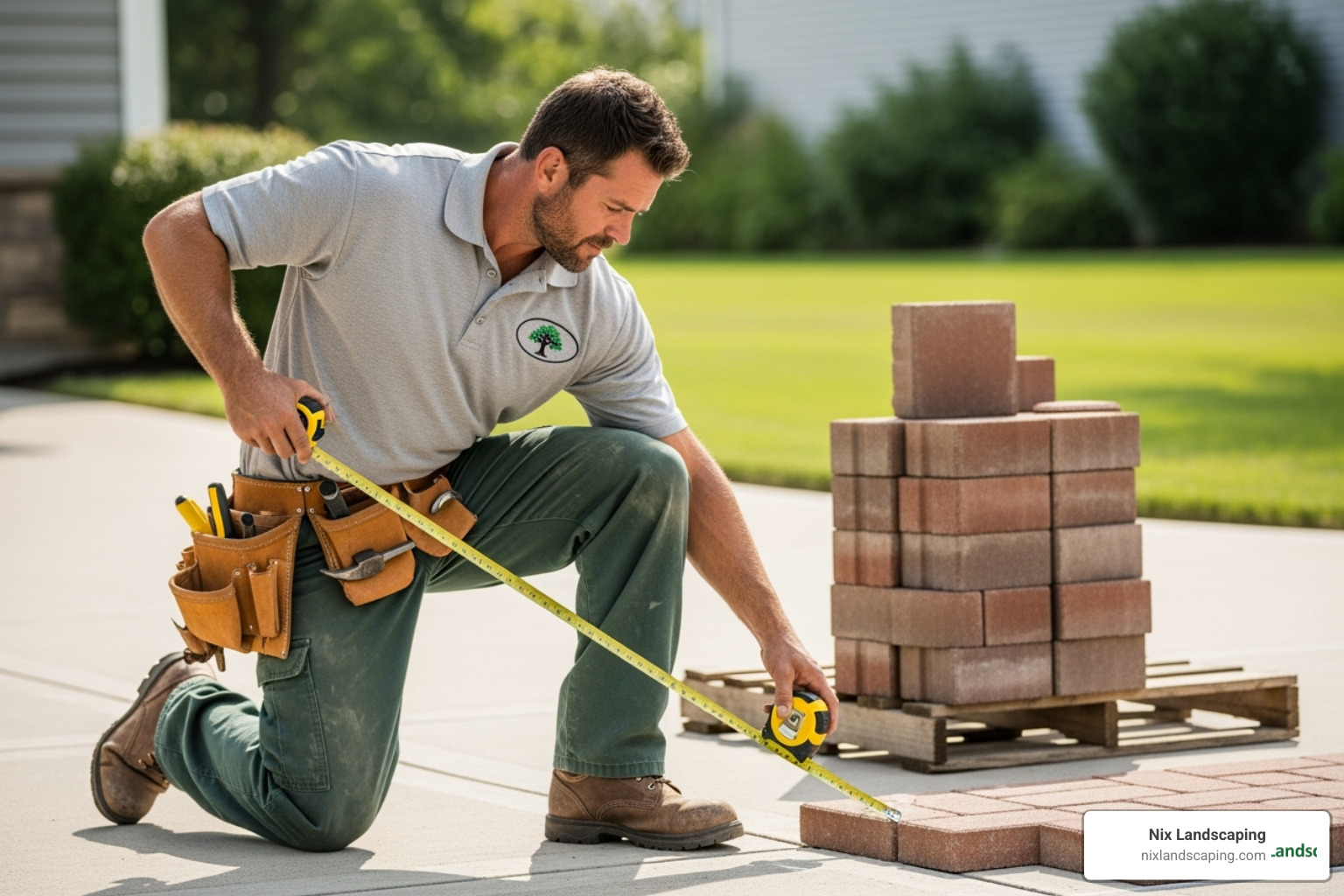
The bottom line? Understanding the true cost to put pavers in driveway means looking at your specific project scope, not just industry averages.
Driveway Size and Design Complexity
Let’s start with the obvious – driveway dimensions matter. A one-car driveway (typically 9-12 feet wide) will naturally cost less than a two-car driveway (usually 18-24 feet wide). But here’s something interesting: larger driveways often have a slightly lower cost per square foot due to economies of scale in material delivery and labor setup.
The real game-changer, though, is design complexity. Think of it like choosing between a simple jigsaw puzzle and a 1,000-piece masterpiece.
Simple paver patterns like a running bond pattern – where pavers are laid in neat, straight lines – are the most cost-effective option. Your installation crew can work efficiently, and there’s minimal waste from cutting.
But maybe you’re eyeing that gorgeous herringbone pattern you saw in a magazine? Those diagonal angles and precise cuts will bump up your labor costs by 10-15%. It’s beautiful work, but it takes more time and skill to execute properly.
Custom inlays – perhaps your family crest or a unique geometric design – add another layer of complexity and cost. These require careful planning, precise cutting, and often special ordering of materials.
Then there’s the matter of curved versus straight edges. Straight lines are a contractor’s best friend – they’re faster to install and require less cutting. Curved driveways with flowing lines or complex shapes? They’re stunning, but expect higher labor costs and some material waste from all those custom cuts.
At Nix Landscaping, we love bringing unique visions to life, whether you want something neatly simple or wonderfully complex. You can see examples of our creative approach to both driveways and other hardscaping projects at Nix Landscaping Custom Patios.
Site Preparation and Base Materials
Here’s where many homeowners get surprised – and where the cost to put pavers in driveway really adds up. Before we lay a single paver, we need to create the perfect foundation. This isn’t just digging a hole and throwing down some sand. It’s engineering.
Existing driveway removal is often the first big expense. If you have old concrete or asphalt that needs to go, removal typically runs $3 to $7 per square foot for basic demolition, or $6 to $11 per square foot if the old driveway was set in mortar. For a typical driveway, that’s $550 to $1,800 just for removal and hauling away debris.
Excavation depth is crucial for long-term success. We typically dig 8-14 inches deep for driveways, and in areas with heavy freeze-thaw cycles like ours in Fishers, we might go even deeper – sometimes up to 20 inches. This is much more extensive than what’s needed for a patio because driveways must handle much heavier loads.
Soil conditions can make or break your project budget. The heavy clay soil common in our area requires thorough compaction (at least 95%) to prevent future settling. Sometimes we need to add geotextile fabric ($0.50-$0.75 per square foot) to keep the base materials from mixing with native soils. And occasionally, we encounter surprises like large tree roots ($100-$350 per load for removal) or old stumps ($100-$550 per stump) that need addressing.
Grading and sloping isn’t optional – it’s essential for proper drainage. We create a gentle slope (around 2%) to direct water away from your home and prevent puddles. If your yard needs extensive regrading, that can add $1,000 to $3,300 to your project.
The crushed stone aggregate base is your driveway’s backbone. We lay down 6-12 inches of Class II road base ($0.75-$1.00 per square foot), compacting it in layers for maximum stability. On top of that goes 1-3 inches of bedding sand ($0.45-$0.55 per square foot), which creates that perfectly level surface for paver installation.
All these steps ensure your investment will handle everything from daily commutes to Indiana’s unpredictable weather for decades to come.
Key Factors That Influence Your Final Price
When you’re planning your paver driveway project, understanding the main cost drivers helps you make informed decisions and avoid surprises. The cost to put pavers in driveway isn’t just about square footage – it’s shaped by several key factors that can dramatically impact your final investment.
Your material choice is probably the biggest decision you’ll make. Whether you go with budget-friendly concrete pavers or splurge on premium natural stone can swing your total cost by thousands of dollars. Then there’s the labor component, which often surprises homeowners with how much skilled installation actually costs. Project complexity also plays a huge role – that beautiful curved edge or intricate pattern you’re dreaming about will require more time and expertise than a simple rectangular design.
Don’t forget about those additional costs that can sneak up on you. Things like permits, drainage solutions, or dealing with unexpected soil conditions can add to your budget. At Nix Landscaping, we always walk through these potential extras during our initial consultation so you know exactly what to expect.
Breaking Down the Cost to Put Pavers in a Driveway by Material
Your paver material choice is where you’ll see the biggest price swings in your project. Think of it like choosing between a Honda and a Mercedes – both will get you where you’re going, but the experience and longevity are quite different.
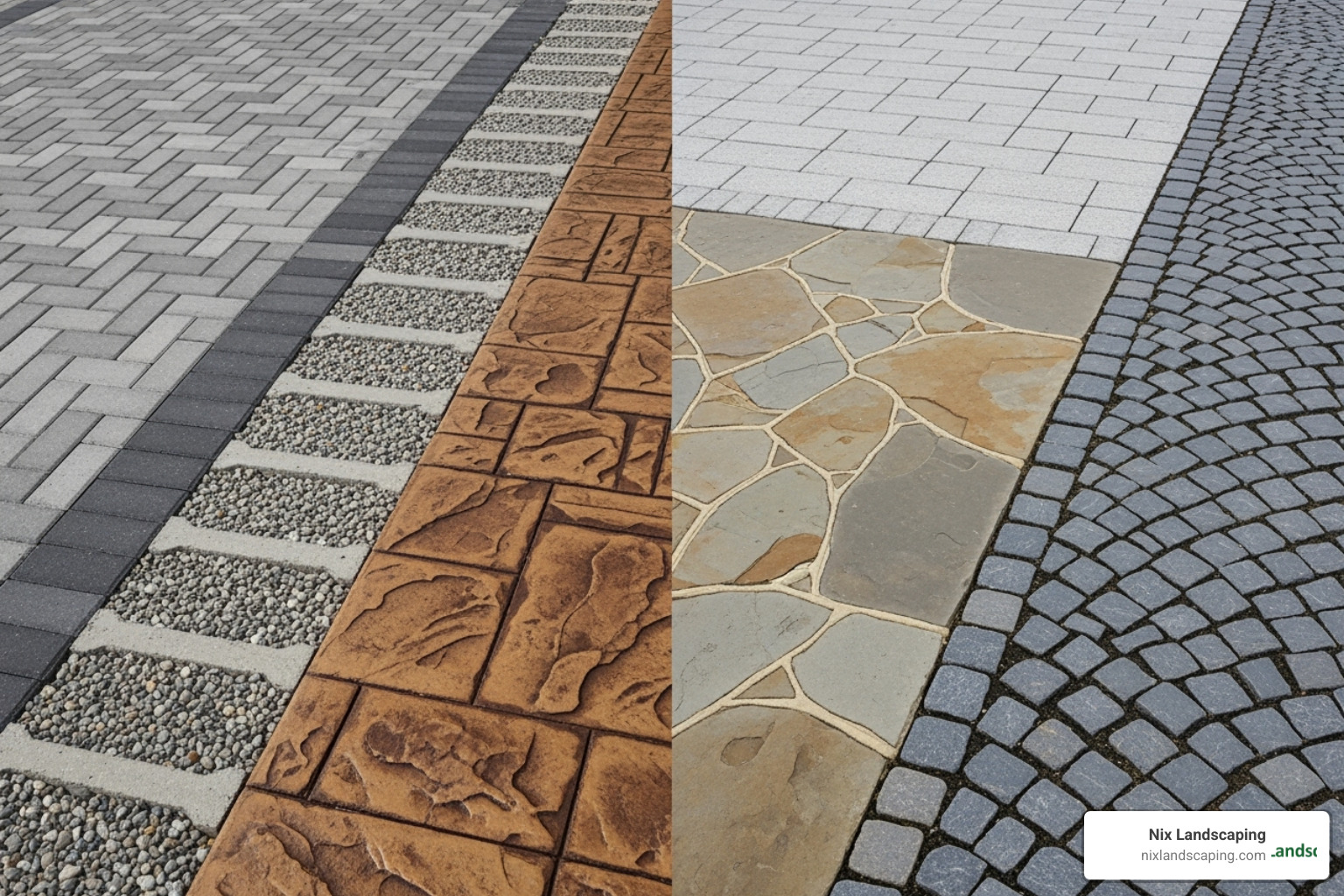
| Paver Type | Avg. Cost/Sq. Ft. (Installed) | Lifespan | Key Features |
|---|---|---|---|
| Concrete Pavers | $10 – $25 | 25-50 years | Most affordable, wide variety of colors, shapes, and patterns, durable, good for heavy vehicles, easy to repair. |
| Natural Stone | $15 – $60 | 50-100+ years | Premium look, unique natural variations, extremely durable, can include granite, travertine, bluestone. |
| Cobblestone | $18 – $70 | Up to 100 years | Highest cost, extremely durable, historic aesthetic, often used for high-end projects, can withstand heavy loads and last for generations. |
Concrete pavers are the workhorses of the paver world, typically running $10 to $25 per square foot installed. Don’t let the word “concrete” fool you into thinking they’re boring – today’s concrete pavers come in amazing colors and textures that can mimic natural stone, brick, or even wood. They’re incredibly durable, can handle heavy vehicles without cracking, and if one gets damaged, you can replace just that single paver. Most of our Fishers clients love concrete pavers because they deliver great looks without breaking the bank.
We work with top manufacturers like EP Henry to ensure you’re getting quality materials that will stand up to Indiana’s weather extremes. You can learn more about our quality installations at EP Henry Paver Installation.
Natural stone pavers, especially cobblestone, are the luxury option that can transform your driveway into a true showpiece. Cobblestone brings that old-world European charm that never goes out of style, and it’s built to last – we’re talking up to 100 years! But this premium quality comes with a premium price, typically $18 to $70 per square foot installed. The higher cost reflects not just the material itself, but also the specialized labor needed to work with these heavier, often irregularly shaped stones.
Understanding Labor Costs
Here’s something that catches many homeowners off guard: labor often represents the largest chunk of your paver driveway investment, typically running $5 to $15 per square foot. But this isn’t just someone placing stones in the ground – it’s skilled craftsmanship that makes the difference between a driveway that lasts decades and one that starts settling within a few years.
What does professional labor actually include? Our crews handle the excavation – digging out your old driveway and preparing the subgrade to exact specifications. There’s hauling – removing tons of old material and bringing in the aggregate base and pavers. The actual installation involves meticulous placement of each paver, ensuring perfect alignment and proper joint spacing. Finally, there’s thorough cleanup so your property looks better than when we started.
The paver pattern you choose directly affects labor costs too. A simple running bond pattern goes down relatively quickly, but that gorgeous herringbone design you saw on Pinterest? That requires precision cuts and careful fitting, which means more time and higher labor costs. Custom inlays or curved edges add even more complexity.
At Nix Landscaping, our experience with Fishers’ unique soil conditions and climate challenges means we know exactly how to prep your base for long-term success. We have the specialized equipment and expertise to prevent those common problems like settling and shifting that can turn your beautiful investment into a maintenance headache.
Long-Term Value: Is a Paver Driveway Worth It?
When you’re staring at the initial cost to put pavers in driveway, it’s natural to wonder if you’re making the right investment. After installing dozens of paver driveways in Fishers over the years, I can tell you with confidence that the long-term value is absolutely worth it.
Let’s talk about return on investment first. A beautiful paver driveway doesn’t just make you smile every time you pull into your garage – it makes potential buyers smile too. We’ve seen homeowners recoup 60-80% of their paver driveway investment when they sell, and in some cases, a stunning entrance can be the deciding factor that gets you a quicker sale at asking price.
The durability factor is where pavers really shine. Unlike rigid concrete that cracks when the ground shifts (and trust me, Indiana soil loves to move with our freeze-thaw cycles), pavers are designed to flex and move with the earth. Think of it like the difference between a rigid board and a chain – when stress hits, the chain bends while the board breaks.
Here’s where paver driveways become absolutely brilliant: repairability. When a concrete driveway cracks, you’re looking at replacing entire sections or even the whole slab. But with pavers? We can pop out a single damaged stone and replace it in about 20 minutes. I’ve fixed driveways where a tree root pushed up one paver, and you’d never know there was ever an issue.
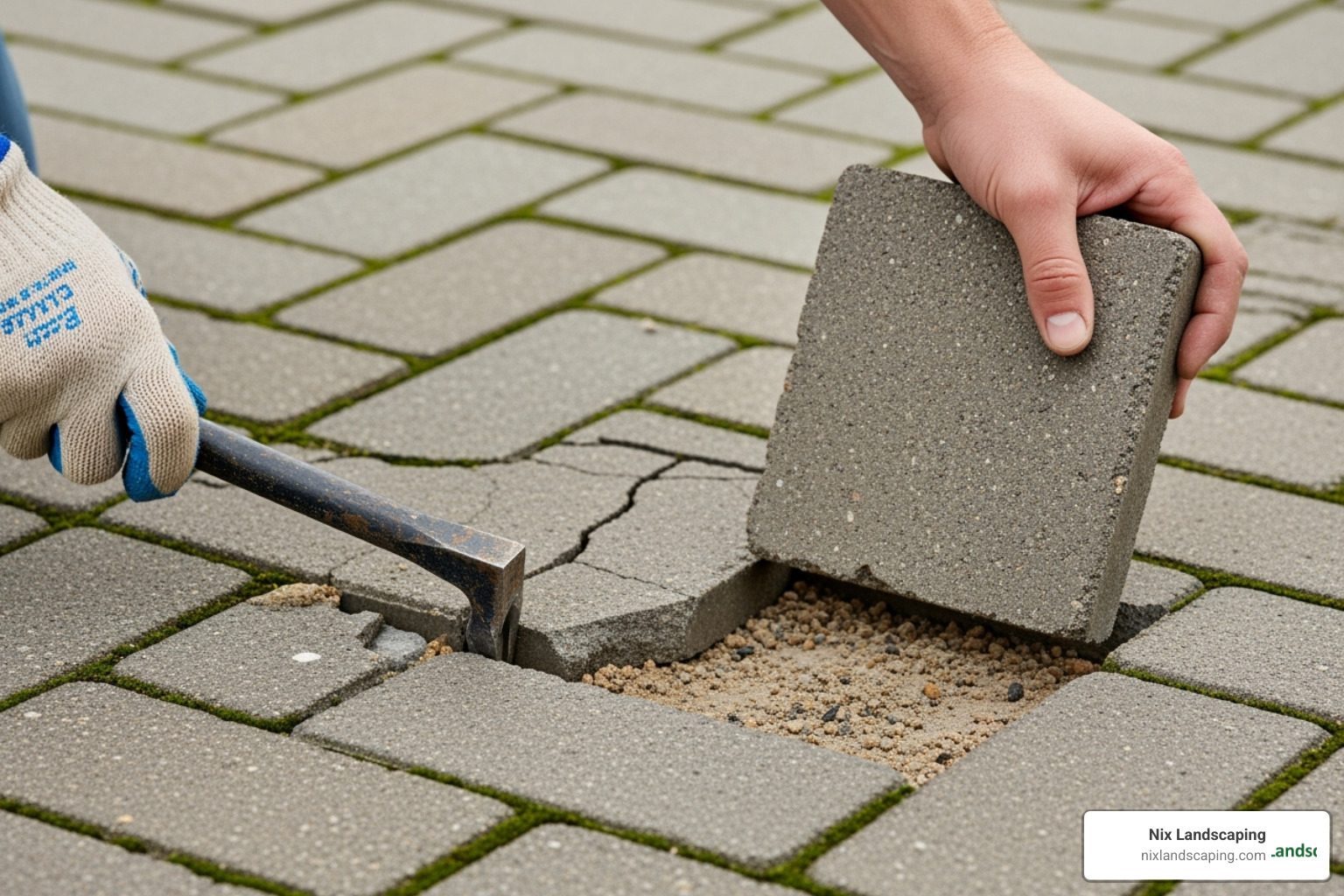
The long-term costs tell the real story. Yes, the upfront cost to put pavers in driveway might be higher than pouring concrete, but over 20-30 years, pavers often cost less. When your neighbor is on their second concrete replacement, your paver driveway will still look fantastic with maybe just a few individual stones replaced here and there.
And let’s be honest about aesthetics – there’s simply no comparison. Pavers offer endless design possibilities that plain concrete just can’t match. Whether you want classic brick charm, modern concrete sleekness, or the timeless elegance of natural stone, your driveway can perfectly complement your home’s style and your personal taste.
DIY vs. Professional: Analyzing the Cost to Put Pavers in a Driveway
I get it – when you see the labor portion of your quote, the idea of doing it yourself becomes pretty tempting. DIY cost savings can be significant, potentially cutting 30-40% off your total project cost since you’re mainly paying for materials and tool rentals like compactors and wet saws.
But here’s where I need to be completely honest with you about the reality of DIY paver installation. This isn’t like laying a small patio – driveways require precise execution under much more demanding conditions. The physical labor alone is intense, and one mistake in the foundation can turn your money-saving project into a costly nightmare.
The most common DIY mistakes I see are heartbreaking because they’re so preventable. Improper base preparation is the big one – without the right excavation depth and proper compaction, your beautiful driveway will develop dips and humps within a year or two. Uneven surfaces create trip hazards and look unprofessional, while poor drainage can undermine your entire investment when water starts pooling and washing out the base.
I’ve been called to fix more DIY driveway projects than I care to count, and unfortunately, the cost of correcting these issues often exceeds what professional installation would have cost in the first place. For something as important and permanent as your driveway, the value of professional installation goes far beyond just having the right tools – it’s about having the experience to handle unexpected soil conditions, proper drainage solutions, and the knowledge that comes from doing this work day in and day out.
Our team at Nix Landscaping Paver Patio & Driveway Experts understands Fishers’ unique soil conditions and has the specialized equipment to ensure your driveway is built to last decades, not just look good for the first season.
Lifespan and Ongoing Maintenance
Here’s where the true value of the cost to put pavers in driveway really becomes clear. When properly installed, paver driveways last 25-100 years depending on the material you choose. Concrete pavers typically give you 25-50 solid years, while natural stone options like cobblestone can easily outlast your mortgage – some cobblestone streets in Europe are still going strong after centuries!
Compare that to asphalt driveways that need replacement every 15-20 years, or concrete slabs that typically crack and require replacement after 20-30 years. When you do the math over your home’s lifetime, pavers often cost less per year than these “cheaper” alternatives.
The ease of repair is what really sets pavers apart. Last month, I helped a client whose delivery truck accidentally cracked a single paver. We popped it out, slid in a new one, and 20 minutes later you couldn’t tell anything had happened. Try doing that with concrete or asphalt!
Maintenance is surprisingly simple when you know what to do. Sealing your pavers every 2-3 years (costing about $0.75-$1.25 per square foot) protects against stains and UV fading. Joint sand replenishment with polymeric sand every 5-7 years keeps everything locked in place and helps prevent weeds.
For ongoing care, an annual pressure washing and keeping an eye on any weed growth in the joints will keep your driveway looking fantastic. The beauty is that unlike concrete or asphalt, small maintenance tasks actually keep your paver driveway looking like new rather than just slowing down its decline.
When you factor in this longevity and easy maintenance, the initial cost to put pavers in driveway transforms from an expense into a smart long-term investment in your home’s value and your own daily enjoyment.
Frequently Asked Questions about Paver Driveway Costs
Over the years, I’ve noticed that homeowners in Fishers tend to ask similar questions when they’re considering a paver driveway project. Let me share the answers to the most common ones we hear.
What is the most affordable type of paver for a driveway?
If you’re looking to minimize the cost to put pavers in driveway while still getting a beautiful, durable result, concrete pavers are your best bet. They typically run between $10 to $25 per square foot installed, making them the most budget-friendly option without sacrificing quality.
Here’s something interesting: while plain poured concrete might seem cheaper upfront, once you add decorative elements like colors, stamps, or patterns to make it look attractive, the price often equals or even exceeds basic concrete pavers. The difference is that concrete pavers give you much more flexibility and durability for roughly the same investment.
Modern concrete pavers have come a long way too. They can beautifully mimic the look of expensive natural stone, brick, or even cobblestone at a fraction of the cost. Plus, you get all the benefits of easy repair and long-term durability that make pavers such a smart choice.
Can you install pavers directly over an old concrete driveway?
I get this question a lot from homeowners hoping to save money on their project. While installing pavers over existing concrete might seem like a clever shortcut to reduce the cost to put pavers in driveway, I have to be honest with you – we strongly advise against it for several important reasons.
First, drainage becomes a nightmare. Concrete doesn’t let water through, so when you lay pavers on top, moisture gets trapped between the layers. This leads to all sorts of problems – mold growth, freeze-thaw damage, and eventually, failing pavers.
Second, if your existing concrete has any cracks, settling, or other issues (and most old driveways do), those problems will eventually show up in your new paver surface. You’ll end up with the same cracks and uneven spots you were trying to fix.
Most importantly, a proper paver driveway needs that thick, compacted aggregate base we talked about earlier – usually 6 to 12 inches deep. This base is what gives your driveway the strength to handle heavy vehicles for decades. Simply laying pavers on concrete skips this crucial foundation entirely.
There’s also a practical issue: adding pavers on top of existing concrete raises your driveway height significantly. This can create problems with garage clearance, mess up your landscaping grades, or make awkward steps where your driveway meets walkways.
For a paver driveway that will truly last and look great, removing the old concrete and building the proper foundation is worth the investment.
How thick do pavers need to be for a driveway?
Driveway pavers need to be much thicker than the ones we use for patios or walkways because they have to handle the weight and constant traffic of vehicles. For residential driveways, we typically recommend pavers that are 60mm thick (about 2.36 inches) or 80mm thick (about 3.15 inches).
The choice between these two thicknesses depends on what your driveway will see. If it’s just family cars coming and going, 60mm pavers work great. But if you regularly have delivery trucks, RVs, or other heavy vehicles, we’ll often recommend the 80mm thickness for extra durability.
The specific paver you choose can also influence thickness requirements. Some manufacturers design their pavers with different load-bearing capabilities, so it’s always best to consult with us about your specific situation and local soil conditions here in Fishers.
Transform Your Curb Appeal with a Lasting Investment
When you step back and look at the numbers, the cost to put pavers in driveway represents far more than just another home improvement expense. It’s a strategic investment that pays dividends in multiple ways – from the moment of installation through decades of reliable service.
Think about it this way: while you might spend $12,000 to $18,000 upfront for a quality paver driveway, you’re getting a surface that could easily last 25 to 50 years with minimal maintenance. Compare that to asphalt, which needs replacement every 15-20 years, and the long-term math becomes quite compelling.
But the financial benefits extend beyond durability alone. A stunning paver driveway creates that perfect first impression that makes neighbors stop and take notice. It’s the kind of upgrade that real estate agents love to highlight because it genuinely boosts your home’s market appeal and value.
What really sets pavers apart is their forgiving nature. When life happens – and it always does – you’re not looking at a complete driveway replacement. A single damaged paver can be swapped out in an afternoon, making maintenance both affordable and stress-free.
At Nix Landscaping, we’ve watched countless Fishers families fall in love with their new paver driveways. There’s something special about pulling into a driveway that perfectly complements your home’s character, whether that’s classic brick pavers for a traditional home or sleek concrete pavers for a modern aesthetic.
Our approach is simple: we listen to your vision, work within your budget, and deliver results that exceed expectations. We understand Fishers’ unique soil conditions and climate challenges, which means your investment is protected by proper installation from day one.
The beauty of working with experienced professionals is that we handle every detail – from permits and excavation to the final sweep of polymeric sand. You get to enjoy the excitement of change without the stress of managing a complex construction project.
Ready to see what’s possible for your home? Contact us for your patios and paving project and let’s start planning your driveway change. Together, we’ll create an entrance that welcomes you home beautifully for years to come.

