
Finding Your Perfect Patio Partner
If you’re searching for garden patio contractors near me, here’s what you need to know:
| Quick Guide: Finding Garden Patio Contractors Near You |
|---|
| 1. Check credentials: Look for licensed, insured contractors with ICPI certification |
| 2. Read reviews: Aim for providers with 3+ star ratings on Google, Angi, and Thumbtack |
| 3. Compare estimates: Get at least 3 quotes with identical specifications |
| 4. View portfolios: Examine past projects similar to your vision |
| 5. Ask questions: Discuss timeline, materials, drainage, warranties, and cleanup |
When you’re dreaming of changing your backyard into an outdoor oasis, finding the right garden patio contractors near me is the crucial first step. A well-designed patio isn’t just a beautiful addition to your home—it’s an investment that can increase your property value by 8-10% while creating a functional space for relaxation and entertainment.
The journey from bare yard to stunning outdoor retreat requires expertise in design, proper base preparation, material selection, and installation techniques. Professional patio contractors bring specialized knowledge of local soil conditions, climate considerations, and permit requirements that DIY enthusiasts often overlook.
What sets quality patio contractors apart? Beyond basic installation, the best professionals offer comprehensive services including 3D design renderings, drainage solutions, creative material combinations, and seamless integration with your existing landscape. They understand that a patio is the backbone of your outdoor living space—the foundation upon which your outdoor lifestyle will be built.
I’m Kyle Nix, owner of Nix Landscaping in Fishers, Indiana, and I’ve spent years helping homeowners steer the process of finding reliable garden patio contractors near me to create stunning outdoor living spaces that stand the test of time and weather.
Relevant articles related to garden patio contractors near me:
– Patio landscape design
– Patio lighting ideas
– Patio installation services
What Does a Garden Patio Contractor Do?
When you’re searching for garden patio contractors near me, it helps to understand exactly what these professionals bring to the table. A garden patio contractor doesn’t just lay stones—they transform your outdoor space into a functional, beautiful extension of your home through specialized design and installation expertise.
At Nix Landscaping, we often tell our clients that “a well-designed, custom paver patio is the backbone of a new landscape.” This foundation requires careful planning and technical know-how that goes far beyond DIY capabilities.
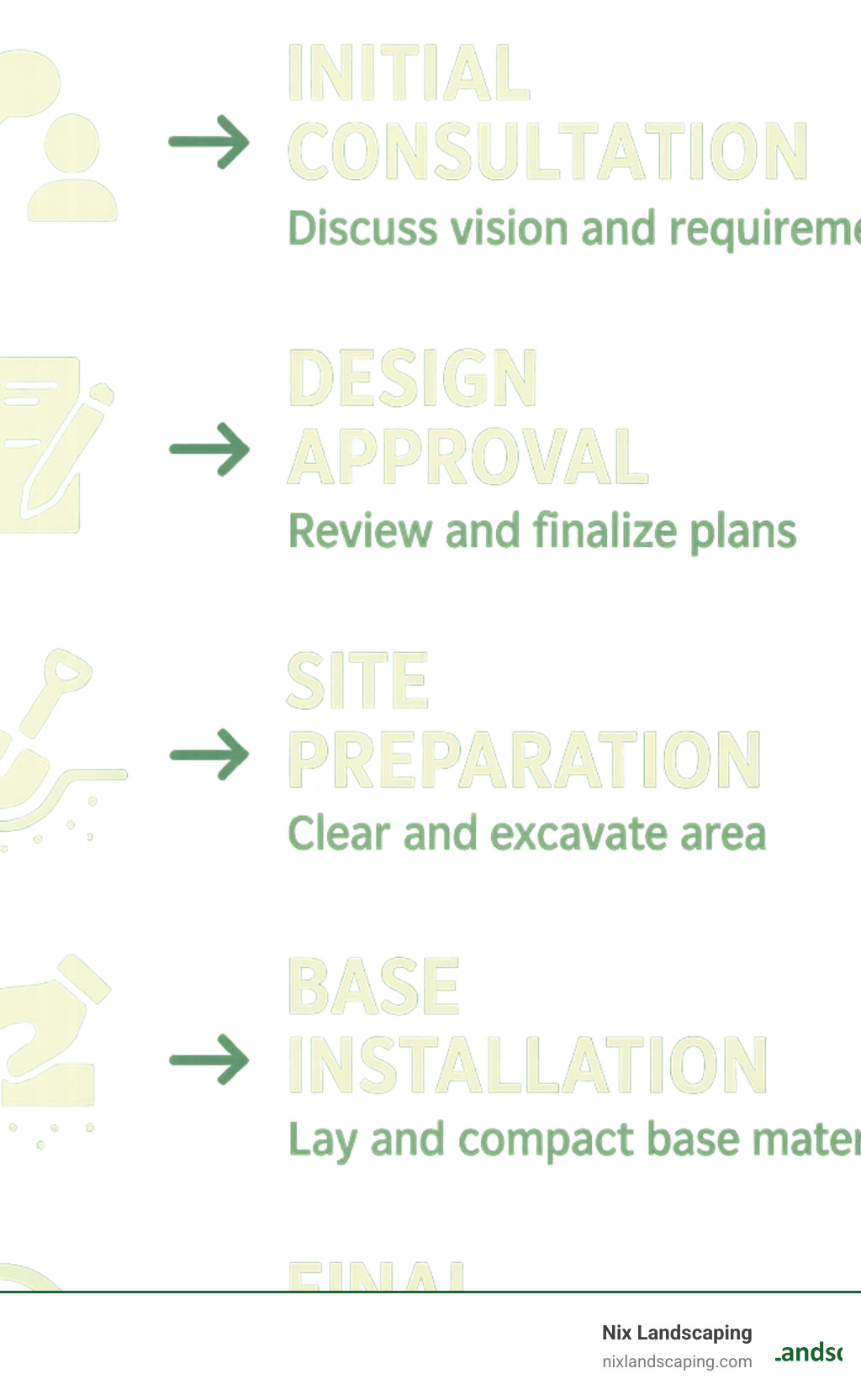
Your patio contractor will guide you through a comprehensive process that typically includes an initial consultation to understand your needs, creating custom designs that match your lifestyle, securing necessary permits, proper excavation and site preparation, installing a durable base, precise placement of materials, implementing proper drainage solutions, and finishing with those critical details that ensure longevity.
“I had no idea how technical patio installation actually is,” shares Tom, a recent client in Fishers. “The Nix team spent more time on the base preparation than the actual paver installation, and now I understand why—my neighbor’s DIY patio is already shifting after one winter, while mine looks perfect.”
After installation, a quality contractor doesn’t just disappear. They’ll provide warranties on their work and detailed care instructions to help maintain your investment for years to come.
Core Services They Provide
Professional patio contractors offer much more than basic installation. Before a single paver is laid, they conduct a thorough site survey and analysis to measure your space and evaluate everything from soil composition to drainage patterns and utility locations. This critical groundwork ensures your patio is built on a solid foundation.
Modern contractors use 3D design renderings to help you visualize your future space. Sarah from Noblesville found this invaluable: “When we saw the 3D rendering, it completely changed our perspective. We realized we needed a larger dining area and smaller fire pit space based on how we’d actually use the patio.”
Beyond the patio surface itself, contractors install complementary hardscaping elements like retaining walls, built-in seating, steps between multi-level areas, fire features, and outdoor kitchens. The best professionals also handle softscaping integration, ensuring your patio blends seamlessly with surrounding plant beds, container gardens, and lawn restoration.
A truly comprehensive service includes lighting design and installation that extends your patio’s usability into the evening hours with strategic path lighting, ambient mood lighting, and smart controls that let you customize the atmosphere with the tap of a button.
Credentials & Certifications to Look For
When researching garden patio contractors near me, verifying proper credentials ensures you’re hiring qualified professionals who will deliver quality results.
First, confirm they maintain appropriate business licensing through state and local authorities. In Indiana, legitimate contractors must register with the Secretary of State and obtain local business permits.
Quality contractors carry comprehensive insurance coverage, including general liability insurance (minimum $1 million), workers’ compensation, and vehicle/equipment insurance. This protects both you and the workers on your property should anything unexpected occur.
Many reputable contractors are also professionally bonded, providing additional financial protection if they fail to complete your project according to contract terms.
Industry certifications demonstrate specialized knowledge and commitment to best practices. Look for ICPI Certification (Interlocking Concrete Pavement Institute) which ensures knowledge of proper paver installation techniques. Other valuable credentials include NCMA Certification (National Concrete Masonry Association) for retaining walls and OSHA Compliance which demonstrates commitment to workplace safety.
“When we verify a contractor has ICPI certification, we know they understand critical factors like proper base preparation and edge restraints,” explains Kyle Nix. “At Nix Landscaping, we maintain these certifications through ongoing education to stay current with industry best practices.”
Ready to explore your patio options? Check out our Patios page for inspiration and examples of our work.
Garden Patio vs. Deck vs. Porch: Know Your Options
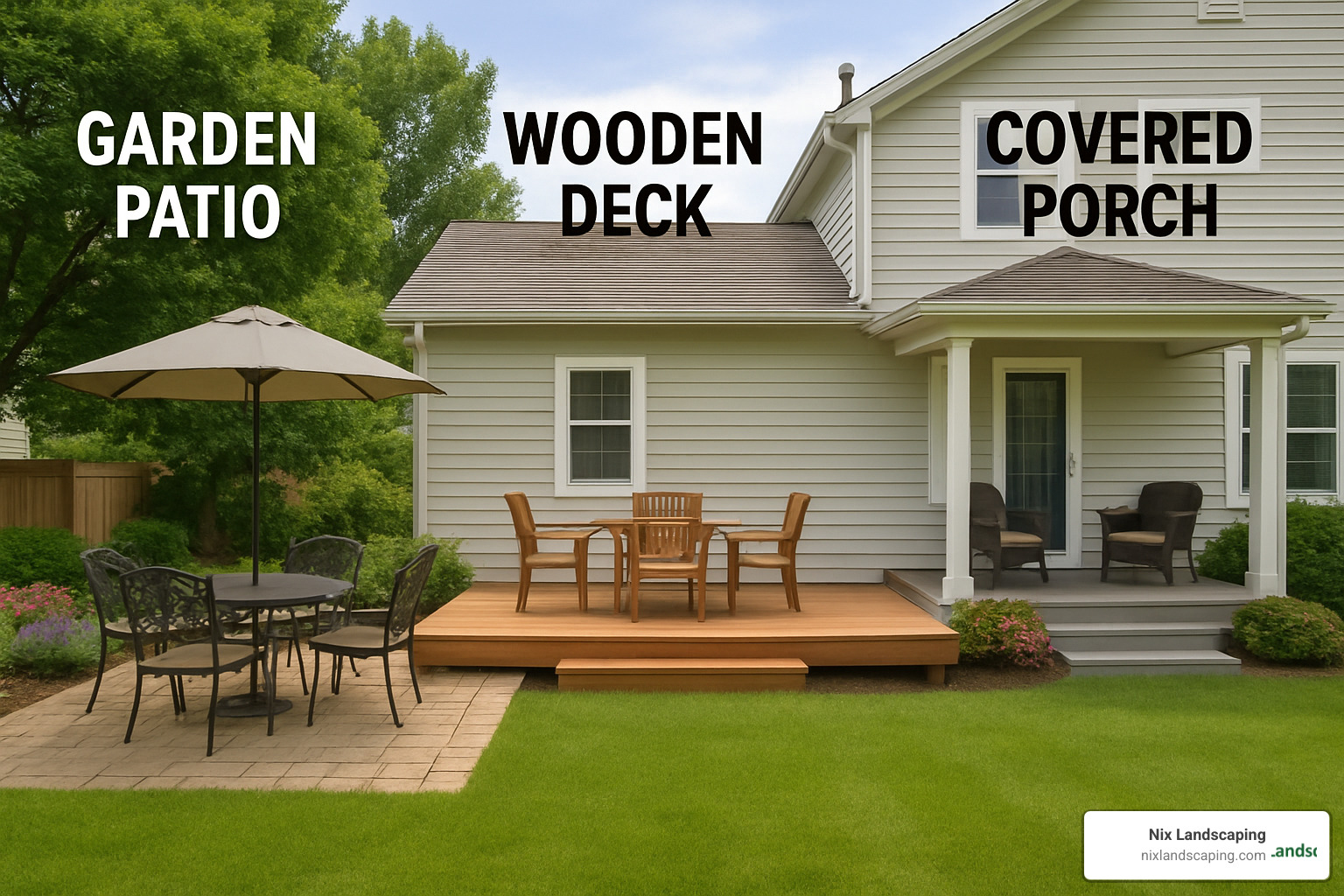
When you’re expanding your outdoor living space, understanding the differences between patios, decks, and porches helps you make the right choice for your home and lifestyle. While people often use these terms interchangeably at backyard barbecues, they’re actually quite different structures with unique benefits and considerations.
| Feature | Patio | Deck | Porch |
|---|---|---|---|
| Elevation | Ground level | Liftd | Attached to house |
| Roof | Optional (pergola) | Typically none | Usually covered |
| Materials | Pavers, concrete, stone | Wood, composite | Various |
| Avg. Cost/Sq Ft | $5-35 | $20-60 | $15-65 |
| Lifespan | 25-100 years | 15-30 years | 20+ years |
| Permits | Sometimes (>200 sq ft) | Almost always | Almost always |
| Maintenance | Low-moderate | Moderate-high | Moderate |
| Property Value Increase | 8-10% | 5-8% | 6-8% |
Patios are hardscaped areas that sit directly on the ground, typically made of pavers, natural stone, or concrete. They blend seamlessly with your landscape, creating a natural flow between your indoor and outdoor spaces. Think of them as outdoor rooms without walls – versatile, durable, and ready to host everything from morning coffee to evening gatherings.
Decks rise above the ground, constructed primarily from wood or composite materials. They attach to your home and extend outward, often providing liftd views of your property. If your backyard has a slope or you’re looking to create different levels for distinct activity zones, a deck might be your perfect match.
Porches serve as covered extensions of your home, usually at the front entrance but sometimes in the back as well. As Kyle from Nix Landscaping explains, “While the terms deck and porch are often used interchangeably, they are two distinct home features. The biggest difference is that porches have roofs offering protection from elements, while decks do not.”
Pros & Cons of Each Structure
When helping clients choose between options, we always lay out the honest advantages and limitations of each approach.
For garden patios, the durability is best – natural stone can last a century with proper installation! They also require the least maintenance among the three options and withstand Indiana’s freeze-thaw cycles admirably when properly installed. The design flexibility is nearly limitless, from traditional brick patterns to modern large-format pavers. However, patios do require relatively flat terrain (or significant grading work), have limited multi-level options, and installation can temporarily disrupt your existing landscaping.
Decks shine on properties with challenging topography. Last year, we worked with a family in Geist who initially wanted a patio but had a steep backyard slope. “The excavation costs would have doubled our budget,” they told us afterward. “The deck gave us the flat outdoor space we needed without massive earthwork.” Decks offer liftd views, can be built around existing trees, and typically install faster than patios. The downside? A shorter lifespan (15-30 years depending on materials), higher maintenance requirements, and greater susceptibility to weather damage.
Porches extend your living space while providing shelter from sun and rain, making them perfect for three-season enjoyment in Indiana’s changeable climate. They integrate architecturally with your home and can be screened for bug-free relaxation. On the flip side, they come with higher construction costs, more complex permitting, limited placement options, and may reduce natural light to adjacent interior rooms.
Choosing the Right Fit for Your Lifestyle
The best outdoor structure for your home depends on how you’ll actually use it day-to-day. We’ve found that considering these factors helps our clients make decisions they’re happy with for years to come:
Family Usage Patterns matter tremendously. If you’re an avid griller who loves hosting weekend dinners, a spacious patio with room for tables, chairs and a cooking area makes perfect sense. For those who cherish relaxing with a good book and a view of the yard, an liftd deck might better serve your needs. Morning coffee drinkers often prefer the shelter of a covered porch that stays usable even during light rain.
Entertainment Goals shape your space requirements. Large gatherings flow naturally across the expanded space a patio offers. Multi-level decks create natural conversation zones where different groups can cluster. Covered porches extend party possibilities during Indiana’s frequent summer showers.
Property Topography often becomes the deciding factor. Flat yards are naturally suited for patios, while homes perched on hills or with significant grade changes may benefit more from decks. Many of our clients in Fishers with split-level homes end up incorporating both elements – perhaps a deck off the main level and a patio below.
Budget Considerations can’t be ignored. While costs vary based on materials and complexity, concrete patios typically require the lowest initial investment. Wood decks fall in the middle range, while porches with roofing and finishing details generally represent the highest upfront cost. However, when considering lifetime value, patios often win due to their longevity and lower maintenance needs.
Climate Factors play a significant role in Central Indiana. Our humid summers can be tough on wooden decks, requiring more frequent maintenance. Patios withstand freeze-thaw cycles well when properly installed with adequate drainage. Covered porches offer protection during our frequent spring and summer storms.
By weighing these factors carefully, you’ll find the perfect outdoor living solution for your home. And if you’re still unsure, the garden patio contractors near me at Nix Landscaping are always happy to walk your property and discuss which option might work best for your specific situation, needs, and budget.
How to Vet Garden Patio Contractors Near Me
Finding the right garden patio contractors near me is a bit like dating – you need to do some homework before committing to a relationship that will transform your outdoor space. The contractor you choose determines not just how your patio looks, but how well it holds up over the years.

“I always tell homeowners that the cheapest bid rarely delivers the best value,” says Kyle Nix with a knowing smile. “We’ve repaired countless patios that failed prematurely because someone cut corners during installation—especially with inadequate base preparation. That’s like building a house on sand!”
When you’re searching for local patio professionals, start by checking their reputation. Look for contractors with consistently positive feedback across multiple platforms. Google Business reviews (aim for 4+ stars), Angi verified reviews, Better Business Bureau ratings (A or A+ preferred), and Thumbtack professional reviews can all give you insight into a company’s track record.
Pay special attention to what past clients say about communication throughout their project, how the contractor handled unexpected challenges (because there are always surprises!), whether they finished on time and on budget, and reviews from folks who’ve had their patio for over a year.
Next, take time to examine their portfolios. Quality contractors proudly showcase their work like proud parents. Look for projects similar to what you’re dreaming of, check for those little details that show craftsmanship, and notice if they’ve worked with a variety of materials and designs. Don’t be shy about asking for before-and-after photos – these show the true change potential.
When collecting estimates, make sure you’re comparing apples to apples. “We recently had a client who received three quotes that varied by over $5,000,” Kyle shares. “When we reviewed them together, we finded the lowest bid didn’t include excavation or base materials—just the pavers themselves! That’s like pricing a cake but forgetting the flour and eggs.”
Step-by-Step Contractor Screening Checklist
Finding a reliable patio company near you becomes much easier when you follow a methodical approach:
Start by verifying their basic qualifications – business license, insurance coverage (always request certificates), bonding if applicable, and industry certifications like ICPI or NCMA. These aren’t just fancy acronyms; they show a commitment to professional standards.
Next, actually call those references they provide. Ask specifically for projects completed 2+ years ago – this tells you how their work holds up over time. Prepare specific questions about the contractor’s performance, and if possible, see if you can visit some completed projects in person.
When you schedule on-site consultations, pay attention to the little things. Are they punctual? Professional? How thoroughly do they assess your property? Good contractors ask as many questions as they answer because they’re trying to understand your vision.
Review contract details with a fine-tooth comb. Ensure all specifications are clearly documented, verify start and completion dates, understand the payment schedule (never pay 100% upfront!), check warranty terms, and confirm cleanup requirements. The best contractors leave your yard looking better than when they started, not like a construction zone.
Finally, establish how you’ll communicate throughout the project. “What impressed me most about Nix Landscaping wasn’t just their beautiful work,” shared a client from Fishers, “but how they communicated throughout the project. I received daily updates and knew exactly what to expect each day.”
Where to Find Trustworthy Pros
When you’re ready to start your search for garden patio contractors near me, begin with these reliable sources:
Google Maps local search can be your best friend. Type “garden patio contractors near me” or “paver installers Fishers” and filter by rating (aim for 4+ stars). Read the most recent reviews first and notice if the business responds to both positive and negative feedback – that tells you a lot about their customer service philosophy.
Angi (formerly Angie’s List) provides verified reviews from actual customers and screens service providers. You can see detailed ratings across multiple categories and check how long companies have been listed on the platform – longevity often indicates stability.
Thumbtack matches you with available contractors based on your specific project details and provides transparent pricing information. The direct communication feature lets you ask questions before committing to an in-person meeting.
Don’t underestimate good old neighborhood recommendations. Ask neighbors with attractive patios who did their work, join neighborhood social media groups to request suggestions, or simply drive around your area and note properties with patios you admire. Sometimes the best contractors are the ones working right in your own community.
“One of our favorite techniques is actually hosting ‘patio tours’ where potential clients can visit previous projects and speak directly with homeowners about their experience,” Kyle explains. “There’s no better reference than seeing the work in person and hearing accounts. Plus, it’s a great excuse to show off our previous clients’ beautiful outdoor spaces!”
Budgeting & Cost Factors for Your Patio Project
Let’s talk money—because creating your dream outdoor space requires a realistic understanding of what goes into the price tag. When homeowners ask me about costs, I always explain that patio projects are a bit like icebergs: what you see is just a fraction of what you’re actually paying for.
“Landscapers typically charge $25 to $50 per person per hour, which equals around $50 to $100 per hour for a two-person crew,” I tell clients at Nix Landscaping. “But the total project cost depends on far more than just labor rates.”
What surprises many homeowners is how many factors influence the final price when working with garden patio contractors near me:
The skill behind the shovel makes a huge difference. Professional installation typically accounts for 40-60% of your total project cost, with complex designs requiring additional skilled labor hours. Those beautiful curved edges and intricate patterns? They require precision cutting and extra time—and yes, that means additional cost.
Material choices dramatically impact your budget too. Think of it like car shopping—there’s a reason some vehicles cost twice as much as others! Entry-level concrete pavers might be perfect for your needs, or you might fall in love with premium natural stone that costs three times as much.
Your property itself can be your budget’s best friend or worst enemy. A perfectly flat, easily accessible backyard is a contractor’s dream. But if your yard resembles a ski slope or has that narrow side passage that equipment can’t steer, your quote will reflect the extra work required.
One Fishers homeowner learned this lesson firsthand: “My narrow side yard ended up being the most expensive three feet of my property! The contractors couldn’t get equipment back there, so everything had to be carried by hand, adding about 20% to my original quote.”
Size matters, but not always in the way you might expect. Larger patios benefit from economies of scale for some aspects, but multiple levels or separate zones increase complexity and cost. That stunning multi-level design on your Pinterest board? Budget accordingly!
Those “little extras” add up quickly too. Proper drainage solutions ($500-$2,500), lighting systems ($2,000-$6,000), seating walls ($25-$50 per linear foot), and fire features ($500-$5,000+) transform a basic patio into an outdoor oasis—while changing your budget too.
Price Per Square Foot by Material
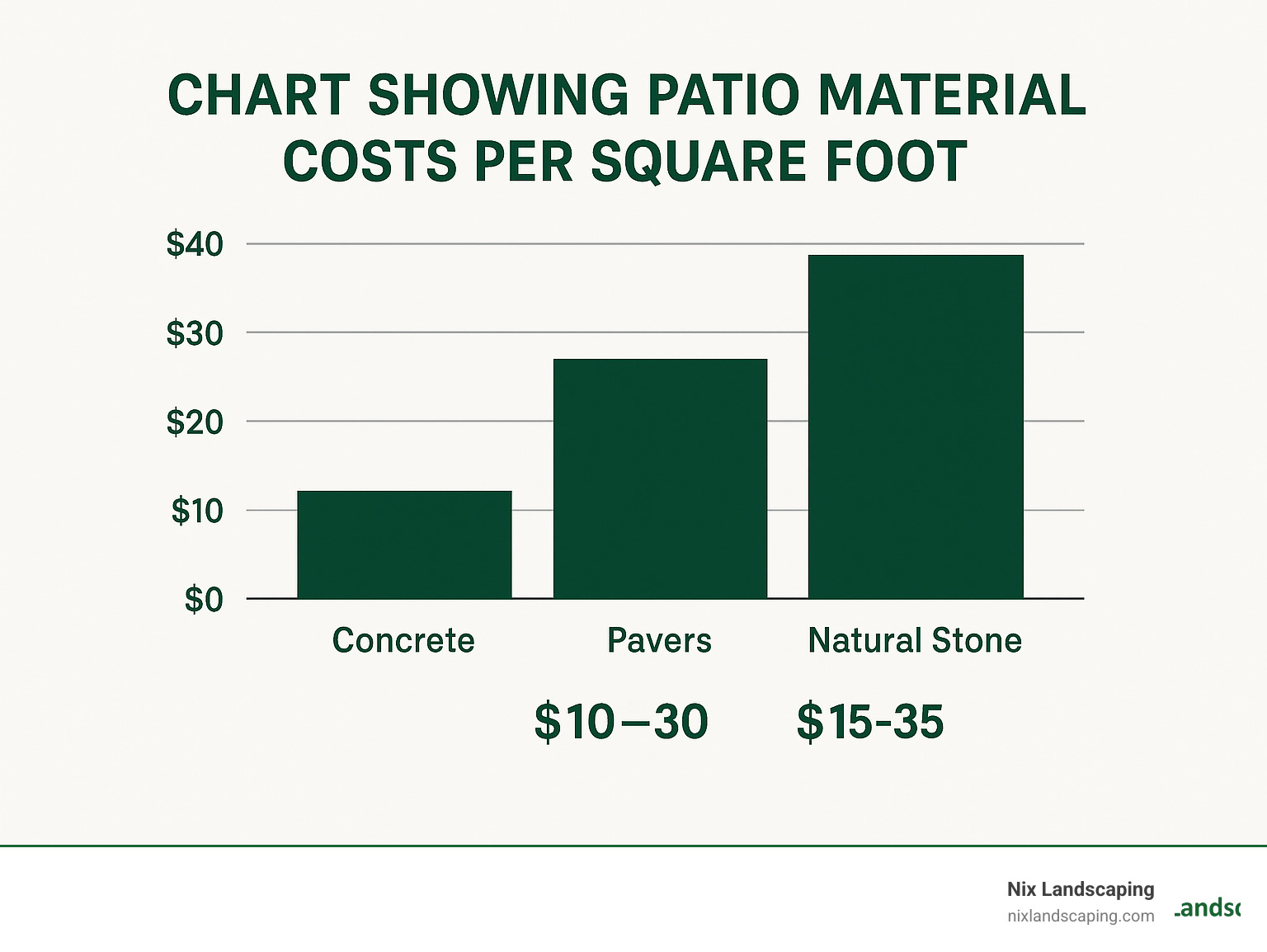
When planning your patio installation, these general price ranges (including professional installation) provide a starting point:
Concrete Patios: $5-$15 per square foot
– Standard poured concrete sits at the lower end ($5-$7), while stamped and colored options climb to $8-$15
Paver Patios: $5-$35 per square foot
– Basic concrete pavers start around $5-$10
– Mid-range interlocking pavers run $10-$20
– Premium designer pavers cost $15-$25
– Permeable pavers (great for drainage!) range from $15-$30
Natural Stone Patios: $15-$35 per square foot
– Flagstone typically runs $15-$25
– Bluestone costs about $20-$30
– Granite or exotic stone commands $25-$35
I often explain material choices to clients using a clothing analogy: “Concrete is like an off-the-rack suit—affordable but limited in customization. Pavers are like a made-to-measure suit—more options and better fit. Natural stone is like a bespoke suit—unique, distinctive, and made to last generations.”
Money-Saving Strategies Without Cutting Corners
I’m a firm believer that beautiful patios don’t have to break the bank. Here are some insider tips for stretching your budget without compromising quality:
Phase your project intelligently. Install the full base area initially, then add sections of finished patio over time. Begin with essential areas like your dining space, then add that dream fire pit or outdoor kitchen later. This approach ensures consistent base preparation (crucial for longevity!) while spreading costs over time.
Get creative with materials. Those gorgeous natural stone pavers might be perfect for your highly visible edges, while less expensive concrete pavers in a complementary color work beautifully for the main field. Many manufacturers now offer concrete pavers that mimic natural stone at half the cost.
Work with standard sizes whenever possible. Custom cutting not only increases material waste but also requires significant additional labor. Using manufacturer-recommended patterns maximizes efficiency and minimizes costs.
Time your project strategically. Many garden patio contractors near me offer 10-15% discounts during slower seasons (late fall, winter, early spring). Yes, weather might cause some delays, but the savings can be substantial if you’re flexible with timing.
Roll up your sleeves for the prep work. “We worked with a family who saved nearly $2,000 by removing their old concrete patio themselves before we arrived,” I recall. “They rented a concrete saw and jackhammer for a weekend, and while it was hard work, the savings were significant.”
Cutting corners on crucial elements like base preparation will cost you more in the long run. A properly installed patio might cost more initially but will save you from expensive repairs and premature replacement down the road. As we say at Nix Landscaping: “Pay for quality installation once, or pay for repairs repeatedly.”
Step-by-Step Patio Installation Timeline
Ever wonder what really happens when you hire garden patio contractors near me? Understanding the installation process helps set realistic expectations and prepares you for the change of your outdoor space. While every project has its own unique timeline, knowing the typical sequence of events helps you plan accordingly.
“Most homeowners are surprised by how much happens before a single paver is laid,” says Kyle Nix. “The magic of a lasting patio is actually in all the preparation work that eventually gets hidden underneath.”
Let me walk you through what you can expect when we transform your backyard:
Pre-Installation Phase (1-3 weeks)
This behind-the-scenes planning stage is crucial for a smooth installation. We’ll start with an initial consultation where we’ll walk your property together, discussing your vision and needs. Next comes the exciting part – developing your custom design and selecting the perfect materials for your space and budget.
Once you’ve approved the proposal and we’ve finalized the contract, we’ll order materials and schedule deliveries. If your project requires permits (typically for patios over 200 square feet or those involving gas lines), we’ll handle the paperwork.
One essential pre-installation step is calling 811 for utility marking. This free service identifies underground utilities before we dig – safety first!
“I always tell clients that patience during this planning phase pays off tremendously,” Kyle explains. “The week or two spent getting everything perfectly organized prevents headaches and ensures we hit the ground running on installation day.”
Installation Phase (3 days to 3 weeks)
Day 1: Site Preparation
This is when the physical change begins! Our crew will carefully mark the boundaries of your new patio and begin excavation. We typically dig 8-12 inches deep, depending on your soil conditions and climate. That depth might surprise you, but it’s necessary for a stable, long-lasting patio that won’t shift or settle.
The excavated materials will be removed from your property, making space for the new base materials. It’s a messy day, but an exciting one – your patio is officially underway!
Day 2-3: Base Construction
Now we build the foundation that will support your patio for decades. We’ll start by installing geotextile fabric, which prevents weeds from growing up through your patio while allowing proper drainage.
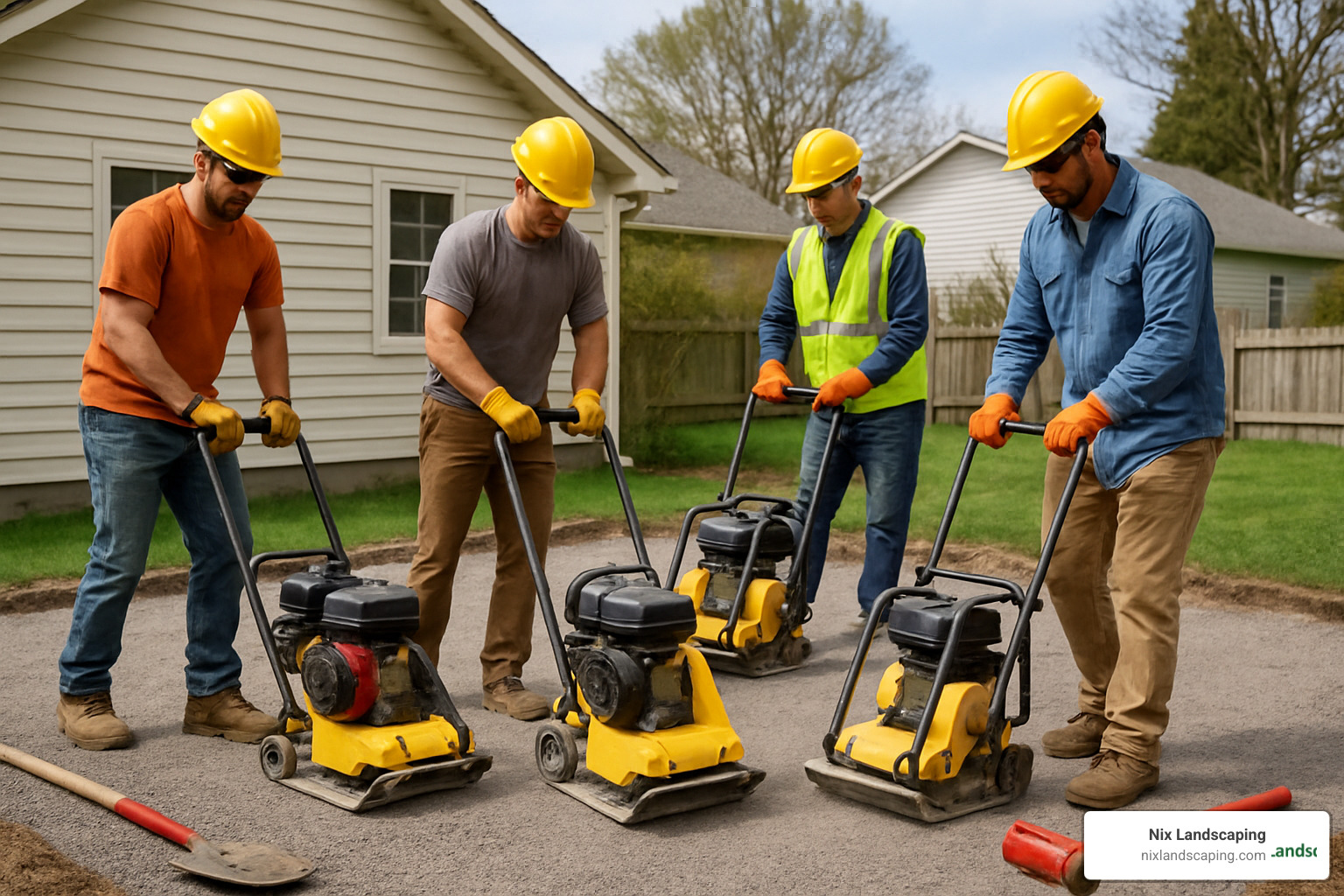
Next comes the delivery and spreading of crushed stone base material. Rather than dumping it all at once, we compact it in multiple “lifts” or layers for maximum stability. This methodical approach takes more time but prevents future settling and shifting.
We’ll carefully grade the base with a slight slope (typically ¼” per foot) away from your home for proper drainage. This subtle slope is nearly imperceptible to the eye but crucial for preventing water issues.
Day 4-5: Setting Course and Edge Restraints
Edge restraints are like the frame of a puzzle – they hold everything in place. We’ll install these around the perimeter to prevent lateral movement of your pavers over time.
Then we’ll spread and carefully level a setting bed, usually made of coarse sand. This thin layer creates a smooth surface for your pavers while allowing for minor adjustments during installation.
Day 6-8: Paver Installation
Finally, the most visible change happens! We’ll begin laying pavers in your chosen pattern, working from a fixed edge and moving outward. Custom cuts around edges, curves, and obstacles require special tools and expertise.
If your design includes special features like decorative borders or inlays, we’ll integrate these elements for a truly custom look.
Day 9: Finishing Touches
The final day brings your patio to life. We’ll sweep polymeric sand into the joints between pavers – this isn’t ordinary sand, but a special formula that hardens when activated with water, locking pavers in place while remaining slightly flexible.
After compacting the pavers to their final position, we’ll activate the sand with a light water misting. Once dry, we’ll clean the entire surface and restore the surrounding landscape.
Post-Installation Phase (1 day)
We’ll walk through the completed project together, addressing any questions or concerns. You’ll receive detailed care and maintenance instructions along with warranty documentation.
“The base preparation is absolutely critical,” emphasizes Kyle. “About 90% of patio failures stem from inadequate base preparation. We spend more time on proper excavation, fabric installation, and compaction than on the actual paver installation—and that’s exactly as it should be.”
What to Expect Each Day on Site
Knowing what to anticipate helps you prepare your household for the construction process:
Crew Size and Hours
Most projects require 2-4 skilled workers, depending on size and complexity. We typically work standard hours from 8am to 5pm, though weather conditions might occasionally adjust our schedule. We’ll always communicate any changes in advance.
Noise and Disruption
Be prepared for some construction noise, especially during the first few days. Excavation equipment creates the most significant noise (particularly on day 1), while compactors produce vibration and moderate noise throughout the base preparation. Cutting tools for pavers generate intermittent noise as we custom-fit pieces around edges and obstacles.
If you work from home, you might want to plan important calls or meetings around the noisiest phases.
Material Deliveries
Expect several deliveries throughout the project – base materials, sand, and pavers will arrive at different stages. Large delivery trucks need adequate access to your property, so you might need to keep your driveway clear on certain days. Materials may be temporarily staged in your driveway or yard until installation.
Property Protection
Your existing landscape is important to us. Professional contractors use plywood to protect existing hardscapes like driveways and walkways from equipment damage. While some lawn areas may be temporarily disrupted during construction, we’ll restore them before completion. If you have irrigation systems, we’ll mark and protect them throughout the project.
Weather Contingencies
Mother Nature occasionally has her own plans! Rain can delay certain phases, especially base preparation and joint sanding. Extreme heat may require additional curing time for certain materials, while cold weather below 40°F might affect the installation of some products.
“We always communicate daily plans and potential weather impacts,” notes Kyle. “Our clients receive updates each evening about the next day’s activities, so they’re never left wondering what’s happening.”
Typical Duration by Project Size
While every project is unique, these timeframes provide general guidelines to help you plan:
Small Patio (under 200 square feet)
A cozy patio for a small seating area typically takes 3-5 working days with a simple design. If you’re adding complex features or patterns, plan for 5-7 working days.
Medium Patio (200-400 square feet)
A standard family patio with space for dining and relaxing usually requires 5-8 working days for simple designs. More complex layouts or features extend the timeline to 8-12 working days.
Large Patio (400+ square feet)
Expansive outdoor living spaces take 8-12 working days for straightforward designs. Complex multi-functional spaces with elaborate features might extend to 2-3 weeks.
Projects with Additional Features
Your timeline will extend with each additional feature: seating walls add 2-3 days, fire features add 1-3 days, outdoor kitchens add 3-7 days, and multiple levels add 3-5 days per level.
“We recently completed a 600-square-foot multi-level patio with a built-in fire pit, seating wall, and outdoor kitchen,” shares Kyle. “The entire project took just under four weeks, but the change was remarkable—from an unusable sloped yard to a resort-like outdoor living space.”
The change may take a few weeks, but the enjoyment lasts for decades. When you’re ready to start your patio journey, the team at Nix Landscaping is here to guide you through every step of the process.
Design Ideas & Custom Features to Lift Your Garden Patio
When it comes to creating an outdoor space that truly feels like an extension of your home, the basic patio is just the beginning. It’s the custom touches and thoughtful design elements that transform a simple slab into a personal sanctuary where memories are made.
“One of the biggest benefits of our design and build approach is that you can make your patio uniquely yours,” explains Kyle Nix. “There are truly endless possibilities.”
I’ve seen how the right features can completely change how families use their outdoor spaces. A recent client in Fishers told me, “What transformed our patio from nice to amazing was the lighting system. During the day, it’s a beautiful stone patio, but at night, it becomes magical with the uplighting on trees and subtle path lights.”
The most popular improvements we install for our garden patio contractors near me clients include fire features like wood-burning pits, gas fire tables, and custom masonry fireplaces that create natural gathering spots and extend your outdoor season by months.
Outdoor kitchens range from simple built-in grills to complete cooking stations with refrigerators, pizza ovens, and bar seating. These have become increasingly popular as families find the joy of cooking and dining al fresco. Our outdoor kitchen design services help you create the perfect configuration for your cooking style and space.
Seating and retaining walls offer practical solutions that double as design elements. We typically build these 18-20 inches high—the perfect height for comfortable seating—and cap them with materials that complement your patio surface.
Water features bring a sense of tranquility to any space. Options like bubbling rock fountains and pondless waterfalls add soothing sounds without the maintenance of traditional ponds.
For protection from the elements, shade structures like pergolas, pavilions, and retractable awnings create comfortable spaces even on the hottest Indiana summer days. And smart lighting systems with path lights, accent lighting, and app-controlled features extend your outdoor enjoyment well into the evening hours.
Trending Materials & Layouts for 2024
The world of patio design is always evolving, and staying current with trends ensures your outdoor space feels fresh and contemporary for years to come.
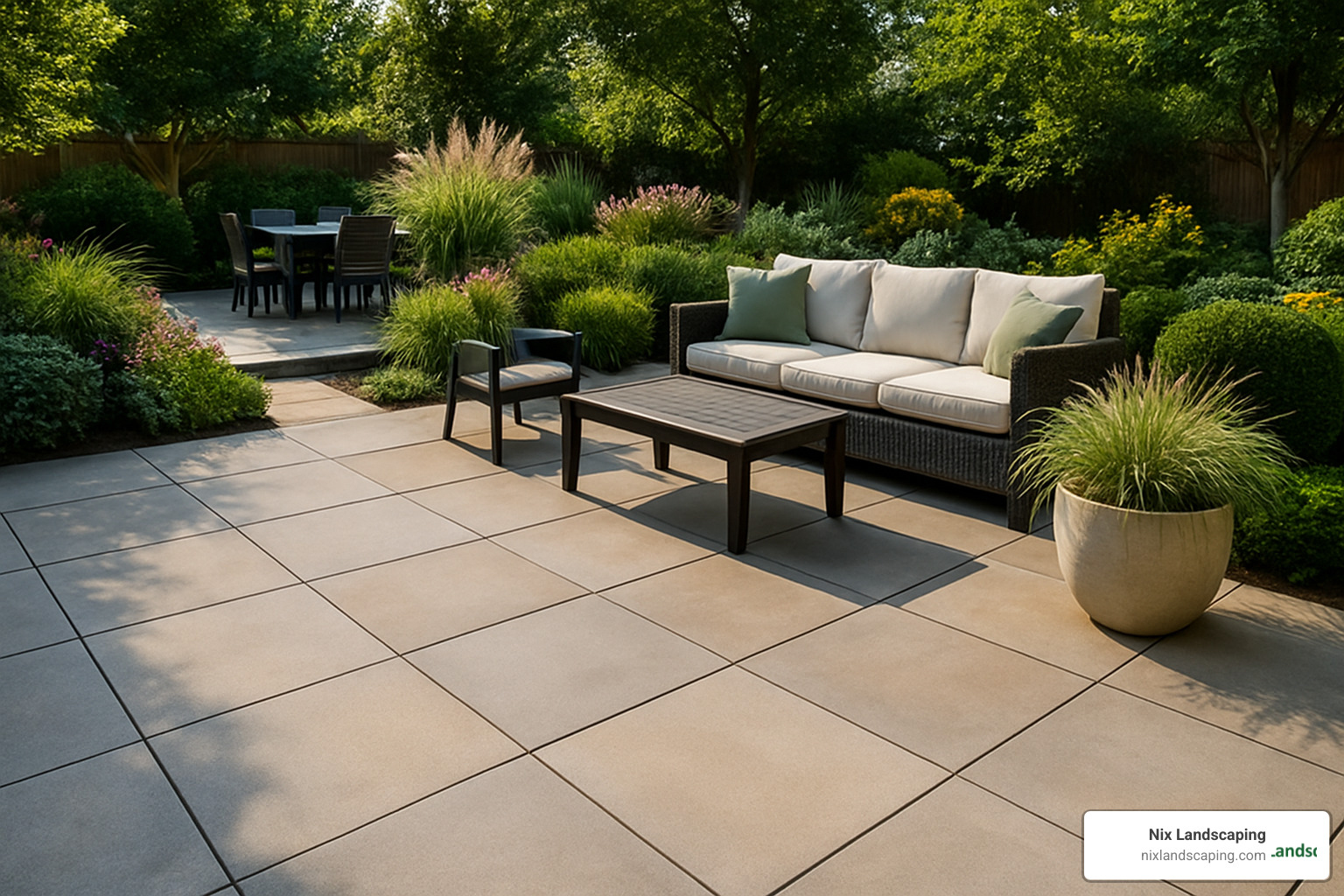
This year, we’re seeing tremendous interest in large-format pavers—those oversized 24″x24″ or larger pieces that create clean, modern surfaces with fewer joint lines. Porcelain pavers have also exploded in popularity, offering incredible durability and virtually no maintenance requirements.
Color preferences have shifted toward earth tones and neutrals—soft grays, warm taupes, and natural browns that blend seamlessly with the surrounding landscape. And rather than sticking with a single material, many homeowners are opting for mixed materials that combine different paver types with natural stone accents and decorative aggregates.
In terms of layout, we’re moving away from basic rectangular designs toward curved and organic shapes that feel more natural and inviting. The concept of defined outdoor rooms continues to gain traction—creating distinct zones for dining, lounging, and cooking, each with its own character but unified by a cohesive design language.
“We’re seeing a major shift toward what we call ‘lifetime patios’—spaces designed to evolve with changing needs,” notes Kyle. “For example, a dining area that can later accommodate a hot tub, or infrastructure for future outdoor kitchens installed during initial construction.”
When browsing backyard patio ideas, consider how your needs might change over time and design with that flexibility in mind.
Add-Ons That Boost ROI
Some features don’t just improve enjoyment—they actually increase your home’s value, offering an impressive return on investment when it’s time to sell.
Built-in planters add color and life to hardscaped areas while defining spaces without solid walls. They bring warmth to stone and concrete surfaces and can be designed for easy seasonal plant rotation.
Low-voltage lighting consistently ranks among the highest ROI landscape improvements, typically returning 150-200% of investment at resale. Beyond the aesthetic benefits, good lighting improves safety and security while dramatically extending the usable hours of your outdoor space.
Heating elements are particularly valuable in Indiana’s climate, where they can extend your outdoor season by several months on either end. Options range from simple fire pits to sophisticated in-floor heating systems beneath pavers.
Privacy features like decorative screens, strategic plantings, and partial walls make your outdoor space feel more intimate and secluded, even in denser neighborhoods. And weather protection elements such as retractable awnings and outdoor-rated ceiling fans make your patio comfortable even during challenging weather.
“A client added a simple pergola with retractable shade and string lights to their patio,” recalls Kyle. “They told me it tripled the amount of time they spent outdoors and was the feature that sold their home when they eventually moved.”
The beauty of working with experienced garden patio contractors near me is that we can help you prioritize these features based on your lifestyle, budget, and long-term plans for your home. Whether you’re creating an intimate retreat or an entertainer’s paradise, the right custom elements will make your patio the heart of your outdoor living for years to come.
Maintenance, Lifespan & Climate Considerations
Investing in a beautiful patio means thinking about the long game – how it will hold up over years of Indiana weather and family gatherings. As a garden patio contractors near me team, we’ve seen how our local climate presents unique challenges for outdoor spaces.
“The patio that looks perfect on installation day needs to still look great in 10 years,” Kyle often reminds our clients at Nix Landscaping. “That’s why we obsess over the details that most homeowners never see.”
Our Indiana weather throws everything at your patio – freezing winters, spring downpours, humid summers, and those beautiful but leaf-dropping autumns. Each season brings its own maintenance needs.
Freeze-Thaw Resilience
Those winter temperature swings can be brutal on outdoor surfaces. Water gets into tiny spaces, freezes, expands, and can literally push your patio apart over time. That’s why we:
Build deeper bases (minimum 8″ for our climate) than you might see in warmer regions. That extra depth provides crucial protection when the ground starts moving during freeze-thaw cycles.
Compact each layer properly during installation. Kyle often jokes, “We vibrate that base more than a massage chair at the mall,” but that vibration eliminates air pockets where water could collect and freeze.
Create proper spacing between pavers to allow for the natural expansion and contraction that happens with temperature changes.
Drainage Considerations
Water is both essential for your landscape and potentially damaging to your hardscape. Proper water management makes all the difference:
“A family near Geist Reservoir called their backyard the ‘Lake Living Room’ because it would flood after every rain,” shares Kyle. “We installed a permeable paver system with improved drainage that completely solved the problem while creating a beautiful outdoor space.”
Your patio should always slope away from your home (minimum ¼” per foot) to prevent water from pooling against your foundation. Sometimes we incorporate French drains or channel drains for problem areas, and in severe cases, permeable paver systems allow water to filter through rather than run off.
UV Protection and Color Retention
That beautiful Indiana sunshine can fade some materials over time. Different patio materials handle UV exposure differently:
Concrete pavers may gradually lighten over many years
Natural stone typically maintains its color indefinitely
Some materials benefit from occasional sealing to preserve their color depth
We consider sun patterns when designing, especially for areas with intense afternoon exposure
Snow and Ice Management
Winter maintenance can significantly impact your patio’s lifespan:
Use plastic snow shovels rather than metal ones to prevent surface scratching
Avoid rock salt on concrete and certain pavers (calcium magnesium acetate is gentler)
Remove snow promptly to reduce freeze-thaw cycles
For high-traffic areas, consider installing snow melt systems during construction
How Long Will Each Material Last?
Your patio is an investment, and understanding the lifespan of different materials helps you make informed decisions about where to put your money:
Concrete Pavers
With a lifespan of 25-45 years, these versatile pavers offer easy repairs when needed. Since the color runs throughout the paver (not just a surface coating), they age gracefully. You’ll need to replenish joint sand every 3-5 years, but that’s about it for maintenance.
Brick Pavers
These classics last 25-45 years and offer timeless appeal with their rich color. They require occasional cleaning and checking for any settling, but otherwise are remarkably low-maintenance.
High-Quality Interlocking Pavers
When you want something truly built to last, these premium options deliver 50-100 years of service with minimal maintenance beyond basic cleaning. Their interlocking design provides exceptional stability over time.
Natural Stone (Flagstone/Bluestone)
“We uncovered a paver driveway from the 1930s during a renovation project,” recalls Kyle. “The pavers themselves were in perfect condition—only the base needed updating. With proper installation, these materials truly can last generations.”
Natural stone patios can easily last 100+ years with proper installation. Each stone offers unique character, and while they require periodic inspection of joints, they’re otherwise remarkably durable.
Poured Concrete
With a lifespan of 20-30 years, poured concrete offers a lower initial cost and smooth surface. However, it requires more maintenance including crack repair and regular sealing to maximize its life.
Routine Care Checklist by Season
Taking care of your patio doesn’t have to be complicated, but it does benefit from some seasonal attention:
Spring Care (March-May)
Spring is patio cleaning season in Indiana. After winter retreats, give your patio a thorough cleaning with mild detergent and a soft-bristle brush. Inspect for any winter damage or settling, replenish joint sand if needed, and apply sealer if appropriate for your material. Check edge restraints and repair as needed.
Summer Care (June-August)
With summer barbecues and outdoor living in full swing, regular sweeping prevents debris buildup. Treat any stains promptly (especially oil, food, and beverages), and gently pressure wash if needed. Keep an eye out for weeds in joints, and check furniture pads to prevent scratching.
Fall Care (September-November)
Those beautiful autumn leaves can stain your patio if left too long. Regular leaf removal, a final cleaning before winter, and checking joints and drainage before freeze season will set you up for success. Consider covering furniture and features for winter protection.
Winter Care (December-February)
When the snow flies, remove it with plastic shovels rather than metal ones to protect your patio surface. Use ice melt products that are safe for your specific paver type, and try to keep drainage paths clear throughout the season.
“Maintenance isn’t complicated, but it is important,” emphasizes Kyle. “We provide all our clients with a seasonal care guide specific to their patio materials, and offer annual maintenance services for those who prefer professional care.”
At Nix Landscaping’s paver patio landscape company, we believe the best patio is one that looks as good in a decade as it did on day one. With proper installation and some simple seasonal care, your outdoor living space will provide enjoyment for generations.
Frequently Asked Questions about Hiring Garden Patio Contractors Near Me
Do I need a permit for a 300-sq-ft patio with a gas line?
Yes, in most jurisdictions including Fishers, IN, you’ll need permits for this type of project. The 300 square foot size triggers permit requirements in most localities, and the gas line definitely requires proper documentation.
“Permit requirements often catch homeowners by surprise,” says Kyle from Nix Landscaping. “We’ve had clients who were ready to start their project the next day, only to learn they needed to wait for permit approval.”
Typically, here’s what you’ll need permits for:
– The patio itself (since it exceeds 200 square feet)
– The gas line installation (which requires specific mechanical permits)
Even smaller patios may require permits if they affect drainage patterns or are attached directly to your home. And don’t forget about HOA approval – many neighborhoods have their own requirements regardless of what the city mandates.
At Nix Landscaping, we handle the entire permitting process for our clients. We prepare and submit all documentation, schedule necessary inspections, ensure compliance with local codes, and even manage HOA approval processes when needed. Our relationships with local building departments in Fishers and surrounding communities help streamline this often confusing process.
How many quotes should I get from garden patio contractors near me?
I always recommend getting three quotes from different garden patio contractors near me. This magic number gives you enough perspective without overwhelming you with options.
“Last year, a client showed me seven different quotes they’d collected,” Kyle remembers with a laugh. “They were more confused than when they started because each contractor had suggested completely different approaches.”
With three quotes, you’ll benefit from:
Competitive pricing that helps identify both bargains and suspiciously low estimates. A substantially lower quote often means something important has been omitted.
Different design perspectives that can introduce ideas you hadn’t considered. Each professional brings their unique experience and creative vision.
A feel for communication styles and professionalism that gives insight into what working with each contractor might be like.
When collecting these quotes, ensure they include detailed scope of work, specific materials with brand names, excavation depth and base specifications, timeline estimates, payment schedule, and warranty information. This makes comparison much easier.
“The key is making sure you’re comparing apples to apples,” I often tell clients. “A $3,000 difference might seem significant until you realize one quote includes a drainage system and the other doesn’t.”
What warranty terms are standard for garden patio contractors near me?
Warranty coverage varies widely among garden patio contractors near me, which is why it’s so important to understand exactly what’s covered before signing a contract.
For workmanship warranties, the industry standard is typically 1-3 years. Better contractors offer 5+ years, while premium services like ours at Nix Landscaping provide a 10-year workmanship guarantee that’s even transferable to new homeowners if you sell your property.
“We stand behind our work with one of the strongest warranties in the industry,” Kyle explains. “When you install patios properly with adequate base preparation, they should perform flawlessly for decades.”
Material warranties are typically provided by manufacturers rather than contractors. Most paver manufacturers offer 25-year to lifetime limited warranties against defects, while natural stone rarely comes with specific warranties due to its inherent durability.
A comprehensive warranty should cover excessive settling beyond normal tolerances, drainage failures, paver shifting or heaving, edge restraint failures, and joint sand issues. However, most warranties exclude normal settling (which is minor and expected), acts of nature like floods or earthquakes, improper use or maintenance, staining from external sources, and damage from improper snow removal.
One Fishers client shared: “When a small section of our patio settled after a particularly rainy spring, Nix Landscaping came out and fixed it immediately—no questions asked. That’s when I really understood the value of working with professionals who stand behind their work.”
The warranty might seem like a minor detail when you’re excited about your new patio, but it can make a significant difference in your long-term satisfaction and peace of mind.
Conclusion
Finding the right garden patio contractors near me feels like searching for a trusted partner—because that’s exactly what it is. You’re not just hiring someone to place some stones in your yard; you’re collaborating with professionals who will transform your outdoor space into a retreat that improves both your daily life and your property’s value.
Throughout our journey together in this guide, we’ve explored what makes for a successful patio project:
We’ve unpacked the comprehensive services that professional contractors provide—from initial design concepts to that final, satisfying walkthrough. We’ve compared patios, decks, and porches to help you determine which outdoor structure best suits your lifestyle and property. We’ve walked through the sometimes-intimidating process of vetting contractors, checking their credentials, studying their portfolios, and calling their references.
“The right contractor doesn’t just build your patio—they build your confidence throughout the process,” as Kyle often tells our clients at Nix Landscaping.
We’ve talked dollars and cents, helping you budget appropriately for materials and features while offering insider tips on where you can save without compromising quality. We’ve pulled back the curtain on the installation process so you know exactly what to expect when work begins. We’ve explored exciting design trends and custom features that can lift your space from ordinary to extraordinary. And finally, we’ve prepared you for the long-term relationship you’ll have with your patio through proper maintenance and care.
Your outdoor living space isn’t just a construction project—it’s the backdrop for countless future memories. Sunday morning coffees, family barbecues, quiet evenings by the fire pit, and maybe even a wedding or graduation celebration someday. The care you take in choosing the right partner for this journey matters.
At Nix Landscaping, we’ve been privileged to help countless homeowners throughout Fishers and Central Indiana create outdoor spaces that bring their dreams to life. We believe in combining solid technical expertise with creative design vision, delivering patios that aren’t just beautiful today but built to stand the test of time.
Ready to start writing the next chapter of your home’s story? We’d love to be part of it. Reach out today for a friendly, no-pressure consultation where we can explore possibilities and take the first step toward your ideal outdoor space.