
Understanding Your Investment: The Real Cost of Paver Walkways
Paver walkway installation cost typically ranges from $1,565 to $3,765 with a national average of $2,665. For most homeowners, you can expect to pay between $9 and $20 per square foot installed, with an average of $14.50 per square foot.
| Walkway Size | Average Cost |
|---|---|
| 80 sq ft | $1,160 |
| 140 sq ft | $2,030 |
| 280 sq ft | $4,060 |
When you look at a beautifully installed paver walkway, what you’re seeing isn’t just stones set in a pattern – it’s an investment in your home’s curb appeal, functionality, and value. A well-designed walkway creates that crucial first impression, guiding visitors through your landscape while adding character and definition to your outdoor space.
The cost of installing a paver walkway depends on several key factors:
- Material choice – Concrete pavers ($8-$15/sq ft), clay brick ($10-$20/sq ft), or natural stone ($12-$50/sq ft)
- Design complexity – Straight paths cost less than curved or patterned designs
- Site preparation – Excavation, grading, and base materials
- Labor costs – Professional installation averages $55-$75 per hour
- Additional features – Edging, lighting, drainage, and sealing
I’m Kyle Nix, owner of Nix Landscaping in Fishers, Indiana, and I’ve overseen hundreds of paver walkway installation projects with costs ranging from simple garden paths to elaborate front entrance designs. With years of experience changing outdoor spaces throughout Fishers, I understand how to balance budget considerations with quality craftsmanship to deliver paver walkways that stand the test of time.
Know your paver walkway installation cost terms:
– bluestone walkway installation
– patio installation services
– landscaping patio contractors
Paver Walkway Installation Cost in 2025: National & Regional Averages
Looking at paver walkway installation cost trends for 2025, the national average holds steady at $2,665, though your actual investment will depend largely on where you live and the specifics of your project. Most homeowners can expect to budget between $1,565 and $3,765 for a complete installation.
Here in the Midwest, particularly in Fishers, Indiana, we’re fortunate to enjoy costs that run slightly below the national average. Our team at Nix Landscaping typically quotes projects between $13-18 per square foot for complete installation – a nice advantage over coastal regions where you might pay 15-20% more for the same work. This regional benefit comes from our relatively stable labor market and good access to quality materials, though recent inflation has certainly made its presence felt across all construction sectors.
Wondering how your specific location affects pricing? The Homewyse calculator offers a helpful starting point, though I always recommend following up with a local professional (like us!) who understands your property’s unique conditions and can provide a more accurate estimate.
Average paver walkway installation cost per square foot
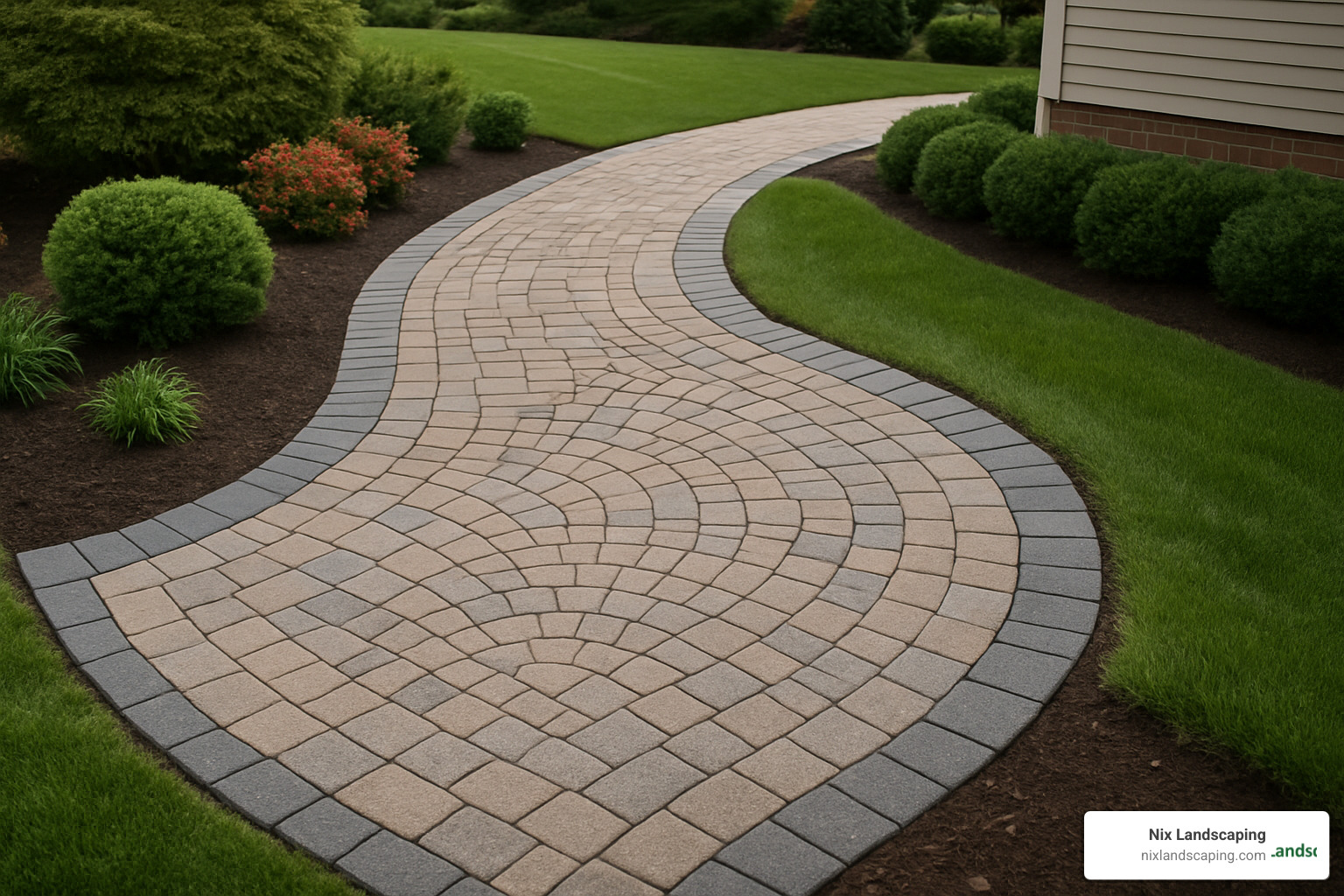
When breaking down paver walkway installation cost by square footage, the design complexity makes a significant difference in your bottom line. Straight walkways offer the most budget-friendly option at about $10-15 per square foot installed, while curved pathways that require more precise cutting and additional labor time typically run between $15-25 per square foot.
Most of our clients end up somewhere near the middle at our average rate of $14.50 per square foot. This figure represents a good baseline for initial budgeting, covering everything from base materials through finished installation. I’ve noticed some homeowners get excited about surprisingly low quotes, only to find later that essential elements like proper base preparation weren’t included – always clarify exactly what’s covered in your estimate!
Total paver walkway installation cost examples
To give you a clearer picture of what your paver walkway installation cost might look like for common project sizes:
A small entrance walkway measuring about 80 square feet (perhaps a simple 20′ x 4′ path from driveway to front door) would cost approximately $1,160 at our average rate of $14.50 per square foot.
For a standard residential walkway of around 140 square feet – think a 35′ x 4′ path connecting different areas of your property – you’d be looking at roughly $2,030.
Larger projects like an extensive garden walkway system covering 280 square feet (maybe 70′ x 4′ with multiple branches) would run about $4,060.
These examples assume standard materials and straightforward installation conditions. I recently worked with a Fishers family who chose a 120 square foot front entrance walkway using concrete pavers with simple border details – their investment came in just under $1,800. Another client opted for a more elaborate 200 square foot natural stone path featuring gentle curves and integrated lighting for approximately $3,600.
What I love about these projects is how dramatically they transform a home’s appearance and functionality. Even a modest investment in a well-designed walkway creates that crucial first impression that welcomes visitors while adding genuine value to your property.
Material Choices & Design Complexity: How They Move the Needle
The materials you select for your paver walkway will significantly impact your overall paver walkway installation cost. Think of material selection as the foundation of your project’s budget—it sets the stage for everything that follows.
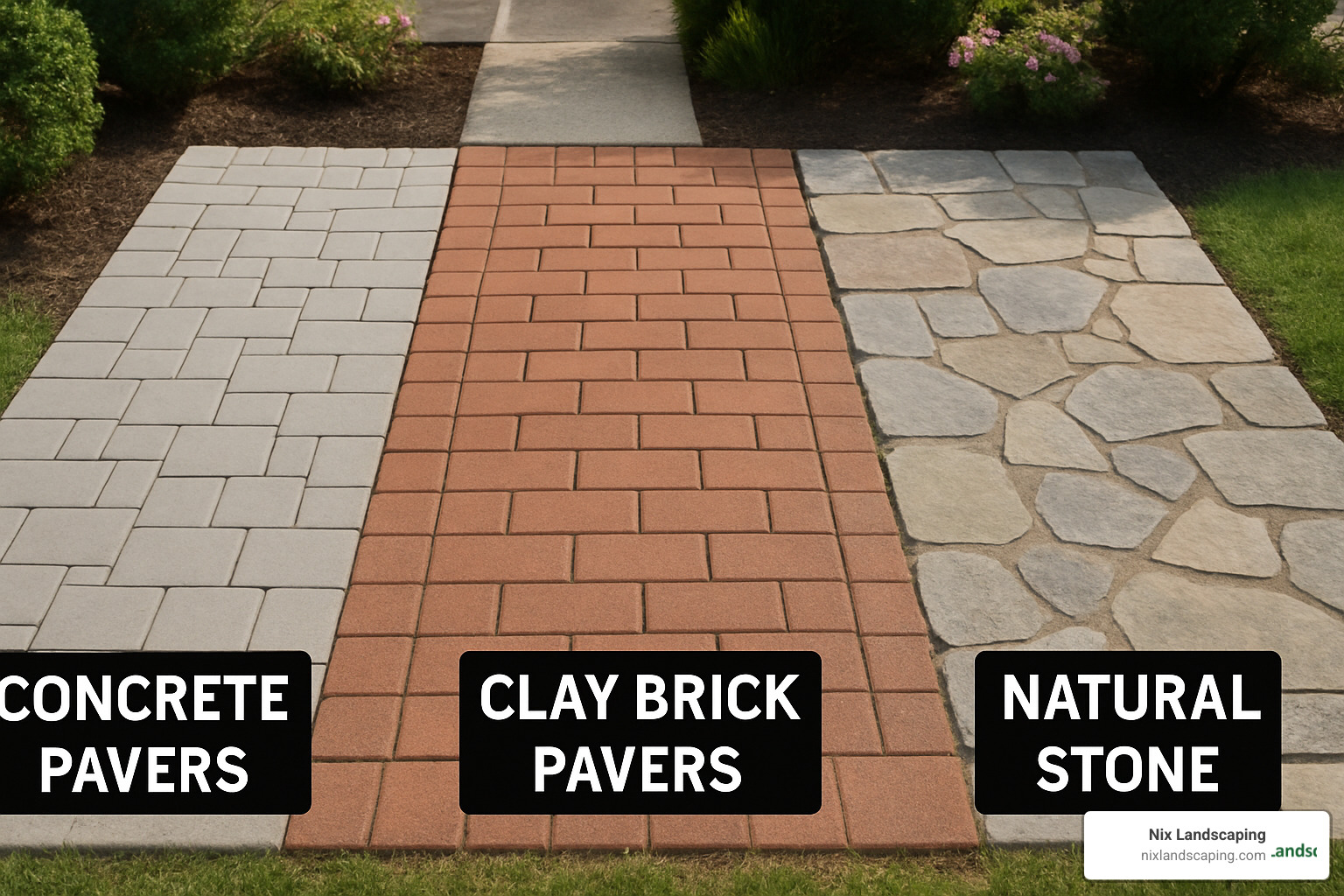
| Material Type | Cost Per Sq Ft (Installed) | Durability | Maintenance Level |
|---|---|---|---|
| Concrete Pavers | $8-$15 | High | Low |
| Clay Brick | $10-$20 | High | Medium |
| Natural Stone | $12-$50 | Very High | Low-Medium |
| Porcelain Pavers | $20-$35 | High | Very Low |
| Slate | $11-$20 | Medium-High | Medium |
| Permeable Pavers | $10-$25 | High | Medium |
I’ve seen how design choices can transform both the look and price of a walkway. Those beautiful curves that flow through your garden? They require more precise cutting and fitting than straight paths, adding labor time and material waste. When you fall in love with an intricate herringbone pattern, remember it typically costs 10-15% more than a simple running bond because of the additional cuts needed.
Those eye-catching borders with contrasting colors? They’ll add about $2-5 per linear foot to your project. And don’t forget about the waste factor—something many homeowners overlook. Complex designs generate more offcuts, meaning you’ll need to purchase more materials than your exact square footage. For simple designs, plan for about 5% extra, but complex patterns might require up to 15% more material.
Concrete vs. Brick vs. Stone
Let me break down what you’re really getting with each popular paver option:
Concrete Pavers ($8-$15/sq ft installed)
– Durability: These workhorses last 25-50 years with proper care. I installed some for a family in Fishers seven years ago, and they still look fantastic after hosting countless backyard gatherings.
– Maintenance: Just an occasional cleaning and resealing every 3-5 years keeps them looking fresh.
– Aesthetics: The chameleons of the paver world—available in countless colors, textures, and shapes. Many of my clients are surprised when I show them concrete pavers that perfectly mimic expensive natural stone.
– Resale Value: They offer good return on investment, especially for homes with modern styling.
Clay Brick Pavers ($10-$20/sq ft installed)
– Durability: These can easily last 50+ years, and unlike concrete, their color stays vibrant without fading. There’s a reason historic districts still have original brick walkways!
– Maintenance: They require a bit more attention—more frequent cleaning and occasionally replacing a damaged piece.
– Aesthetics: Nothing beats brick for that classic, timeless warmth. I recently completed a brick walkway for a 1920s-era home in Fishers that perfectly complemented its historic character.
– Resale Value: Excellent, particularly for traditional or historic homes where period-appropriate materials matter.
Natural Stone Pavers ($12-$50/sq ft installed)
– Durability: These can literally last generations—100+ years when properly installed.
– Maintenance: Varies by stone type; some require regular sealing while others are virtually maintenance-free.
– Aesthetics: Each piece tells its own story with unique variations and character. Mother Nature remains the best designer!
– Resale Value: Premium; can significantly boost property value, especially for high-end homes where these details matter.
Here in Fishers, I’ve noticed most of my clients gravitate toward concrete pavers for their excellent balance of cost, durability, and design flexibility. That said, for front entrances where curb appeal matters most, natural stone options like bluestone or limestone have been gaining popularity—they complement Indiana’s architectural styles beautifully and make a statement that says “quality.”
Adding Style Without Breaking the Bank
Want the look of premium materials without the premium price tag? After hundreds of installations, I’ve developed some tricks to lift your walkway’s style without draining your wallet:
Use mixed materials strategically—concrete pavers for the main walkway area with natural stone as accent borders or focal points gives you high-end appeal without the high-end cost. One of my Fishers clients saved nearly $1,200 on their project with this approach.
Consider simple patterns with impact. A basic herringbone or basketweave pattern using standard concrete pavers creates visual interest without premium pricing. The pattern, not the material, becomes the star of the show.
Add a soldier course border where pavers stand vertically along the edge. This simple technique creates definition and a custom look while using the same affordable materials as the main walkway.
Try color blending with two complementary shades of the same paver type. This creates a custom look without increasing material costs significantly—just the visual complexity.
Focus on focal areas by concentrating your budget where it counts most. Use more expensive materials or complex patterns at entrance points or gathering areas, with simpler designs for connecting pathways.
Just last month, we completed a project for a family in Fishers featuring a simple running bond pattern with concrete pavers, but incorporated a striking natural stone medallion at the entrance. Their neighbors can’t stop complimenting them, and they achieved this high-end look while keeping their overall project cost well within budget.
Good design doesn’t always mean expensive materials—sometimes it’s about using standard materials in creative ways. At Nix Landscaping, we pride ourselves on finding that perfect balance between your vision and your budget.
Beyond Pavers: Labor, Site Prep & Hidden Fees
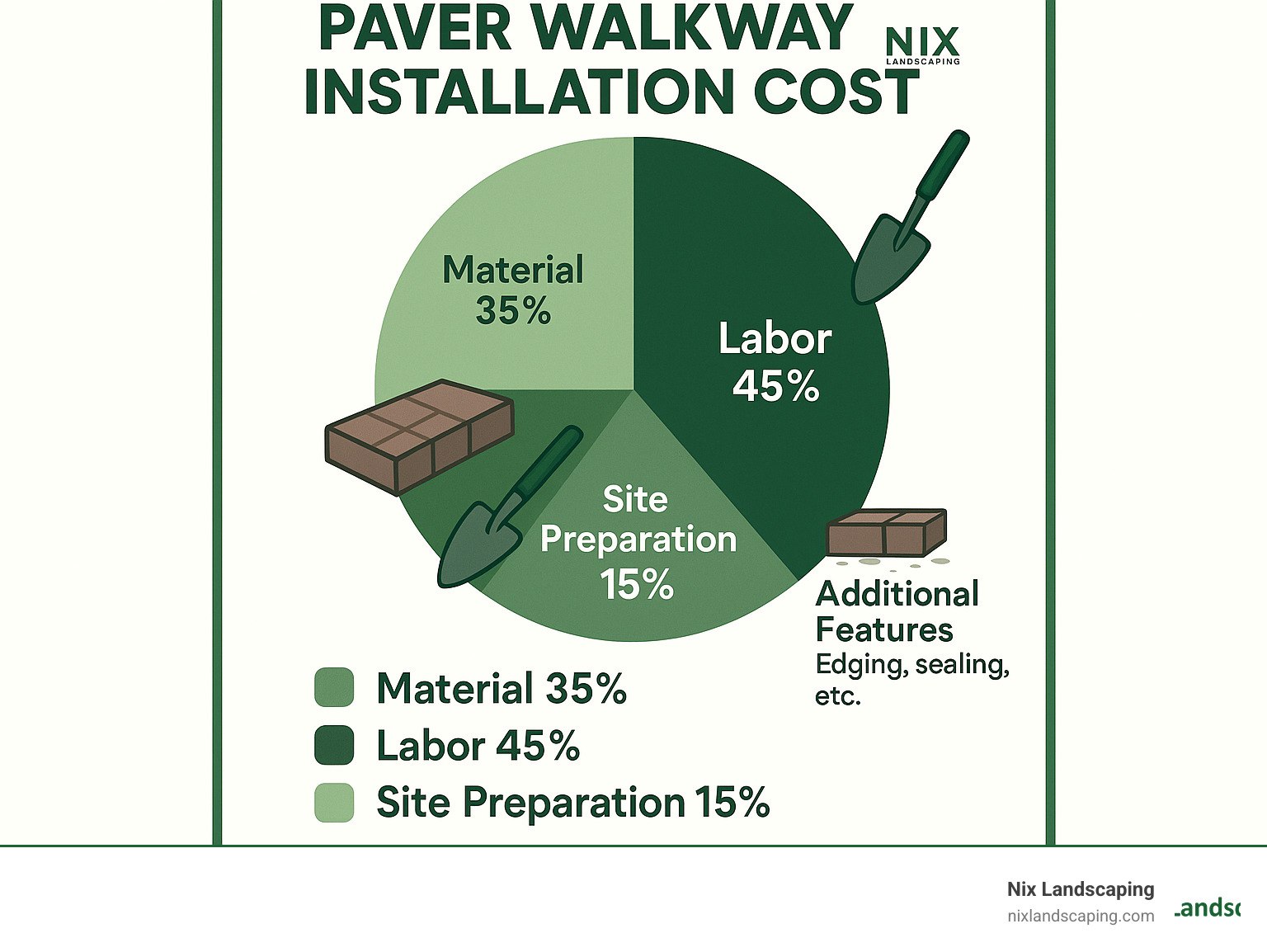
When budgeting for your paver walkway, it’s important to understand that the paver walkway installation cost involves much more than just the pavers themselves. In fact, labor and site preparation typically account for over half of your total investment.
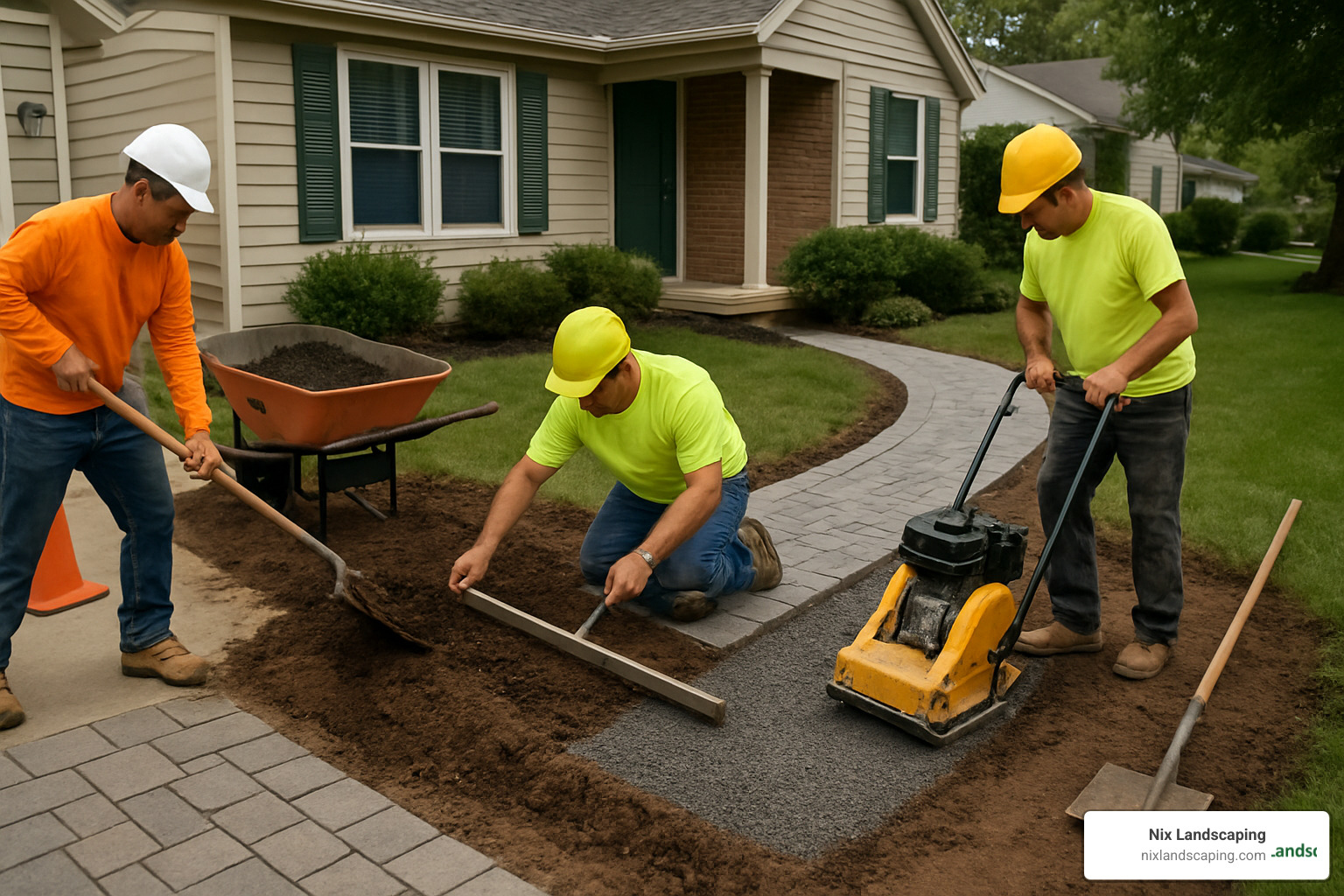
Here in Fishers, professional installation labor runs between $55-$75 per hour. For a typical residential walkway, you’ll have 2-3 of our team members spending 1-3 days bringing your vision to life, depending on your project’s size and complexity. This hands-on craftsmanship ensures your walkway will stand the test of time.
The foundation of a great walkway is literally… well, the foundation! Site preparation costs include excavation ($2-$5 per square foot), a proper gravel base ($2-$5 per square foot for 4-6 inches deep), and sand bedding ($1-$3 per square foot for 1-2 inches). This careful preparation prevents future settling and extends the life of your walkway by decades.
Your walkway also needs proper finishing touches like edging ($1-$5 per linear foot) to maintain its integrity, sealing ($0.50-$2 per square foot) to protect against stains, and sometimes drainage solutions ($5-$15 per linear foot) to prevent water issues.
Don’t forget the paperwork! Permit costs range from $200-$1,000, particularly for front walkways connecting to public sidewalks. And if you’re working through a general contractor rather than directly with us at Nix Landscaping, you might see an additional 13-22% markup on your project.
These figures aren’t just our estimates – they’re backed by industry data from sources like the Bureau of Labor Statistics, which tracks wage information for landscaping and hardscaping professionals.
Common Surprise Costs
Even with careful planning, several factors can affect your paver walkway installation cost. I’ve seen plenty of projects where unexpected challenges arose, but being prepared helps minimize surprises.
The clay-heavy soil in certain Fishers neighborhoods often requires soil corrections, adding $2-4 per square foot for additional excavation and base materials. If your beautiful backyard has limited access, we might need to wheelbarrow materials rather than deliver them directly, increasing labor costs by 15-25%.
Finding irrigation lines or electrical conduits during excavation can be a real “uh-oh” moment, potentially adding $200-500 for rerouting. And don’t forget about the dirt we dig up – debris haul-off can add $200-600 depending on volume.
Some of our clients opt for winter installation to save money (and yes, we can do that!), but it might require additional measures to ensure proper setting, adding 5-10% to labor costs.
At Nix Landscaping, we conduct thorough site assessments before providing quotes to minimize these surprises. That said, I always recommend budgeting an additional 10-15% contingency for the unexpected. Better to be pleasantly surprised than caught off guard!
Money-Saving Tips for Homeowners
While quality paver installation is an investment, there are several ways to reduce your paver walkway installation cost without cutting corners on quality. After all, we want to help you get the most value from your landscaping budget!
Got a strong back and some free weekends? Consider handling the excavation yourself. Many of our clients save $500-1,000 this way, leaving the technical aspects to our team. Or take advantage of our off-season scheduling discounts of 5-15% during fall or early spring when demand is lower.
Simplifying your design makes a huge difference in cost. Each curve or pattern change adds labor time, so a straight walkway with a basic pattern will cost significantly less. If you’re planning other hardscaping projects, combining them into one order can lead to bulk discounts of 5-10% on materials.
Some homeowners opt for phased installation, starting with essential sections and adding extensions later. If you’re replacing an existing walkway, we might be able to reuse the existing base materials if they’re in good condition, saving on excavation costs.
Don’t be shy about comparing material sources either. Prices for identical pavers can vary by 10-20% between suppliers, and we’re happy to work with materials you’ve sourced if they meet our quality standards.
At Nix Landscaping, we’re committed to helping our Fishers neighbors find the perfect balance between budget constraints and quality results. We’ll always be transparent about where you can save and where investment is truly necessary for a walkway that will make you smile every time you use it.
DIY vs. Professional Installation: Crunching the Numbers
Thinking about tackling your paver walkway as a DIY project to save on paver walkway installation cost? I completely understand the appeal—there’s something satisfying about creating something beautiful with your own two hands. But before you grab that shovel, let’s have an honest conversation about what you’re really signing up for.
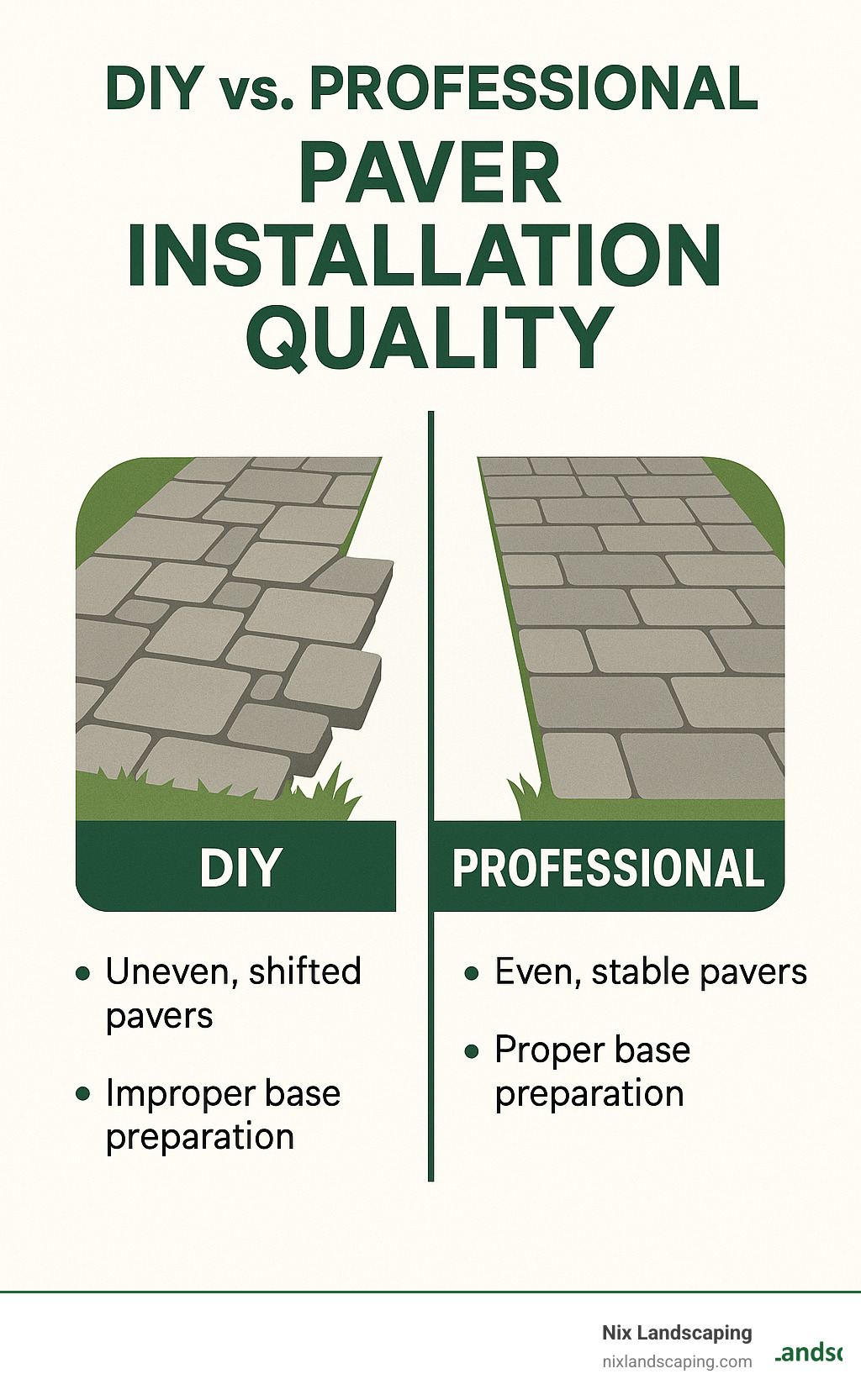
When homeowners call us after their DIY project has started sinking or shifting, I always wish we could have had this chat sooner. The truth is, while DIY can save on labor costs, there’s more to consider than just the initial price tag.
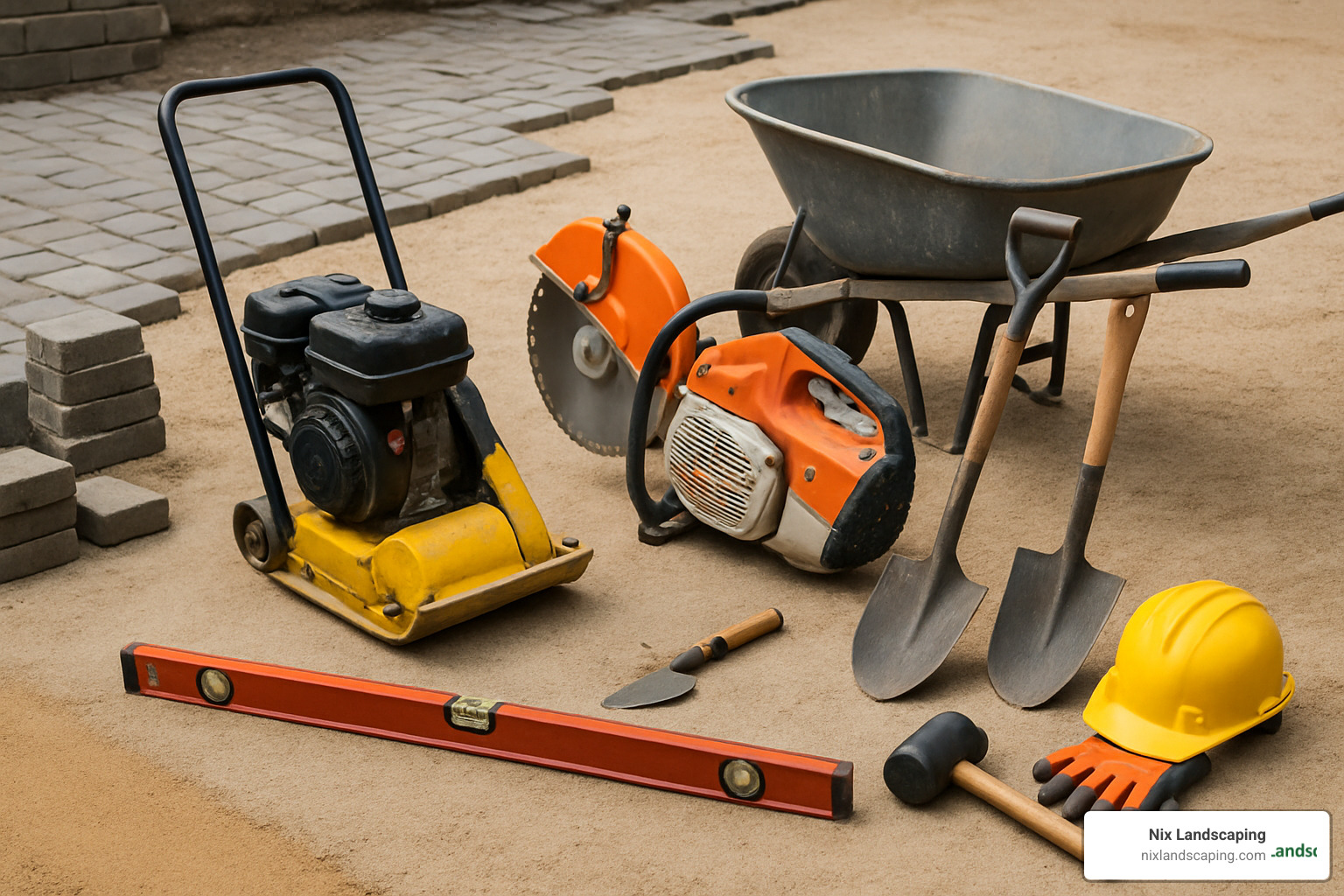
For a typical 35′ x 4′ walkway, expect to spend around $2,978 on DIY materials and tools. This breaks down to approximately $1,400 for pavers, $800 for gravel, $200 for sand, $150 for edging materials, $75 for polymeric sand, and at least $350 for tool rentals (that plate compactor isn’t light on your back or your wallet!).
What many homeowners don’t factor in is the time investment—usually 3-4 full weekends for what our team completes in 1-3 days. There’s also a steep learning curve. Trust me, watching YouTube tutorials is helpful, but there’s no substitute for the experience gained from installing hundreds of walkways in Indiana’s specific soil conditions.
On the professional side, you’re looking at labor costs of $5-$15 per square foot depending on the complexity of your design. But you’re getting more than just labor—you’re buying expertise, efficiency, proper equipment, and peace of mind. Our team has access to commercial-grade tools that ensure optimal compaction (the secret to a walkway that doesn’t sink after the first frost).
Pros & Cons of DIY
There’s definitely something rewarding about completing your own paver walkway. The potential savings of 30-40% on labor costs is nothing to sneeze at, and the personal satisfaction of pointing to your walkway and saying “I built that” has real value. You’ll also have complete control over the timeline—work at your own pace without coordinating with contractors.
But let’s be real about the downsides too. That 40-60 hour time investment is significant—that’s multiple weekends you won’t get back. The physical toll shouldn’t be underestimated either; proper base preparation involves moving literally tons of material. There’s also the risk of costly mistakes without warranty protection. I’ve seen too many DIY projects fail prematurely because of inadequate base preparation, requiring repairs that ultimately cost more than professional installation would have in the first place.
Value of Hiring Certified Pros
When you hire our team at Nix Landscaping, you’re not just paying for labor—you’re investing in decades of combined experience installing walkways specifically in Fishers and surrounding areas. We’ve seen every soil condition and drainage challenge Central Indiana can throw at us.
Our commercial-grade equipment ensures proper compaction levels that rental equipment often can’t match. We also bring material knowledge that helps you select the right pavers for our climate and your specific needs.
One of the biggest advantages is our workmanship warranty. If something isn’t right, we’ll fix it—no questions asked. And don’t underestimate the value of efficiency; we’ll have your project completed while DIYers are still figuring out how to operate the wet saw.
Safety is another consideration that often gets overlooked. Working with heavy materials and cutting tools carries real risks that professionals are trained to manage. We also handle all the permitting paperwork and ensure your project meets local code requirements—something that can become a headache quickly for homeowners.
For many of our clients in Fishers, the decision ultimately comes down to value rather than just cost. When you factor in the longer lifespan and reduced maintenance needs of a professionally installed walkway, the investment often pays for itself over time.
Learn more about our patio installation services to see how our professional approach can benefit your project.
Step-by-Step Walkway Installation Budget Planner
Planning your paver walkway installation cost becomes much more manageable when you break it down into phases. As someone who’s helped countless Fishers homeowners transform their outdoor spaces, I’ve found that understanding each step helps prevent budget surprises.
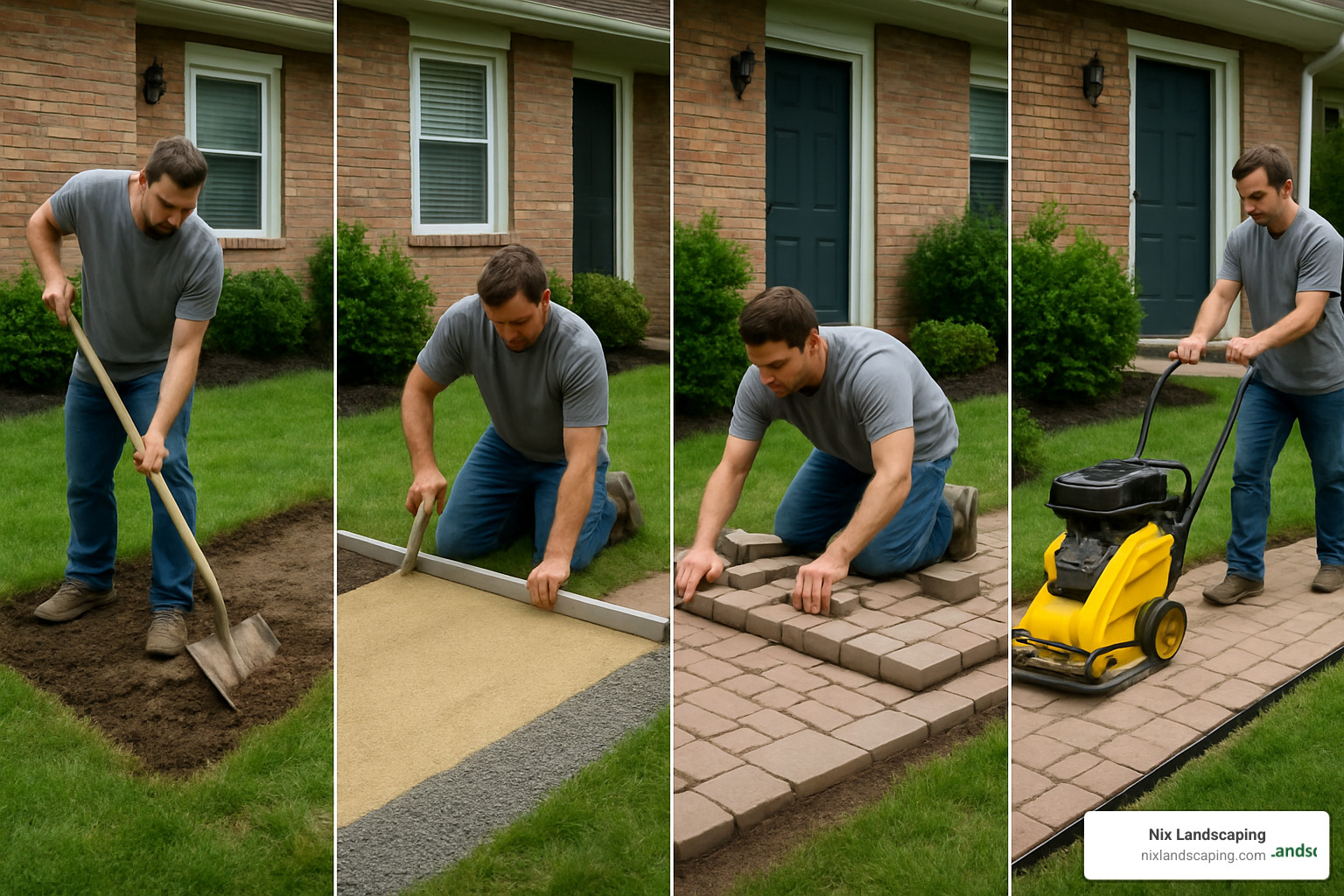
Let’s walk through the journey your project will take, from first measurements to final touches:
The process begins with design and planning ($0-500), where you’ll measure your area and mark your layout with spray paint or rope. This is when you’ll decide on the shape, width, and flow of your walkway. If your project connects to public sidewalks, you’ll likely need permits, which can add $200+ to your budget.
Next comes site preparation ($2-7 per square foot), arguably the most crucial phase for long-term success. This involves excavating 7-9 inches below your finished grade, removing soil, and grading for proper drainage. We’ll also install geotextile fabric as a weed barrier—a small investment that pays dividends in reduced maintenance.
The base installation ($3-8 per square foot) follows, where we add 4-6 inches of gravel in layers, compacting each 2-inch layer thoroughly. We’ll grade this base with a slight slope (¼ inch per foot) to ensure water runs away from your home. Then comes a 1-2 inch sand bed, carefully screeded for a perfectly smooth surface.
During paver installation ($5-35 per square foot), we’ll set your chosen pavers in your selected pattern. Edge pieces are precision-cut with a wet saw, and edge restraints are installed to prevent future shifting. After compacting the installed pavers, we sweep polymeric sand into the joints and mist with water to activate it, creating a solid, weed-resistant surface.
The finishing phase ($0.50-2 per square foot) includes thorough cleaning and optional sealing, which improves color and provides stain protection. We’ll also restore any disturbed landscaping around your new walkway.
With proper maintenance ($0.25-0.50 per square foot annually), your investment will stand the test of time. Well-installed paver walkways can last 50-100 years—outlasting most other hardscape options and making them an excellent long-term value despite the initial cost.
How Many Pavers Will You Need?
Calculating materials accurately helps prevent wasteful spending and mid-project supply runs. For your paver walkway installation cost estimate, you’ll need to determine paver quantity with some simple math.
Start by calculating your walkway’s total square footage (length × width). Then divide by the coverage of your chosen paver—standard concrete pavers cover about 0.33 sq ft each, brick pavers around 0.25 sq ft, and large format pavers approximately 1 sq ft.
Always add an overage factor—5-10% for straight pathways and up to 15% for complex patterns or curves. This accounts for inevitable cuts and breakage. For example, a 140 sq ft walkway using standard concrete pavers would require about 466 pavers (including 10% overage).
Pavers typically come on pallets, with coverage varying by style. Concrete paver pallets usually cover 100-120 sq ft, while brick covers 50-60 sq ft and natural stone 80-100 sq ft. Delivery fees ($50-150) can be economized by combining your paver order with other materials.
At Nix Landscaping, we help our clients calculate precise material needs to minimize waste while ensuring you don’t run short during installation.
Schedule & Maintenance Timeline
Understanding the lifetime care requirements helps you appreciate the true paver walkway installation cost over decades of enjoyment.
Your new walkway requires minimal attention in year 1—simply allow the polymeric sand to fully cure (about 30 days) and clean the surface as needed with mild detergent. We might need to address minor settling that naturally occurs as the base fully compacts.
During years 2-3, you’ll want to apply sealer ($0.50-2 per square foot), replace any damaged pavers, and ensure edge restraints remain secure. This early maintenance establishes the pattern for long-term care.
Every 2-3 years, plan to reapply sealer to maintain color vibrancy and stain resistance. Always clean thoroughly before sealing for best results.
Every 5-7 years, check for and replenish polymeric sand as needed. This is also the time to address any shifting by lifting and resetting affected areas—a simple repair that’s impossible with poured concrete.
The beauty of pavers lies in their modular nature. Unlike concrete slabs that crack and require complete replacement after 20-30 years, pavers allow for spot repairs and individual replacements. This makes their lifetime maintenance cost significantly lower than other hardscape options.
In Fishers, where freeze-thaw cycles put stress on outdoor surfaces, this flexibility proves invaluable year after year. As your local experts, we’re always available to help with maintenance advice or services to protect your investment for decades to come.
Frequently Asked Questions about Paver Walkway Installation Cost
Homeowners considering a new walkway often come to us with similar questions. Let’s address some of the most common concerns about paver walkway installation cost and what you can expect from your investment.
How long will my paver walkway last?
One of the most remarkable things about paver walkways is their incredible lifespan. With proper installation and routine maintenance, your paver walkway can last between 50 and 100 years! This exceptional longevity is why many of our Fishers clients see pavers as an investment rather than an expense.
Unlike a single concrete slab that can crack from freeze-thaw cycles or tree root pressure, the beauty of pavers lies in their individual nature. If a single paver gets damaged or stained beyond cleaning, we can simply replace that individual piece without disturbing the entire walkway. This modular design also allows the surface to flex slightly with ground movement without cracking – perfect for Indiana’s seasonal changes.
Your choice of materials will affect longevity too. Concrete pavers typically last 25-50 years, while clay brick pavers can remain beautiful for 50-100 years. Natural stone is the champion of durability, often lasting well beyond 100 years with proper care. I’ve personally seen century-old brick walkways in historic Fishers neighborhoods that still look charming and function perfectly.
Do I really need a permit for a residential walkway?
This is a great question that can save you headaches down the road. In Fishers, permit requirements for paver walkways depend on several factors. You’ll typically need permits for:
- Walkways that connect to public sidewalks or rights-of-way
- Projects that could potentially alter drainage patterns
- Installations that include electrical components like pathway lighting
- Walkways that incorporate steps or retaining walls over a certain height
Permit costs generally start around $200 and may include inspection fees. While this adds to your initial paver walkway installation cost, proceeding without required permits can result in much costlier fines and potential removal orders – definitely not worth the risk!
At Nix Landscaping, we handle all the necessary permitting paperwork as part of our installation service. We’ve developed good relationships with local inspectors and understand exactly what’s needed to ensure your project is fully compliant with Fishers’ regulations.
What’s cheaper: concrete slab or pavers in the long run?
While poured concrete might tempt you with its lower upfront cost ($6-10 per square foot installed compared to $9-20 for pavers), the long-term financial picture tells a different story.
When you look at the lifetime cost of your walkway, pavers almost always win the economic battle. Here’s why:
Repairs make a huge difference in lifetime costs. When concrete cracks (and it almost always does eventually), repair options are limited and often unsightly. Complete replacement is frequently the only real solution. With pavers, we can lift and replace individual pieces without disturbing the entire walkway.
Lifespan is another major factor. Concrete walkways typically need replacement after 20-30 years, while your paver walkway can serve your family for 50-100 years with proper care.
Maintenance requirements are surprisingly similar for both options. Both need periodic cleaning, but concrete often requires more frequent sealing to prevent staining and deterioration, especially in our Indiana climate.
Aesthetics over time favor pavers dramatically. Concrete tends to fade unevenly and show stains more prominently, while pavers maintain their appearance better and can be refreshed with simple cleaning and resealing.
Property value considerations shouldn’t be overlooked either. In our experience helping Fishers homeowners prepare for resale, paver walkways typically add more to property value than concrete walkways, partially offsetting the higher installation cost.
When you factor in the near-certainty of at least one complete replacement of a concrete walkway during the period a paver walkway would remain functional, pavers emerge as the smarter long-term investment for most homeowners.
I remember one Fishers client who initially chose concrete for budget reasons, only to call us five years later when tree roots had caused significant cracking. The replacement cost far exceeded what they would have spent on pavers initially. Now they have a beautiful paver walkway that will likely outlast their ownership of the home!
Conclusion
Investing in a paver walkway is so much more than just another landscaping expense—it’s a smart addition to your property that pays dividends in value, functionality, and that all-important first impression. While the initial paver walkway installation cost might make you pause, the exceptional durability and minimal upkeep make pavers one of the wisest choices for homeowners thinking long-term.
Here at Nix Landscaping, we’ve been changing outdoor spaces throughout Fishers and surrounding Indiana communities for years. We’ve seen how a thoughtfully designed paver walkway can completely change the feel of a property, guiding visitors through your landscape while adding character that complements your home’s architecture.
What makes our approach different is that we don’t believe in cookie-cutter solutions. Your property is unique, and your walkway should be too. That’s why we take the time to understand exactly what you’re looking for—whether it’s a simple garden path that winds through your backyard or an impressive front entrance that makes a statement to everyone who visits.
The real value in working with our team isn’t just in the materials we use, though those are certainly top-quality. It’s in the expertise we bring to every project, the attention to detail during installation, and the peace of mind knowing your walkway will perform beautifully for decades to come. There’s something deeply satisfying about doing things right the first time, and that’s the standard we hold ourselves to with every project.
I’m particularly proud of how we’ve helped homeowners throughout Fishers balance their aesthetic goals with practical budget considerations. Sometimes that means phasing a project over time, sometimes it means finding creative material combinations—but it always means honest conversations about what matters most for your specific situation.
Ready to improve your property with a beautiful paver walkway that will stand the test of time? We’d love to help bring your vision to life. Contact us to schedule a consultation where we can discuss your ideas, explore options that fit your budget, and develop a plan custom specifically to your property. Learn more about our services and get inspired by examples of our previous work.
Your walkway isn’t just a path—it’s the journey through your outdoor space. Let’s make it exceptional together.