
When Your Retaining Wall Shows Signs of Distress
Retaining wall repair services are critical when your wall begins to lean, crack, or crumble. These structures hold back soil and prevent erosion, but their failure can have severe consequences.
Quick Answer for Retaining Wall Repair Services:
- Minor repairs: $200-$1,000 (cracks, loose blocks)
- Major repairs: Several thousand dollars (structural issues)
- Professional services needed for: Leaning walls, drainage issues, structural damage
- DIY suitable for: Small cracks, minor cosmetic fixes only
- Permits required: Walls over 3-4 feet in height
- Find contractors: Look for hardscape specialists with proper licensing
Retaining walls are essential for creating usable flat space and preventing erosion. However, what starts as a small crack can quickly escalate into a dangerous and costly collapse. The primary culprits behind retaining wall failure are poor drainage, inadequate construction, and material deterioration. Ignoring early warning signs like tilting or water seepage can lead to complete structural failure and significant property damage.
As Kyle Nix, owner of Nix Landscaping in Fishers, Indiana, my experience in hardscaping has shown that proper retaining wall repair services save homeowners from catastrophic failures. Early intervention is always more cost-effective than a complete rebuild.
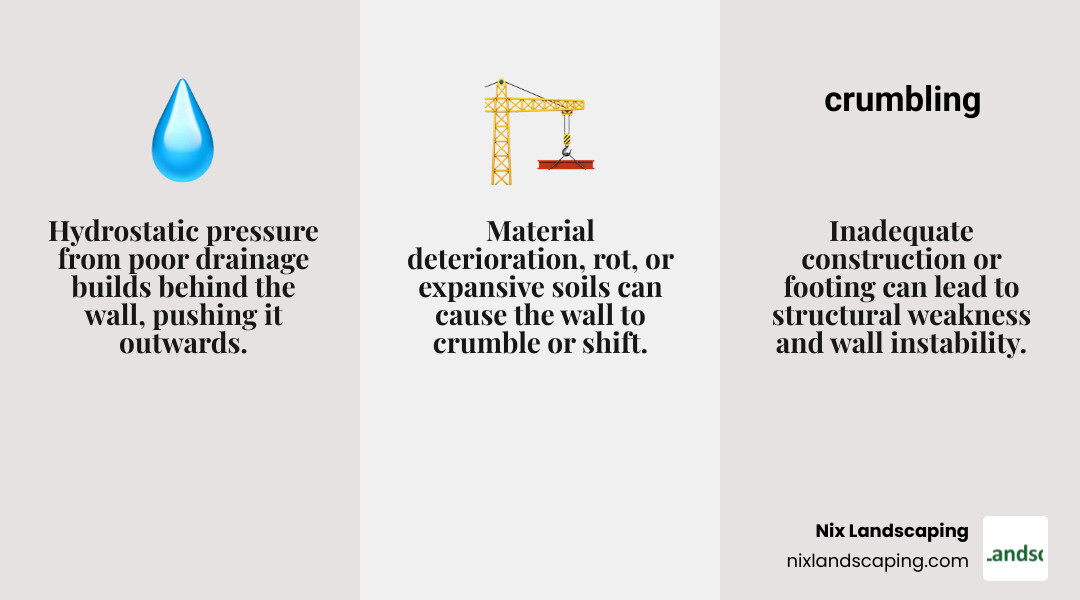
Essential Retaining wall repair services? terms:
Is Your Wall Crying for Help? Common Signs of Failure
Your retaining wall communicates distress through visible signs. Early detection is key to preventing minor issues from becoming major, costly failures. A simple visual inspection after heavy rains or seasonal changes can help you spot problems early.
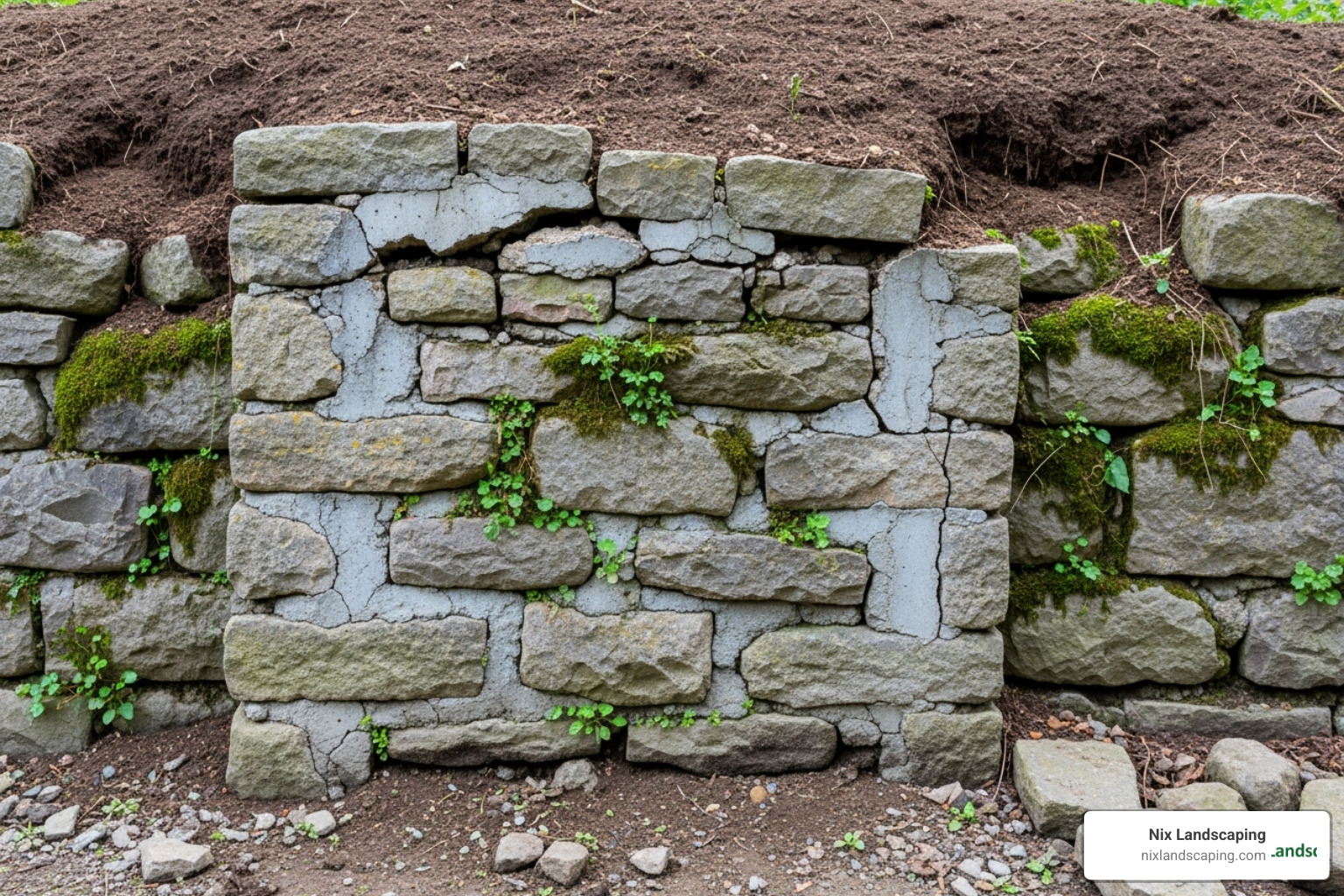
Here are the common signs of failure to look for:
- Tilting or leaning: This is the most obvious sign of a serious problem. It indicates that soil pressure is overwhelming the wall or its foundation is shifting.
- Bowing or bulging: A bulge in the middle of the wall means the soil behind it is pushing the structure outward.
- Cracking: While tiny hairline cracks may be cosmetic, large vertical or horizontal cracks are serious. Vertical cracks often suggest foundation settlement, while horizontal cracks indicate excessive lateral pressure. Widening cracks require immediate retaining wall repair services.
- Crumbling or deteriorating materials: Weather, freeze-thaw cycles, and age can cause materials to flake and crumble. This is common in timber walls, where wood rot can compromise the structure.
- Separating from adjacent structures: Gaps between the wall and your house foundation or other connected sections indicate movement.
- Water seepage: While weep holes are designed to release water, excessive seepage through cracks or pooling at the base signals trouble. This creates hydrostatic pressure from water-soaked soil.
Acting quickly on these warning signs can prevent a complete collapse and save you from more extensive repairs.
What Causes a Retaining Wall to Fail?
Most retaining wall failures result from a combination of issues. Understanding the root cause is essential for an effective repair.
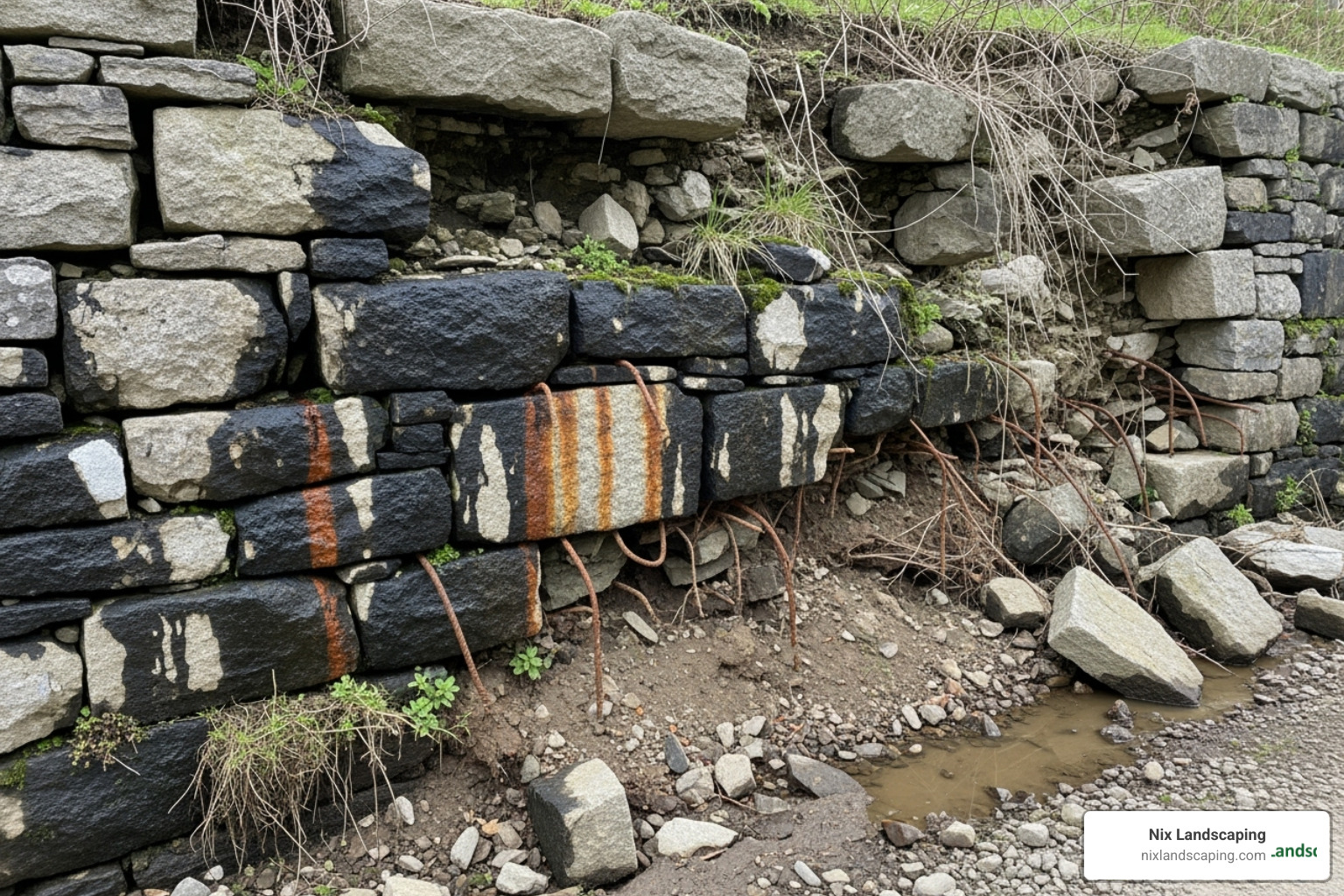
- Hydrostatic pressure: This is the number one cause. Water accumulating behind a wall becomes incredibly heavy (over 62 pounds per cubic foot), exerting immense force on the structure.
- Poor drainage: This is a primary contributor to hydrostatic pressure. A wall needs a proper drainage system (weep holes, gravel backfill, pipes) to manage water. If these are clogged, missing, or improperly installed, water builds up. Learn more about retaining wall drainage solutions.
- Improper construction: A wall with an inadequate footing will settle, tilt, or slide. Any wall over 4 feet high MUST be engineered by a qualified professional. Lack of reinforcement (like geogrid or rebar) leaves a wall unable to resist soil pressure. Poor backfill compaction and low-quality materials also lead to premature failure.
- Material decay: Different materials fail in different ways. Wood rot destroys timber walls, while concrete and mortar can deteriorate over time.
- Soil issues: Expansive soils (clay-rich) swell when wet and shrink when dry, causing constant movement that damages walls. Erosion can undermine the base, and excessive surcharge (weight from buildings or driveways) can overload the wall.
Effective retaining wall repair services must address these root causes, not just the visible symptoms. For more on proper construction, see our guide on how to build retaining walls.
From Failing to Fixed: Professional Retaining Wall Repair Methods
When a retaining wall shows distress, the first step is a professional assessment to decide between repair and replacement. Retaining wall repair services should begin by identifying the root cause of the failure and evaluating the wall’s structural integrity.
Many issues can be repaired without a complete, expensive rebuild. Targeted repairs that address underlying problems can preserve your existing structure. However, if the damage is extensive or the foundation is compromised, replacement may be the safest long-term solution. Understanding proper construction is key to lasting repairs. Learn more about how to build retaining walls correctly.
Structural Reinforcement Techniques
For leaning or bowing walls, surface fixes are not enough. These problems require structural reinforcement.

- Wall anchors: These are steel rods that extend through the wall deep into stable soil behind it. An exterior wall plate is connected to the anchor, which can be tightened over time to gradually pull the wall back to its original position.
- Helical tiebacks: These are large steel screws drilled deep into the earth behind the wall. They are especially useful in rocky soil or tight spaces and provide exceptional holding power.
Both systems transfer pressure from the soil behind the wall to stable ground deep underground. This stabilizes the soil and prevents further movement, often allowing us to pull the wall back into alignment.
Addressing Drainage and Material Issues
Effective retaining wall repair services also address drainage and material problems to prevent future failures.
Drainage Solutions:
- Weep holes: Small openings at the wall’s base are installed or cleared to let trapped water escape.
- Gravel backfill: Clean, coarse gravel is installed behind the wall to allow water to flow freely to drainage points.
- Filter fabric: This fabric separates the gravel from the soil, preventing clogs in the drainage system.
- Drainage pipes: A French drain system can be installed at the wall’s base to collect and divert water away.
Material Repairs:
- Patching cracks: Specialized epoxy or sealants are used to fill gaps and prevent water infiltration.
- Repointing mortar: Deteriorated mortar joints in brick or stone walls are replaced with fresh, durable mortar.
- Replacing damaged units: Individual damaged blocks or timbers can be carefully removed and replaced.
- Partial or full rebuilding: For extensive damage, dismantling and reconstructing compromised sections may be necessary. If the original construction was fundamentally flawed, a full rebuild is the best option for a long-lasting, properly engineered wall.
Understanding the Costs and Requirements of Retaining Wall Repair Services?
The cost of retaining wall repair services can vary dramatically. Key factors that influence the price include:
- Wall size and material: Larger walls and more complex materials cost more to repair.
- Accessibility: Difficult site access increases labor costs.
- Extent of damage: Minor cosmetic fixes are far less expensive than major structural overhauls.
For a broader understanding of project costs, you can explore More info on the cost of retaining wall installation.
How Much Do Retaining Wall Repair Services Cost?
While every situation is unique, here are some realistic price ranges:
- Minor repairs: For fixing small cracks, repointing mortar, or replacing a few loose blocks, expect to pay “$200 to $1,000”.
- Major structural repairs: For issues like leaning, bowing, or rebuilding sections, costs can be “several thousand dollars”. A general estimate for significant repairs or rebuilds is around “$80 per square foot”.
Specific repair costs can include:
- Wood rot repair: $40 to $60 per square foot.
- Crumbled foundation repair: $40 to $75 per linear foot.
- Crack repair: $150 to $400.
- Bowing or leaning repairs: $250 to $1,500.
- Wall anchors: “$60 to $80 per linear foot”.
Investing in proper repairs now can prevent a much more expensive rebuild later.
Do I Need a Permit for Repairs?
Permit requirements for retaining wall repair services depend on local building codes and the scope of the work.
Minor maintenance, like patching small cracks, typically does not require a permit. However, significant structural changes or work on taller walls usually will.
In most areas, walls “over 3 or 4 feet” in height are subject to stricter regulations. It is a code requirement that walls “over 4′ in height MUST be engineered” by a civil structural engineer to ensure they can handle the specific loads and soil conditions.
Before beginning any significant repair, always check with your local building department. For residents in Fishers, this would be the Department of Planning & Zoning or Building Department. They can provide the exact requirements, preventing costly mistakes and ensuring compliance.
DIY vs. Hiring a Pro: Making the Right Choice for Your Wall
Deciding between DIY and professional retaining wall repair services is a critical choice that involves safety, complexity, and cost. While DIY may seem tempting, retaining wall repairs are often more complex than they appear and require specialized knowledge to fix correctly.
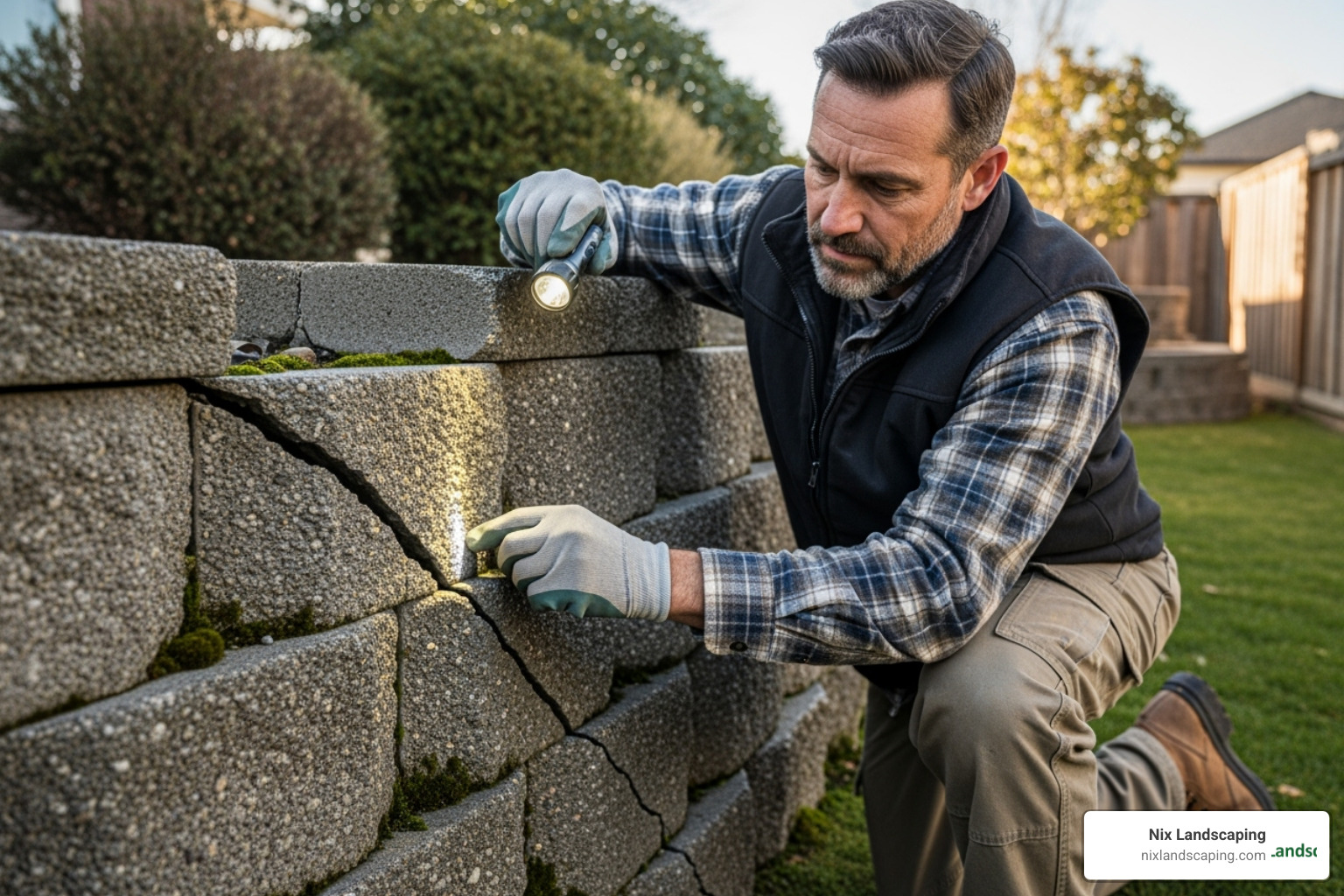
An incorrect repair can worsen the problem, leading to a more expensive failure. Before attempting any work, review The Do’s And Don’ts Of Retaining Wall Repair to understand the risks.
When Can You DIY? (And When You Shouldn’t)
DIY repairs are only suitable for minor, cosmetic issues that do not affect the wall’s structural integrity. This includes filling small, superficial cracks or re-tucking a single loose stone in a decorative wall.
For anything more significant, the risks of DIY are substantial:
- Making the problem worse: A DIY fix might mask the symptoms while the underlying cause (like poor drainage) continues to damage the wall, leading to a full collapse later.
- Structural collapse and safety hazards: Retaining walls support immense pressure. Attempting structural work without proper knowledge can trigger a sudden failure, endangering people and property. Working with heavy materials and on unstable structures is also dangerous for the untrained.
- Lack of geotechnical knowledge: Effective repairs require an understanding of soil mechanics, drainage, and structural engineering. Guessing at solutions can lead to catastrophic failure.
Finding the Best Retaining Wall Repair Services
For most retaining wall issues, hiring a professional is the safest and most effective choice. A professional offers:
- Experience to diagnose the root cause correctly.
- Proper equipment for excavation, compaction, and anchoring.
- Insurance to protect you from liability.
- Warranties on labor and materials for peace of mind.
When searching for a contractor:
- Look for specialists: Choose companies that specialize in Hardscape and retaining walls, like Nix Landscaping.
- Verify credentials: Ensure they are licensed and insured. Ask to see past projects and speak with references.
- Get multiple detailed quotes: Compare the scope of work, materials, timeline, and warranty, not just the final price. Be wary of unusually low bids.
- Ask the right questions: Inquire about their specific experience with retaining wall repair services, their repair methods, and how they handle unexpected issues.
Choosing a professional is an investment in your property’s safety and value. When you need an expert, Contact Nix Landscaping for retaining wall repair services for a lasting solution.
Ensuring Long-Term Stability for Your Repaired Wall
After your wall is repaired by professional retaining wall repair services, ongoing preventative maintenance is essential to ensure its longevity. With proper care, a retaining wall can last 50 to 100 years. Proactive attention, especially after significant structural work, will protect your investment and prevent future issues.
Common Mistakes to Avoid
To protect your repaired wall, avoid these common mistakes:
- Ignoring the root cause: Ensure the repair addressed the underlying problem (e.g., poor drainage), not just the symptom (e.g., a lean). Otherwise, the problem will likely return.
- Using cheap materials: Quality materials are a crucial investment in the wall’s strength and durability.
- Improper backfilling: The area behind the wall must be backfilled with the correct aggregate (like gravel) and properly compacted to prevent settlement and uneven pressure.
- Blocking drainage: Keep all weep holes and drain pipes clear of debris. Blocked drainage leads to hydrostatic pressure buildup, the very problem you likely just fixed.
- Incorrect terracing: When stacking terraced walls, the upper wall must be set back at least “double the height of the lower wall”. For a 3-foot lower wall, the upper wall must be at least 6 feet back to avoid overloading.
Post-Repair Maintenance Tips
Follow these tips to keep your repaired wall in top condition:
- Regular inspections: Check your wall every 3-5 years (more often for older walls) for new cracks, leaning, or water issues. Early detection saves money.
- Keep drainage clear: Regularly clear weep holes and drain outlets of debris, especially after storms, to prevent pressure buildup.
- Manage water runoff: Direct downspouts, gutters, and surface grading away from the retaining wall to avoid overwhelming its drainage system.
- Avoid new surcharges: Do not place heavy objects like sheds or patios behind the wall unless it was designed for the extra load. Avoid planting large trees nearby, as their roots can cause damage.
Nix Landscaping offers professional maintenance plans to ensure the long-term health of your wall. We provide regular inspections and proactive care to protect your investment. Explore our comprehensive services to learn more.
Conclusion: Secure Your Landscape by Calling the Experts
When your retaining wall shows signs of distress like leaning, cracking, or crumbling, it’s time to act. Ignoring these warning signs can lead to a catastrophic and costly collapse.
This guide has covered the key signs of failure, their root causes like poor drainage and improper construction, and the professional repair methods needed to fix them. We’ve highlighted that while minor cosmetic fixes can be a DIY project, structural issues require the expertise, equipment, and engineering knowledge of a professional. Understanding the costs, permit requirements for walls over 3-4 feet, and the importance of post-repair maintenance is crucial for long-term stability.
Don’t wait for a total collapse. Proactive repair saves money, protects your property, and ensures your family’s safety. A small repair today prevents a major reconstruction tomorrow.
For expert assessment and repair of your Retaining Walls, contact Nix Landscaping today. Our experienced team provides professional retaining wall repair services to keep your landscape beautiful and secure.

