
Why Your Yard’s Soil is a Precious, Disappearing Act
Retaining wall to prevent erosion? Yes, retaining walls are one of the most effective solutions for stopping soil erosion. Here’s what you need to know:
- How they work: Retaining walls hold soil in place by providing lateral support and preventing it from sliding downhill
- Key benefits: Stop erosion, create usable flat areas, protect foundations, and improve drainage
- When you need one: Steep slopes, exposed foundations, water runoff problems, or soil washing away after storms
- Materials: Natural stone ($25-30/sq ft), concrete blocks ($20/sq ft), or timber ($15/sq ft)
- Critical elements: Proper drainage, solid foundation, appropriate backfill, and professional installation for walls over 3-4 feet
Your yard’s topsoil is disappearing. It takes nature hundreds of years to create one inch of topsoil, yet it can be lost quickly to erosion. Globally, approximately 24 billion tons of fertile soil are lost this way each year.
Heavy rain or snowmelt washes away this precious soil, threatening your foundation, reducing usable yard space, and causing costly drainage issues.
Retaining walls act as barriers that stabilize your soil and redirect water flow. They transform unusable slopes into functional terraced areas while protecting your property investment.
I’m Kyle Nix, owner of Nix Landscaping in Fishers, Indiana. I’ve helped countless homeowners solve erosion problems with strategic retaining walls. The right wall system can completely transform the function and beauty of your outdoor space.
Basic Retaining wall to prevent erosion? terms:
Understanding the Enemy: What Causes Soil Erosion on Your Property?
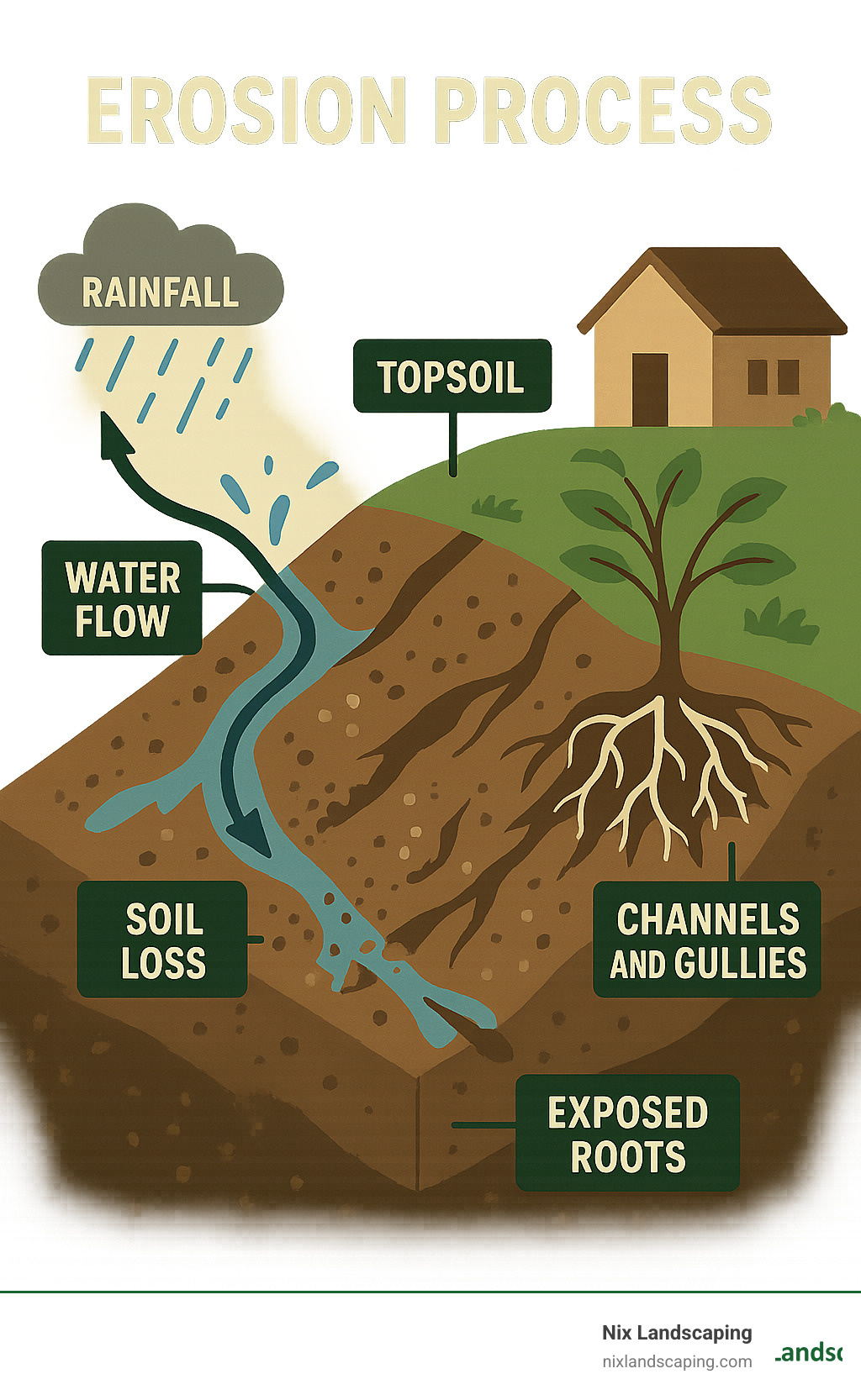
After a heavy storm, you might see channels carved into the earth where a grassy slope used to be. This is soil erosion in action, a common problem for homeowners.
Water runoff is the biggest culprit in Indiana. When heavy rain or snowmelt hits your property, it needs to go somewhere. On steep slopes, gravity turns that water into a powerful force that carries your topsoil away.
The steeper the slope, the faster water moves, carrying more soil with it. This process strips away fertile topsoil that took centuries to develop.
Lack of vegetation worsens the problem. Plant roots are nature’s retaining system, holding soil together. Bare patches or sparse grass leave soil vulnerable when rains come.
Human activity can also cause erosion. Construction projects, new landscaping, or even heavy foot traffic can disturb soil and remove protective plant cover, leading to sudden erosion problems on previously stable slopes.
Poor drainage compounds these issues. When water has no proper path, it carves its own—usually right through your yard, taking topsoil with it.
The consequences can be severe. First, you lose rich topsoil. Then, your foundation may become exposed as surrounding soil washes away. Eventually, you could face potential mudslides during heavy rains, threatening structures and safety.
You also lose usable yard space as slopes become unstable. What was once a functional part of your property becomes a problem area.
This is why a retaining wall to prevent erosion is a game-changer. It provides a permanent solution that stops the problem at its source.
For comprehensive solutions beyond retaining walls, check out our full range of hardscape solutions that work together to protect your property from erosion damage.
The Hero’s Toolkit: How Does a Retaining Wall to Prevent Erosion?

A retaining wall to prevent erosion is a rigid barrier designed to hold soil at different elevations, standing strong against the forces of erosion. Through lateral soil support, the wall provides a stable boundary against gravity and water, turning a troublesome slope into manageable, terraced levels.
This powerful soil stabilization offers permanent protection. The wall doesn’t just stop erosion—it creates level ground from an unusable slope, giving you more yard to enjoy.
For more detailed information about these incredible structures, check out our Retaining Walls page.
What is the fundamental role of a retaining wall to prevent erosion?
The core function of a retaining wall to prevent erosion is holding soil in place through engineering strength. It creates an immovable barrier that soil cannot push past.
A well-designed wall is built to resist lateral pressure that soil exerts, especially when wet. It must handle this force without budging, bulging, or cracking to prevent soil shifting.
This resistance stops the formation of ugly erosion channels and gullies. Instead of a gradual landslide, you get permanent stability that protects your landscape investment.
By creating functional tiers, a retaining wall can completely transform your property. A sloped yard that was once unusable becomes a series of level platforms perfect for gardens, patios, or play areas. Through terracing, we are literally increasing usable area by changing your land’s topography.
Why is drainage critical for a retaining wall to prevent erosion?
The biggest threat to a retaining wall isn’t soil; it’s water accumulation. Without proper drainage, trapped water creates immense pressure that can lead to wall failure.
This force, known as hydrostatic pressure, is incredibly destructive. Water weighs about 62 pounds per cubic foot, and its constant pressure can cause even the strongest wall to fail.
The solution is channeling water safely away. Weep holes are small openings at the wall’s base that act as pressure release valves, allowing trapped water to escape.
Behind the wall, perforated pipes collect water and direct it away from the foundation. These pipes sit in gravel backfill, a material that drains well and prevents water from pooling against the wall.
Without this system, your retaining wall to prevent erosion becomes waterlogged and unstable, especially during Indiana’s freeze-thaw cycles. Proper drainage is what separates a wall that lasts for decades from one that fails in a few years. Learn more about these critical systems at our Retaining Wall Drainage Solutions page.
Choosing Your Champion: Materials and Types of Retaining Walls

When selecting materials for a retaining wall to prevent erosion, you’re choosing the look and performance of your landscape solution. Each material has unique strengths, aesthetics, and costs. The right choice depends on your budget, desired look, and how long you want the wall to last.
Natural Stone and Boulders
Natural stone is a timeless material that offers a premium, natural aesthetic, blending seamlessly into the landscape. These walls are built to last, with a lifespan of 50 to 100 years with proper construction.
However, at $25 to $30 per square foot, stone is typically the most expensive option. The installation is also labor-intensive, requiring skilled masons to fit irregular shapes together.
Styles include dry-stack walls, which fit stones without mortar and drain naturally, and mortared walls, which use cement for extra rigidity but require planned drainage.
Concrete and Segmental Blocks
Concrete blocks are a practical, versatile, and strong option. They come in many styles that can mimic natural stone or create clean, modern lines to complement your home. Their uniform shape makes installation more predictable than with natural stone.
At about $20 per square foot, concrete blocks offer a great balance of affordability and performance, lasting 50+ years.
Modern interlocking systems fit together without mortar. For taller walls, they can be reinforced with geogrid—fabric sheets extending into the soil for extra holding power. Other types include poured concrete for maximum strength or reinforced cinder block.
Concrete walls can be engineered in different ways. Gravity walls use mass to hold back soil, anchored walls use cables for support, and cantilevered walls use an integrated foundation to convert soil pressure into vertical weight.
Timber and Wood
Timber walls offer a warm, rustic charm that suits natural or traditional settings. At around $15 per square foot, timber is the most budget-friendly option and can be more DIY-friendly for small projects.
However, timber has limitations. With a lifespan of 10 to 20 years, it is susceptible to rot, decay, and insects. Common materials include pressure-treated lumber and recycled railroad ties. For walls over three feet tall, proper bracing is critical, as timber lacks the inherent strength of stone or concrete.
Comparing Your Champions
| Material | Average Cost/Sq. Ft. | Lifespan | Pros | Cons |
|---|---|---|---|---|
| Natural Stone | $25 – $30 | 50+ years | Best natural aesthetics, highly durable, long-lasting | High material and labor cost, labor-intensive, requires skilled installation |
| Concrete/Segmental | $20 | 50+ years | Versatile, strong, uniform, wide range of styles, durable | Can look less natural than stone, requires proper drainage and engineering |
| Timber/Wood | $15 | 10 – 20 years | Lower cost, rustic look, easier for DIY (small walls) | Shorter lifespan, susceptible to rot/insects, requires maintenance, less structural for tall walls |
A retaining wall to prevent erosion is an investment. Sometimes it makes sense to spend more upfront for a solution that will last for decades. For more inspiration, check out our Retaining Wall Ideas for Backyard.
The Blueprint for Success: Critical Design and Construction Elements
Building a successful retaining wall to prevent erosion requires proper planning and meticulous execution. Success lies in the details, not just piling up materials. Proper planning starts with a site evaluation to understand your soil type, slope angle, and drainage patterns before any work begins. For detailed guidance, check out How to Build Retaining Walls.
A Solid Foundation
A retaining wall is only as strong as its foundation. A solid, level base is non-negotiable for long-term stability.
Excavation depth is key. A good rule is to bury at least one-third of the wall’s total height below ground. This buried portion acts as an anchor against soil pressure.
Next, a compacted gravel base is installed in the trench. This creates a solid, level foundation that distributes weight evenly and prevents settling.
Leveling the first course of blocks or stones is absolutely critical. Any error here will be magnified as the wall gets higher.
For larger walls or those supporting heavy loads, concrete footings provide additional stability and prevent shifting.
Backfill and Reinforcement
The backfill behind the wall is just as important as the wall itself. It can either support or sabotage the structure.
Proper backfill material, like gravel or crushed stone, is used directly behind the wall because it drains freely, preventing dangerous hydrostatic pressure.
Geotextile fabric is a permeable barrier placed between native soil and gravel backfill. It prevents soil from clogging the drainage system, acting like a filter for the wall.
Compaction in layers is crucial. Backfill is added in six to twelve-inch layers, with each one compacted thoroughly to prevent future settling.
For taller walls, geogrid reinforcement is essential. These polymer grids are laid horizontally within the backfill, extending back into the soil to create a reinforced mass that improves the wall’s strength.
Height, Permits, and Professional Help
Height limits, permits, and professional help are critical considerations.
Local building codes typically set height limits around three to four feet for retaining walls built without an engineer. These height regulations exist for safety and structural reasons. For more on these requirements, visit our page on Retaining Wall Height Regulations.
When to hire an engineer is about protecting your investment. Walls supporting driveways, structures, or dealing with poor soil need professional design.
Permit requirements ensure your project meets safety standards. Most municipalities require permits for walls above a certain height. We can help guide you through Retaining Wall Permit Requirements in our area.
Building a retaining wall to prevent erosion right the first time saves money and protects your property for decades. Getting these fundamentals right is essential.
Building a United Front: Complementary Landscaping for Erosion Control

A retaining wall is powerful, but it’s even more effective when combined with strategic plantings. This integrated approach uses both hardscaping (the wall) and softscaping (plants) to protect your property. The wall handles the heavy lifting, while plants create a living shield that slows water and holds soil with their roots.
This combined strategy is not just functional; it creates a landscape that looks natural and inviting. For insights into how this affects your project investment, check out our Cost of Retaining Wall Installation.
The Power of Plants
Plants are a secret weapon in the fight against soil loss. Underground, plant roots create an intricate web that holds soil particles together. These root networks act as living anchors, preventing soil from washing away. Plants play an essential role in anchoring soil, and we can harness this natural power in your landscape.
Ground covers are front-line defenders. Low-growing plants like Juniper, Clover, and Iris create a protective carpet over exposed soil, minimizing the impact of raindrops.
Shrubs and trees bring heavy artillery. Their deeper, more extensive root systems offer greater stability. They also break the force of rainfall before it hits the ground.
I always recommend native plant selection, as they are adapted to Indiana’s climate and soil. They require less maintenance and provide excellent long-term erosion control.
Other Erosion Control Techniques
Beyond walls and plants, other techniques can be deployed. Mulching with wood chips or bark acts as a protective blanket over soil, retaining moisture and buffering against rain.
For challenging slopes, terracing with a series of shorter walls can reduce water speed and create usable garden areas.
Swales are shallow channels that capture and redirect runoff, allowing it to soak into the ground. You can learn more about swales and drainage solutions for managing water flow.
Erosion control blankets provide immediate protection for newly seeded areas, holding soil in place while plants take root.
In areas with heavy water flow, riprap (large, angular stones) can dissipate water’s energy and prevent scour.
When we combine these elements with a properly designed retaining wall to prevent erosion, we create a comprehensive defense system that is both beautiful and effective.
Conclusion: Secure Your Landscape and Boost Your Property’s Value
A retaining wall to prevent erosion can stop your yard’s soil from disappearing. It transforms from a simple structure into your landscape’s most valuable guardian.
The benefits extend far beyond stopping erosion. A well-designed retaining wall is an investment that adds significant value. Property values typically increase by 10-15% with professional hardscaping, and homes with these features often sell up to 20% faster.
Homeowners experience a real change: unusable slopes become beautiful terraced gardens or new favorite outdoor spaces. This creates more usable space to enjoy.
The improved aesthetics are clear. No more unsightly erosion channels or exposed foundations. Instead, you get clean lines, stable soil, and a foundation for beautiful landscaping.
A properly built retaining wall is a long-term investment. With proper drainage, solid foundations, and quality materials, it will protect your property for decades, providing peace of mind.
The importance of proper design and installation cannot be overstated. Every detail matters for a wall that works perfectly from day one. That’s why we take such care with each project.
For homeowners in Fishers, IN, and surrounding areas, Nix Landscaping provides expert design and construction for retaining walls that are both functional and beautiful. We understand our local climate challenges, and every wall we build reflects this expertise.
Ready to stop watching your landscape slide away? Contact us to learn more about our retaining wall services. Let’s turn your erosion problem into your property’s greatest asset.

