
Transform Your Landscape with Water and Stone
Retaining wall with water feature? Absolutely! Here’s what you need to know:
- Water Features: Cascading waterfalls, sheet flows, fountain spillways
- Benefits: Improved ambiance, increased property value, noise masking
- Cost Range: DIY ($300-$1,500), Professional ($2,000-$10,000+)
- Materials: Natural stone, concrete blocks, gabion cages
- Maintenance: Weekly water checks, seasonal cleaning, pump inspection
A retaining wall with water feature combines structural functionality with the soothing elements of moving water, changing an ordinary landscape into a peaceful retreat. Retaining wall with water feature designs can range from simple spillways to elaborate multi-tiered waterfalls, depending on your space, budget and personal style preferences. Beyond their aesthetic appeal, these hardscape elements solve practical problems by managing elevation changes while creating a focal point that engages multiple senses.
I’m Kyle Nix, owner of Nix Landscaping in Fishers, Indiana, with over a decade of experience designing and installing retaining wall with water feature systems that transform ordinary yards into extraordinary outdoor living spaces. My team specializes in creating custom solutions that balance engineering requirements with aesthetic vision, ensuring your landscape improvement stands the test of time.
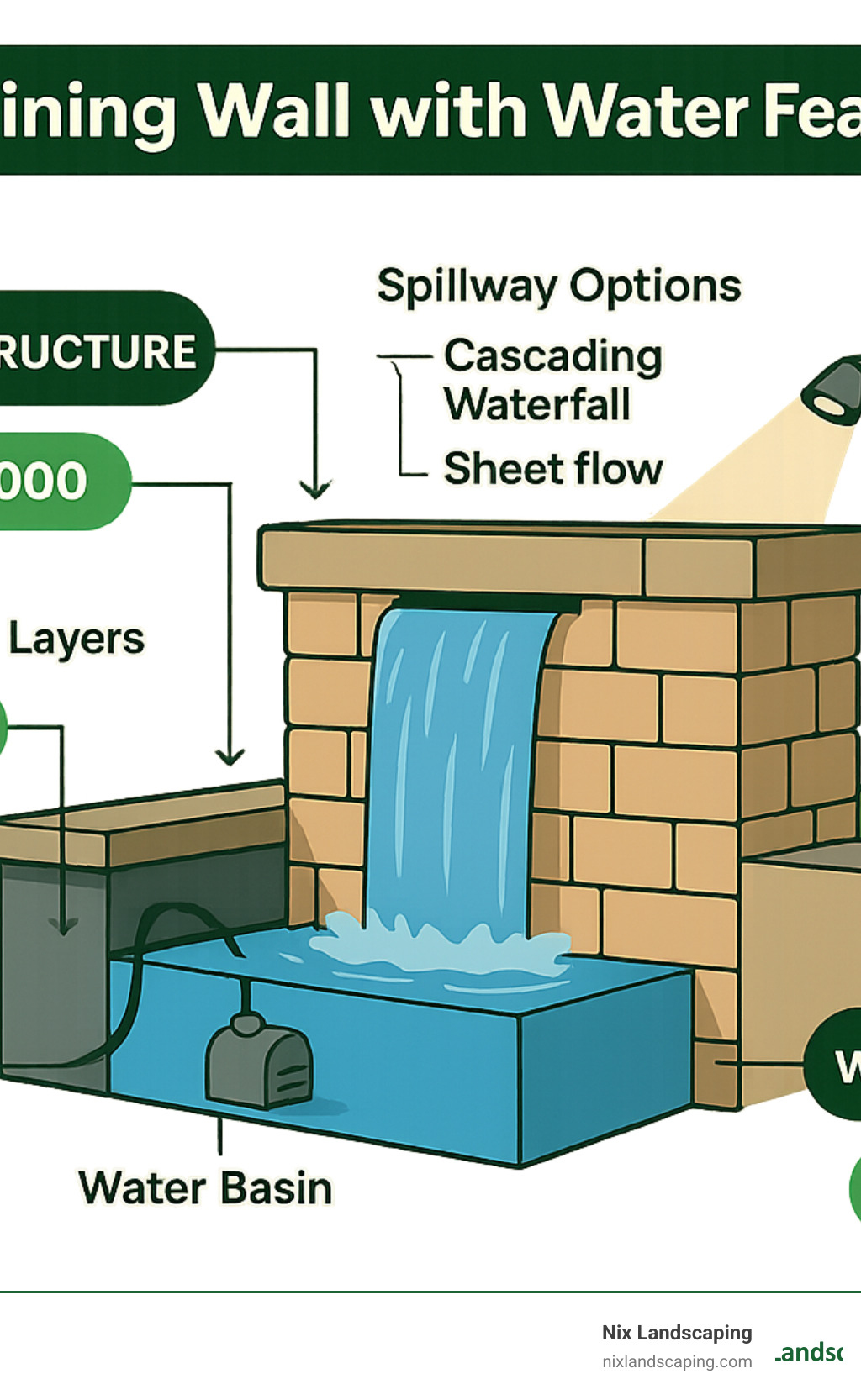
Benefits of Blending Walls and Water
When homeowners ask us about combining a water feature with their retaining wall, I can’t help but smile. This is one of those perfect landscape marriages where the whole becomes so much more than the sum of its parts. Let me share why this combination has become one of our most requested projects at Nix Landscaping:
The Sensory Experience
There’s something almost magical about the gentle soundtrack of flowing water in your backyard. Unlike static landscaping elements, a retaining wall with water feature engages multiple senses at once. Many of our Fishers clients tell us how their water feature drowns out neighborhood noise, creating a peaceful sanctuary right in their own yard. After a long day, that soothing sound becomes nature’s stress reliever.
Natural Habitat Creation
Water naturally attracts life. Birds stop by for a drink or quick bath, butterflies visit for moisture, and beneficial insects help keep your garden healthy. I’ve watched clients’ faces light up when they spot a colorful dragonfly or hear new birdsong around their water feature. Your landscape transforms from a static space into a living, breathing mini-ecosystem.
Property Value Improvement
Beyond the joy these features bring, they’re also smart investments. A thoughtfully designed retaining wall with water feature becomes a standout selling point if you ever decide to move. In Fishers’ competitive real estate market, homes with custom water elements tend to attract more interest and often command higher prices. Beauty that pays you back—what’s not to love?
Practical Benefits Beyond Beauty
While the aesthetic appeal is immediately obvious, there are some impressive practical advantages too:
Erosion control becomes more effective when your retaining wall integrates water management. Instead of fighting water runoff, we harness it as part of the design.
Microclimate creation happens naturally around water features. On hot Indiana summer days, the evaporative cooling effect can make the surrounding area feel noticeably more comfortable.
Outdoor living improvement occurs as water features naturally become gathering spots. They draw family and friends outside and encourage everyone to linger longer in your outdoor spaces.
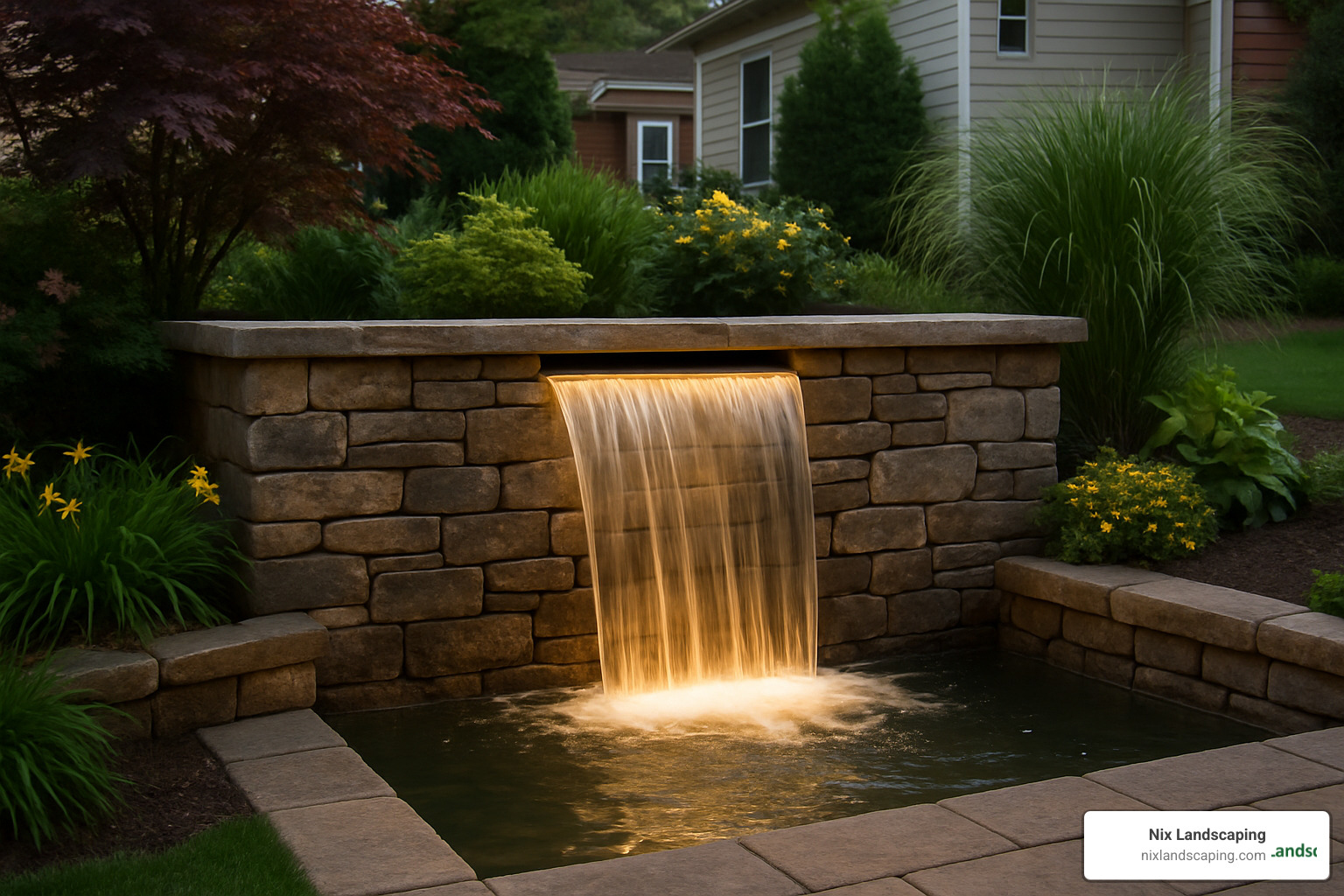
Our project data shows something remarkable: homeowners who add water features to their landscapes report using their outdoor spaces up to 70% more frequently. There’s something about the combination of solid structure and dynamic water that draws people outside like nothing else can.
Ready to improve your landscape with a retaining wall water feature? We’d love to show you how these elements can transform your property into the outdoor space you’ve always wanted.
Retaining wall with water feature? Design Essentials
Before diving into construction, proper design is crucial for a successful retaining wall with water feature project. At Nix Landscaping, we follow a comprehensive design process that addresses both aesthetic desires and engineering requirements.
Site Assessment Fundamentals
Every successful project begins with a thorough site evaluation:
- Slope Analysis: We measure the gradient of your property to determine appropriate wall height and water flow patterns.
- Soil Composition: Different soil types require different foundation approaches and drainage solutions.
- Existing Drainage Patterns: Understanding how water naturally moves across your property helps us integrate your feature without creating problems.
- Utilities Location: We identify underground utilities to avoid costly and dangerous disruptions during excavation.
Material Selection Matrix
The materials you choose will impact both the appearance and longevity of your retaining wall with water feature. Here’s a comparison of popular options:
| Material | Aesthetic | Durability | Cost | Water Integration Ease |
|---|---|---|---|---|
| Natural Stone | Organic, timeless | Excellent | High | Good (requires skilled masonry) |
| Concrete Blocks | Clean, modern | Very good | Medium | Excellent (designed for integration) |
| Gabion Cages | Industrial, contemporary | Excellent | Medium-High | Good (natural water flow through stones) |
| Timber | Rustic, warm | Fair (5-15 years) | Low | Poor (waterproofing challenges) |
Waterproofing and Drainage: The Hidden Heroes
The most beautiful retaining wall with water feature will fail quickly without proper waterproofing and drainage. These critical elements include:
- EPDM Liner: We use 45-mil rubber liners sandwiched between protective geotextile layers to prevent leaks.
- Drainage Layer: A layer of clean gravel behind the wall allows water to move freely without building up pressure.
- Proper Basing: Creating a stable, level foundation prevents settling that could compromise waterproofing.
At Nix Landscaping, we’ve seen too many DIY projects fail because these invisible elements were overlooked. Our approach prioritizes these structural necessities before addressing the visible design elements.
Is a Retaining wall with water feature? right for my yard?
While we love installing these dynamic landscape elements, they aren’t right for every situation. Here’s how to determine if your property is suitable:
Space Considerations
A typical retaining wall with water feature requires:
– Minimum 3-4 feet of depth for the wall structure and water basin
– Clearance for maintenance access
– Appropriate viewing distance to appreciate the feature
Budget Realities
Budget expectations should align with your vision:
– Simple spillway into a small basin: $2,000-$4,000 professionally installed
– Mid-range waterfall with 4-6 foot wall: $5,000-$8,000
– Elaborate multi-tiered system: $10,000+
DIY options can reduce these costs significantly, with some homeowners completing simple projects for as little as $300-$1,500 using reclaimed materials and doing their own labor.
Retrofit Possibilities
Already have a retaining wall? Good news! In many cases, existing walls can be modified to incorporate water features. We assess:
– Wall stability and construction method
– Access to power for pumps
– Potential for adding a basin at the wall base
– Waterproofing options for the existing structure
Integrating garden style and hardscape
A successful retaining wall with water feature should feel like an organic part of your overall landscape design. Consider these integration strategies:
Color Harmony
Select materials that complement both your home’s exterior and your existing landscaping. For Fishers homes, we often recommend:
– Warm limestone tones for traditional homes
– Bluestone or slate for contemporary designs
– Earth-toned concrete products for versatile applications
Plant Integration
Softening the hardscape with appropriate plantings creates a more natural appearance:
– Create planting pockets within the wall structure
– Use trailing plants from the top of the wall to soften edges
– Install moisture-loving plants near the water basin
– Consider how seasonal changes will affect the overall look
Lighting Schemes
Strategic lighting transforms your retaining wall with water feature from a daytime attraction to a nighttime showpiece:
– Underwater lights illuminate the water itself
– Uplighting highlights the texture of the wall
– Path lights ensure safe navigation around the feature
– Smart controls allow programmable scenes for different occasions
At Nix Landscaping, we design complete lighting packages that improve both the safety and beauty of your water feature after dark.
Step-by-Step Build Guide
Ready to bring your dream retaining wall with water feature to life? Whether you’re a brave DIYer or just curious about how our team at Nix Landscaping works our magic, I’m excited to share our tried-and-true process that’s transformed countless Fishers backyards into tranquil retreats.
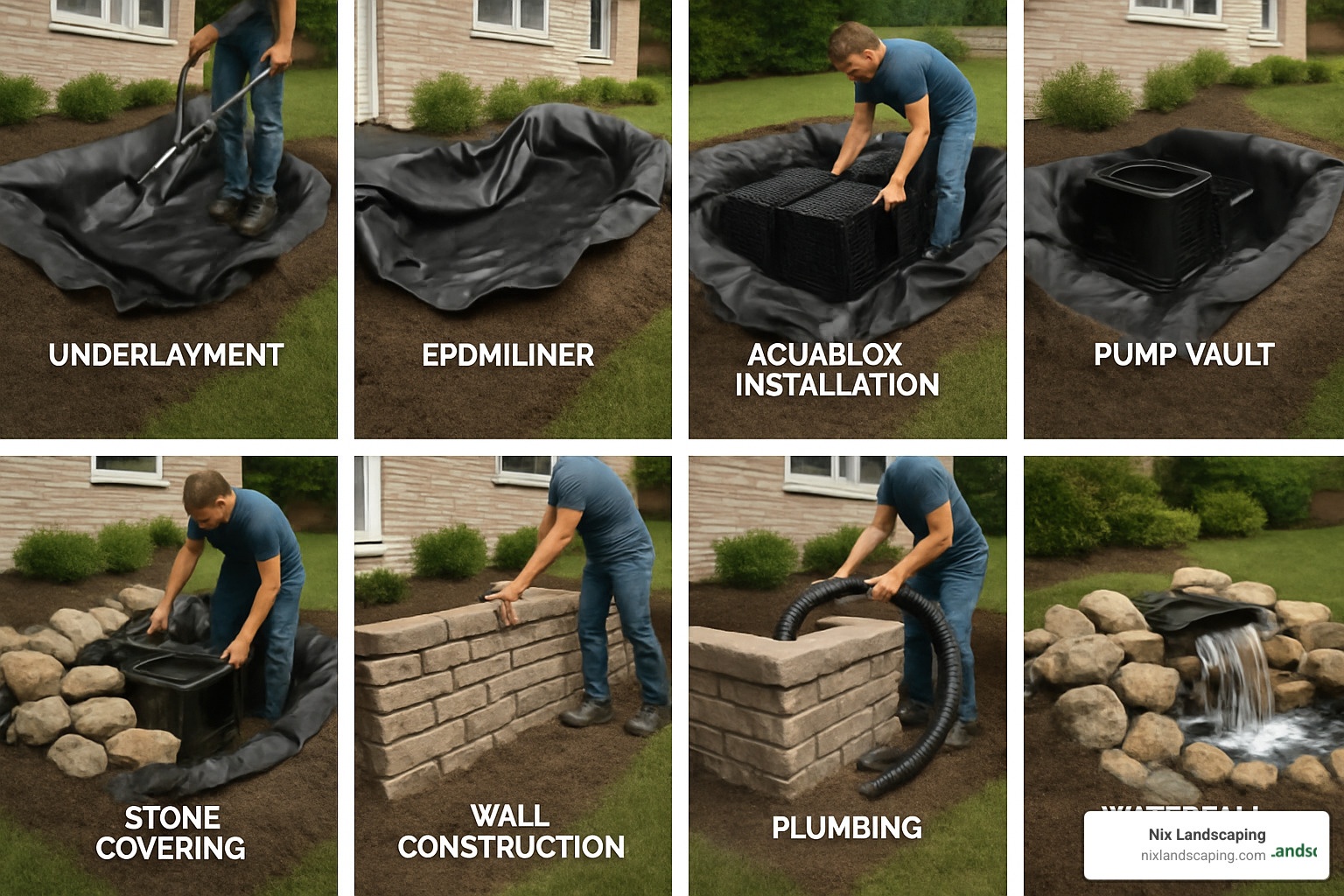
1. Excavation and Foundation Preparation
Every great water feature starts with proper groundwork. Think of this as laying the literal foundation for years of enjoyment:
We start by carefully marking your wall’s future home with stakes and string – this simple step prevents costly mistakes. Then comes the digging! We excavate 6-12 inches below grade for a solid wall base, plus another 18-24 inches for your water basin. That crushed stone base we carefully compact? It’s your insurance policy against settling and shifting that could damage your beautiful feature down the road.
2. Basin Construction
This hidden component is truly the heart of your water feature:
We begin with a protective underlayment that shields your EPDM liner from punctures. The liner itself gets generous overlap at the edges – better safe than sorry when it comes to water containment! Those AquaBlox water storage modules we install might look simple, but they’re engineering marvels that provide about 60 gallons of water storage while maintaining structural integrity. The pump vault we position makes future maintenance a breeze rather than a backbreaking chore. Finally, we cover everything with 1-3 inch round stones that both protect and beautify.
3. Wall Construction
Building your wall isn’t just about stacking blocks – it’s about creating something that’s both beautiful and engineered to last:
That first base course absolutely must be perfectly level – we check, double-check, and sometimes triple-check this critical element. Each subsequent course gets a slight step-back according to engineering requirements, creating that subtle but crucial slope that gives your wall stability. We thoughtfully leave openings for plumbing lines during construction, and often incorporate plant pockets that will soften the hardscape with greenery once completed.
4. Waterfall and Plumbing Installation
Now comes the part where your retaining wall with water feature truly comes alive:
We carefully position spillway units at your desired heights to create that perfect water music. The flexible PVC lines we run from pump to spillways remain hidden but accessible. Before finalizing anything, we’ll test the water flow and make adjustments – sometimes it’s the smallest tweaks that make the biggest difference in how your waterfall looks and sounds. Our team at Nix Landscaping takes particular pride in this fine-tuning stage.
5. Finishing Touches
It’s these final details that transform a good water feature into an extraordinary one:
Decorative stone strategically placed around the basin creates natural-looking transitions. The lighting systems we install will showcase your feature after dark, creating entirely new moods and experiences. Carefully selected plants appropriate for moisture levels complete the natural look. Depending on your materials, we may apply sealants that protect your investment for years to come.
Plumbing & Electrical Must-Dos
When it comes to the technical aspects of your retaining wall with water feature, cutting corners simply isn’t an option. Here’s what we prioritize:
Plumbing Essentials
Water needs reliable pathways to create that soothing flow. We use durable Schedule 40 PVC for buried lines that need to withstand soil pressure, while flexible tubing works perfectly for those connections to spillways that might need slight adjustments. Those check valves we install? They prevent the annoying backflow that happens when pumps shut off. We carefully size all pipes to match your pump’s flow rate – typically 1-2 inches for residential features. And because we know future-you will appreciate it, we create smart access points for seasonal maintenance and winterization.
Pump Selection Science
Your pump is the beating heart of your water feature, and choosing the right one involves some thoughtful calculations. We measure the vertical lift (the height from water surface to spillway) and account for friction loss in piping to determine the perfect flow rate – typically 1,500-2,000 gallons per hour per spillway creates that ideal movement.
For most Fishers homes, we recommend pumps that circulate between 4,000-8,000 gallons per hour, with remote control capabilities so you can adjust the flow from your patio chair. Our clients particularly love the variable-speed options that allow for different moods and energy savings.
Electrical Safety
Water and electricity require a healthy respect and careful planning. We always use GFCI protected outlets for all water feature components – this isn’t just recommended, it’s essential for safety. Electrical conduit gets buried at the appropriate depth (typically 18 inches) per local Indiana codes.
For complex installations, we partner with licensed electricians to ensure everything is up to code. Those waterproof connections and junction boxes we insist on might seem like overkill on installation day, but they’re what keep your system running safely through Indiana’s changing seasons. And for those special locations without easy access to power? We can explore solar options that provide freedom from electrical constraints.
Want to learn more about our water feature installation process? Check out our detailed guides on Retaining Walls, Water Features Installation, or how to Build Pond with Waterfall. The team at Aquascape also offers excellent change guides that complement our installation approach.
Keeping It Flowing: Maintenance & Water Quality
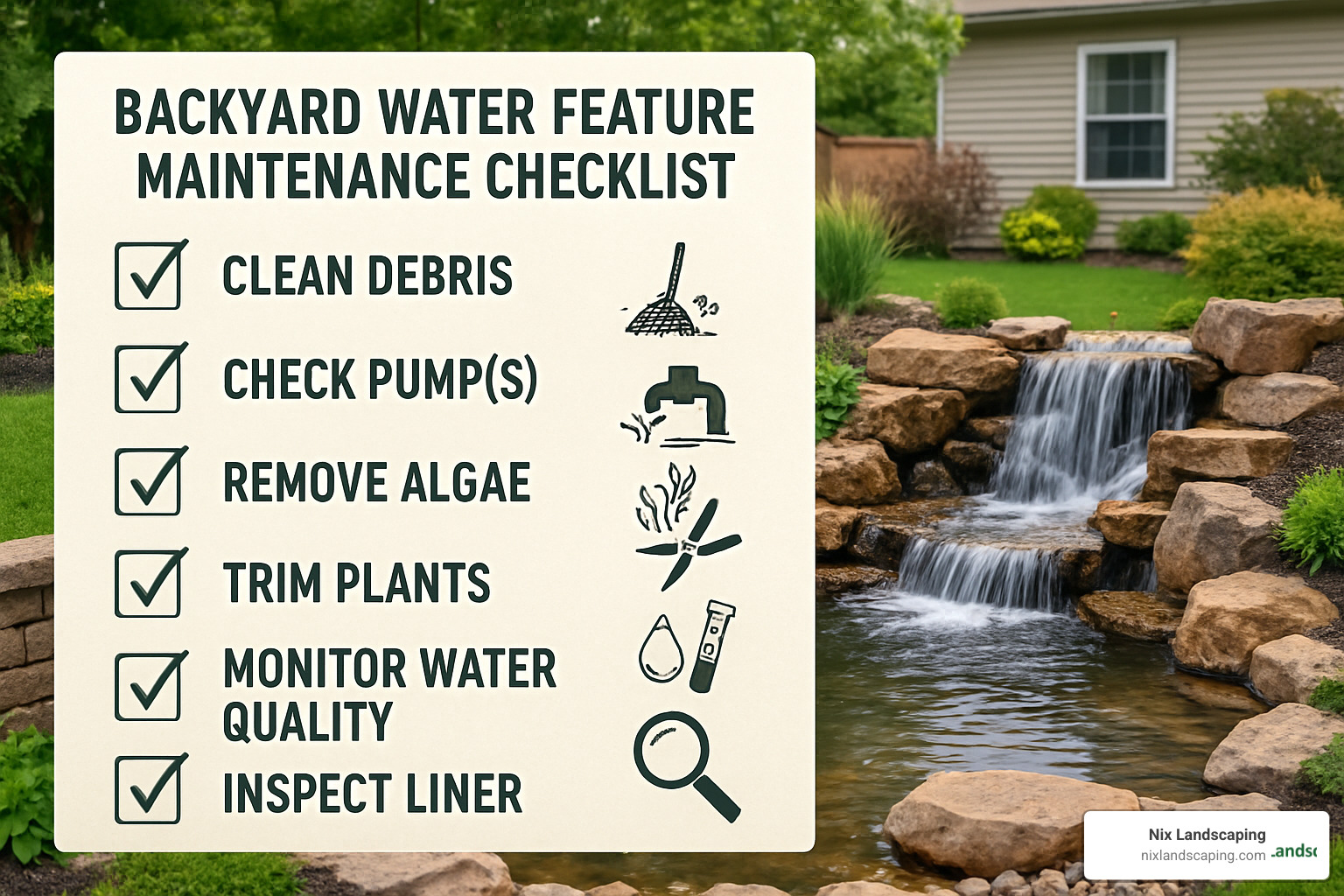
Your retaining wall with water feature should be a source of joy, not a maintenance headache. With some simple, regular care, you’ll keep that peaceful cascade flowing beautifully through the changing Indiana seasons.
Seasonal Maintenance Schedule
Living in Fishers means adapting your water feature care to our distinct Midwest seasons. Here’s what your calendar should look like:
Spring:
When the world wakes up, so does your water feature. As temperatures rise, it’s time to remove any debris that winter left behind. Restart your pump after its winter hibernation, and take a close look at the wall structure for any frost heaving or cracking. This is also the perfect time to replenish water levels and add beneficial bacteria to kickstart a healthy ecosystem.
Summer:
Those hot Indiana summers mean more evaporation, so check water levels weekly—especially during July and August heat waves. Make skimmer and filter cleaning part of your regular routine, just like mowing the lawn. Keep an eye on plants around your feature too—they love to creep closer to that moisture source and might need occasional trimming to prevent overgrowth.
Fall:
As beautiful as those autumn leaves are on the trees, they’re not so lovely clogging your water feature. A quick check every few days during peak fall will save you hours of cleanup later. This is also the time to prepare for winter by trimming back plants and considering a partial water change to reduce organic material.
Winter:
You have two options when the freeze sets in. If you’re keeping things running (which creates beautiful ice formations), ensure consistent water flow to prevent freezing damage. If shutting down, remove and store your pump indoors, and thoroughly drain all plumbing lines to prevent cracking.
Water Quality Management
Clear, healthy water isn’t just more attractive—it makes your entire maintenance routine easier. At Nix Landscaping, we’ve found these approaches work best for our Fishers clients:
Beneficial bacteria work wonders in naturally balancing your water feature’s ecosystem. These microscopic helpers break down organic matter before it can become problematic. Think of them as your invisible maintenance crew.
For stubborn algae issues, an IonGen system offers an excellent chemical-free solution. These systems release copper ions that prevent algae formation without harsh chemicals that might harm visiting wildlife or your plants.
Larger water features benefit from UV clarifiers that kill suspended algae as water passes through them. They’re especially helpful during those warm summer months when algae growth accelerates.
Perhaps most importantly, maintain proper circulation throughout your water feature. Stagnant areas quickly become problem spots, so ensure your pump is creating movement throughout the entire system.
Common mistakes when building a Retaining wall with water feature?
After building dozens of water features across Fishers and repairing many more, I’ve seen the same issues pop up repeatedly. Avoid these pitfalls to save yourself time, money, and frustration:
1. Inadequate Drainage
Water is wonderful when it’s flowing where you want it—but destructive when it isn’t. Proper drainage behind and around your retaining wall is absolutely essential. Without it, hydrostatic pressure builds up silently until something gives way—usually at the worst possible time.
Always include drainage gravel behind your wall, with perforated drain pipe at the base to channel water away safely. The ground should always slope gently away from your structure, not toward it.
2. Undersized Pump Systems
That bargain pump might look like a good deal until it burns out after three months of struggling. Select a pump rated specifically for your wall height, and then add about 20% more capacity for good measure. This gives you flexibility for adjustments and ensures your pump isn’t constantly working at its maximum.
For features that run continuously, energy-efficient models quickly pay for themselves in lower electric bills. Your wallet—and your water feature—will thank you.
3. Foundation Failures
The part of your retaining wall with water feature that nobody sees is actually the most important. Skimping on foundation work is like building a beautiful house on sand—eventually, problems will surface.
Always excavate down to undisturbed soil, use proper crushed stone (not rounded pea gravel which shifts), and compact thoroughly in layers. For walls over three feet tall, consider adding geogrid reinforcement for extra stability.
4. Permit Oversights
Many homeowners are surprised when the city inspector shows up asking questions. In Fishers, walls over four feet typically require permits, and electrical work almost always needs official approval. Some neighborhoods have HOA restrictions specifically addressing water features.
A quick call to the building department can save you from potential fines or even having to remove your beautiful new feature. At Nix Landscaping, we handle all permitting as part of our service, so you never have to worry about this often-overlooked step.
5. Mismatched Materials
Your retaining wall with water feature should look like it belongs in your landscape, not like it was dropped there from another property. Choose stone or blocks that complement your home’s architecture. Select coping that not only looks good but functions well with water flow. And always ensure all materials are specifically rated for water exposure—interior-grade materials will quickly deteriorate in the constant moisture.
With proper maintenance and avoiding these common mistakes, your retaining wall water feature will provide years of enjoyment while adding significant value to your Fishers home.
Budget, Permits and Safety
Let’s talk about the practical side of creating your dream retaining wall with water feature. Understanding costs, navigating permits, and ensuring safety will help your project flow as smoothly as the water that will soon be cascading down your beautiful wall.
Budget Planning
I always tell my clients that having a realistic budget from the start helps avoid those uncomfortable mid-project conversations. Here’s what you can expect:
For the DIY enthusiasts among you, here’s a breakdown of typical costs: Wall materials will run about $10-30 per square face foot, depending on whether you choose basic concrete blocks or premium natural stone. Your liner and underlay will cost roughly $1-2 per square foot. A quality pump and plumbing system typically falls between $200-500, while filtration adds another $100-300. Don’t forget lighting at $200-600 and those finishing touches like decorative stone and accents at $200-1,000.
If you’re considering professional installation through Nix Landscaping, our projects typically range from $2,000-4,000 for simpler designs, $5,000-8,000 for mid-range projects with multiple elements, and $10,000+ for those show-stopping custom features that become the talk of the neighborhood.
Professional installation includes not just labor, but also our design expertise, professional-grade equipment, comprehensive warranty coverage, and the peace of mind knowing your feature will function beautifully from day one.
Permit Requirements in Fishers, IN
At Nix Landscaping, we handle all the permitting paperwork for our clients (it’s one of those headaches we’re happy to take off your plate). If you’re going the DIY route in Fishers, here’s what you should know:
Building permits are typically required for walls over 4 feet in height. Any new outdoor wiring needs electrical permits (this is non-negotiable for safety reasons). Depending on your specific location, you might also need drainage permits, especially if you’re in a watershed-sensitive area. And don’t forget to check with your HOA, as many neighborhoods have specific approval processes for visible landscape changes.
The permit process in Fishers usually takes about 1-2 weeks and costs between $50-200, depending on your project’s scope. It’s a small investment that prevents much larger headaches down the road!
Safety Considerations
I can’t stress this enough – safety should never be an afterthought when combining water and electricity in your landscape.
For electrical safety, ensure all pumps and lighting are connected to GFCI protected circuits – this is literally a lifesaver if water and electricity ever meet unexpectedly. Have wiring professionally installed and inspected, even if you’re doing the rest yourself. Consider installing an emergency shutoff switch in an easily accessible location for quick power cutoff if needed.
Structural safety matters too. Make sure your walls are built to proper engineering standards (this is why those permits exist!). Include safety barriers for walls over 30 inches high to prevent accidental falls. And don’t forget adequate pathway lighting for safe nighttime enjoyment of your feature.
For households with children or pets, consider a pondless design that eliminates standing water concerns. If you do include basin areas, keep water depths minimal. For deeper water features, motion detectors or alarms provide an extra layer of protection.
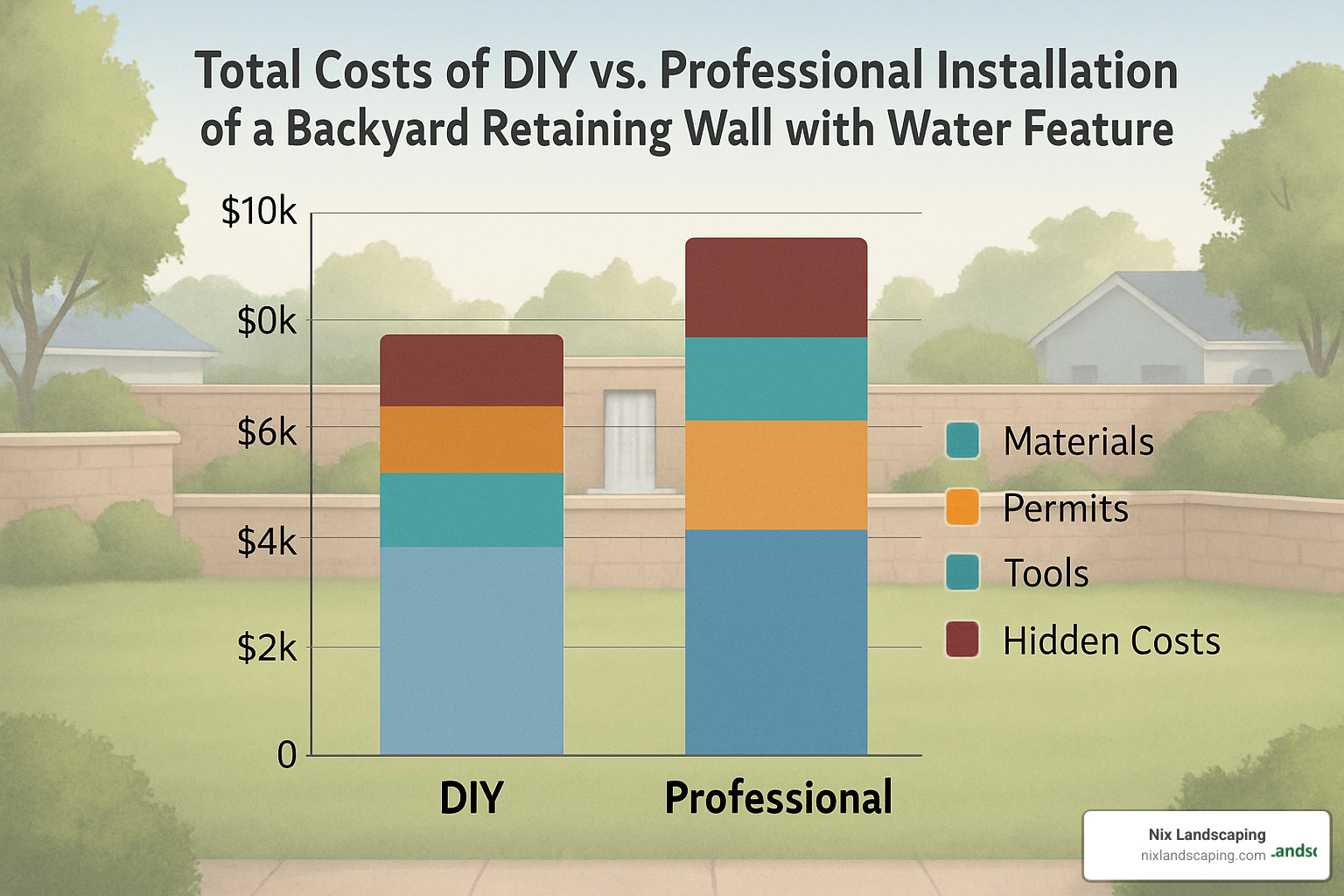
DIY vs Professional Cost Snapshot
When weighing DIY against professional installation, look beyond the basic material costs to get the full picture.
With DIY, you’ll face some hidden costs that aren’t always obvious at first glance. Equipment rental for excavation and compaction tools can add $200-500. There’s also the learning curve – mistakes happen and sometimes require costly rework. Time is another consideration – most moderate projects take 2-4 full weekends of work. And remember that DIY typically comes with limited warranties covering only the components themselves, not the installation.
Professional installation through Nix Landscaping adds value through our design expertise and project visualization, access to contractor-grade materials not available at retail, proper equipment and our experienced crew, full warranty on both materials and workmanship, and complete permitting and inspection coordination.
In my years of experience serving Fishers homeowners, I’ve found that most clients ultimately appreciate the peace of mind that comes with professional installation, especially for features that combine important structural elements with water systems. When you’re ready to discuss your specific project, we’re here to help you weigh all these considerations.
Inspiration Gallery & Advanced Ideas
The possibilities for your retaining wall with water feature are virtually endless. Over the years, we’ve created some truly spectacular designs for homeowners throughout Fishers and beyond. Let me share some of our favorite innovative approaches that might spark your imagination.
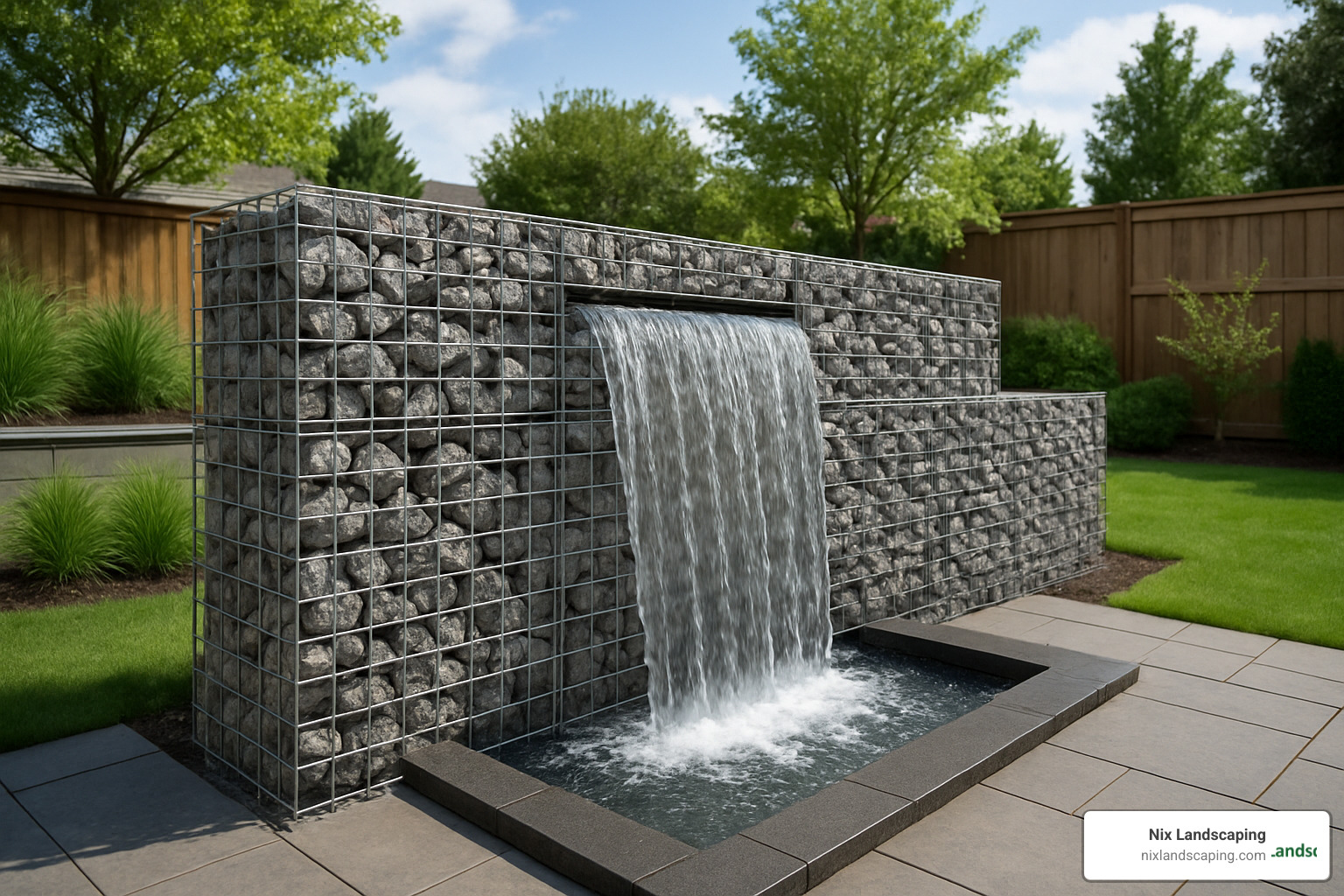
Gabion Waterfall Walls
There’s something magical about the way water interacts with a gabion wall. These wire cages filled with stone offer a contemporary aesthetic that’s become increasingly popular with our more modern-minded clients.
Water can either cascade over the top of these structures or weave its way through the stones themselves, creating a gentle, natural flow that sounds absolutely divine. The industrial look pairs beautifully with modern architecture, and I’ve found that these structures create fascinating opportunities for creative lighting. When LED lights shine through the spaces between stones at night, the effect is nothing short of enchanting.
Tiered Terraces with Connecting Falls
For properties with significant elevation changes, we often recommend a tiered approach that transforms a challenging slope into a series of functional spaces connected by water.
These upper terraces become perfect locations for intimate seating areas or lush garden beds, while the water travels playfully through a series of small falls between levels. The sound changes as it moves from tier to tier, creating a symphony of water music that varies throughout your landscape. This approach not only solves drainage and erosion issues but turns what could be a problematic slope into the most captivating part of your property.
Sheet-Flow Water Walls
When clients ask for something truly dramatic, we often suggest a sheet-flow design. Unlike traditional spillways that create a bubbling stream effect, sheet-flow creates an unbroken curtain of water that flows evenly across a smooth surface – often metal, glass, or polished stone.
The visual impact is stunning, especially when combined with strategic LED lighting that makes the water shimmer and dance after dark. The sound is also more substantial than traditional spillways, creating a more pronounced water presence that can effectively mask unwanted neighborhood noise. Many of our Fishers clients have told us their sheet-flow features have become their favorite spot to unwind after a long day.
Fire and Water Combination Features
For the ultimate sensory experience, nothing beats the combination of opposing elements. We’ve installed numerous retaining wall with water features that incorporate fire elements, and they never fail to become the centerpiece of outdoor entertaining spaces.
Imagine fire bowls or gas features positioned strategically along the top of your water wall, with flames reflecting in the water below. The interplay creates a mesmerizing effect that extends the usability of your outdoor space well into Indiana’s cooler months. There’s something primal and comforting about gathering around both fire and water – it’s outdoor living at its finest.
Copper-Faced Cascades
For clients looking for something truly distinctive, copper-faced water features offer unparalleled elegance. What makes copper special is how it evolves over time – developing a living patina that grows more beautiful with age.
Beyond its visual appeal, copper naturally inhibits algae growth (a practical benefit any water feature owner will appreciate). The warm, rich tones complement many landscape styles, from traditional to contemporary, and create a sense of established luxury that’s hard to achieve with other materials.
At Nix Landscaping, we love pushing the boundaries of traditional retaining wall with water feature designs. Our team gets genuinely excited when clients are open to creative solutions that go beyond the ordinary. Whether you’re interested in a garden pond build or want to explore how these advanced water feature ideas might work in your specific landscape, we’re here to turn your outdoor dreams into flowing reality.
Frequently Asked Questions about Retaining Wall Water Features
How do I choose the right pump size?
Picking the perfect pump isn’t just about power—it’s about finding the right balance for your particular water feature. When clients ask me about pump sizing, I always walk them through a simple process:
First, measure the vertical distance from your water surface to the highest point water will travel—this is your “head height.” Then consider how wide your spillway will be—each foot of width typically needs about 1,500-2,000 gallons per hour for that perfect, satisfying cascade effect that everyone loves.
Don’t forget to account for friction loss in your plumbing! I always recommend adding an extra 10-20% to your calculated capacity because those twists, turns, and fittings in your pipes create resistance. It’s like trying to drink a thick milkshake through a skinny straw—you need a bit more power to overcome the resistance.
For most of our Retaining wall with water feature? projects here in Fishers, we typically install pumps in the 4,000-8,000 GPH range. I’m a big fan of variable-speed pumps with remote controls—they let you adjust the flow from a gentle trickle to a dramatic rush without wading into the water basin. Plus, they can significantly reduce your electric bill when running at lower speeds.
Can I add a water feature to an existing retaining wall?
Good news—you absolutely can transform that plain retaining wall into a water feature! I’ve helped dozens of Fishers homeowners breathe new life into existing walls, and the results are often spectacular.
The feasibility really depends on a few factors. Concrete block walls tend to be the easiest to modify—they’re like the blank canvases of the hardscape world. Mortared stone walls require a bit more finesse, but they’re still workable with the right approach. The most important question is whether your wall is structurally sound with proper drainage already in place. A leaning or bulging wall needs to be fixed before adding the stress of water.
The retrofit process is surprisingly straightforward. We typically create openings for spillways, waterproof the sections that will contact water, install a basin at the wall’s base, and add the necessary plumbing and electrical connections. For many of our clients, this approach saves 30-40% compared to starting from scratch with a new wall.
Just last month, we transformed a plain 10-year-old retaining wall in the Geist area into a gorgeous waterfall feature for about half the cost of building new—and the homeowners couldn’t be happier with their “new” landscape focal point.
How do I prevent algae without chemicals?
Keeping your water crystal clear without harsh chemicals is definitely possible! As someone who has maintained hundreds of water features across Fishers, I’ve found that a natural approach is not only better for the environment but often more effective in the long run.
Beneficial bacteria is my first line of defense. These microscopic helpers break down the organic matter that would otherwise feed algae. Think of them as your underwater cleaning crew, working 24/7 to keep things pristine. I recommend adding them every 2-3 weeks during warm months.
Proper circulation is absolutely crucial—stagnant water is basically an algae invitation. Make sure your pump is moving water through all areas of your feature.
For more stubborn situations, UV clarifiers work wonders by killing single-celled algae as water passes through them. And one of my favorite solutions is the IonGen system, which releases tiny amounts of copper ions—completely safe for plants and animals but remarkably effective against algae.
Strategic plantings around your Retaining wall with water feature? also help by competing with algae for nutrients. Water lilies, for example, shade the water and reduce sunlight (which algae needs to grow), while bog plants absorb excess nutrients.
How much maintenance does a retaining wall water feature require?
One of the biggest myths I hear is that water features are maintenance nightmares. With proper design, your Retaining wall with water feature? should require minimal upkeep—certainly less than mowing that same area of lawn!
Weekly maintenance takes about the time it takes to brew your morning coffee—just a quick check of water levels, removing any obvious debris, and making sure your pump sounds happy. I tell my clients to make it part of their Saturday morning routine while enjoying their outdoor space.
Monthly, you’ll want to spend 15-30 minutes cleaning out your skimmer basket or filter and adding beneficial bacteria if you use it. It’s about the same time commitment as watering your houseplants.
Seasonal maintenance (typically spring and fall) takes a bit longer—maybe 1-2 hours to clean up surrounding plants, check all components, and remove any sediment that’s accumulated in the basin. Think of it like changing your furnace filter—a small investment that prevents bigger problems.
Our maintenance clients in Fishers typically spend less than 10 hours per year on their water features, with most of that time concentrated in spring and fall. That’s a pretty small time investment for the constant enjoyment these features provide!
What lighting options work best with water features?
Lighting is what transforms your Retaining wall with water feature? from a daytime attraction into a nighttime showstopper. I’ve seen clients literally gasp the first time they see their water feature lit up after dark!
Submersible LED lights placed directly in the water create that magical glow that makes water come alive at night. I love positioning uplights to highlight the texture of the wall itself—stone and water were made for dramatic lighting. For a more subtle effect, strip lighting hidden under the coping creates a floating glow that’s especially beautiful for entertaining spaces.
Color-changing options have become incredibly popular with our Fishers clients—they let you match your lighting to the season or your mood. Blue for summer parties, orange for fall gatherings, red and green for holidays… the possibilities are endless.
The technology has come so far in recent years that most of our installations now include smart controls that integrate with home automation systems. Being able to adjust your water feature lighting from your phone while sitting on the patio is the kind of simple luxury our clients absolutely love.
For safety, longevity, and energy efficiency, we exclusively use low-voltage LED systems. They’re safe around water, last for years, and use a fraction of the electricity of older lighting technologies. Plus, they can be integrated with your overall landscape lighting for a cohesive nighttime look that improves your entire property.
Conclusion
Imagine stepping into your backyard and being greeted by the gentle sound of cascading water, flowing over natural stone. A retaining wall with water feature isn’t just a landscape element—it’s a change that brings your outdoor space to life through the perfect marriage of function and beauty.
Throughout my years at Nix Landscaping, I’ve watched countless homeowners’ faces light up when they see their finished water feature for the first time. There’s something magical about the way moving water captivates us, drawing family and friends outdoors and creating a natural gathering spot for conversation and relaxation.
Your journey toward creating this special space doesn’t have to be overwhelming. Our team handles every step—from sketching initial designs that complement your home’s architecture to navigating permits with the City of Fishers, and from precision construction to teaching you simple maintenance routines. We’re committed to creating a seamless experience that results in a feature you’ll enjoy for years to come.
What makes our approach different is our focus on personalization. We don’t believe in cookie-cutter solutions. Your property has unique characteristics, and your family has specific needs and preferences. That’s why we take the time to understand how you use your outdoor space before recommending the perfect retaining wall with water feature design for your lifestyle.
For many of our Fishers clients, the decision to add water to their landscape has transformed not just their property, but their daily habits. Morning coffee beside a bubbling waterfall, evening conversations with the soothing soundtrack of flowing water in the background—these simple pleasures add immeasurable value to everyday life.
Whether you’re looking to tame a sloped yard, create a more distinctive landscape, or simply bring the restorative qualities of water into your daily experience, we’re here to help turn that vision into reality. We invite you to learn more about our retaining wall services or schedule a complimentary consultation to explore the possibilities for your unique space.
The perfect combination of stone and water awaits—let’s create something beautiful together.

