
Why Wireless Lighting Control for Outdoor Lights is Changing Modern Landscapes
Wireless lighting control for outdoor lights allows you to manage your landscape lighting remotely through smartphone apps, voice commands, or automated schedules. This technology eliminates the need for complex wiring while providing improved security, energy savings, and convenience for homeowners and businesses alike.
Key Benefits:
- Remote Control – Adjust lights from anywhere using your phone
- Automated Scheduling – Set lights to turn on/off automatically
- Energy Savings – Reduce electricity costs by up to 80% with smart dimming
- Improved Security – Motion sensors and scheduling deter intruders
- Easy Installation – No complex rewiring required
Gone are the days of manually switching outdoor lights or dealing with complicated timer systems. Modern wireless systems use technologies like Wi-Fi, Bluetooth Mesh, and Zigbee to create seamless networks that can control everything from pathway lights to architectural features.
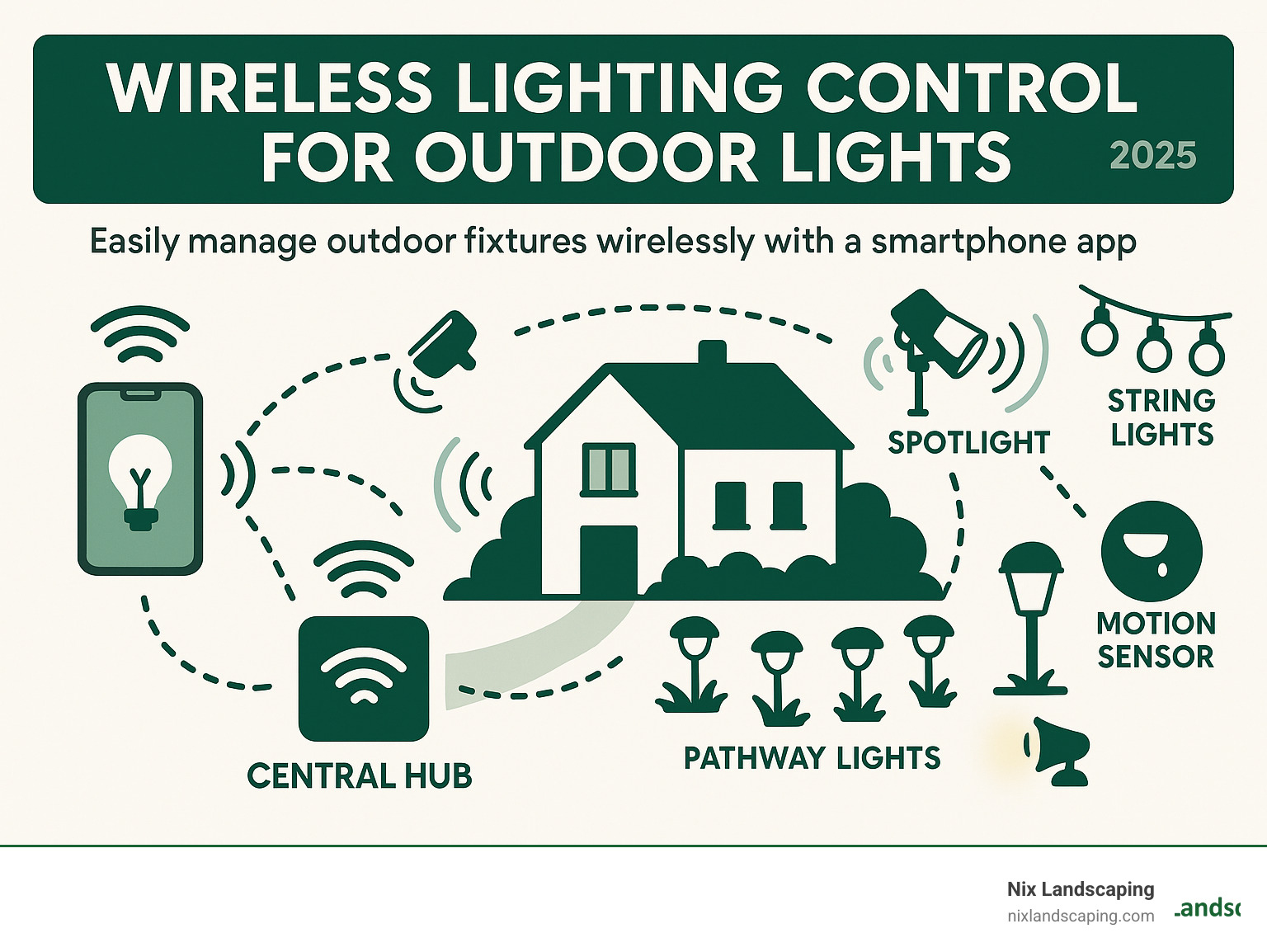
The technology works through three main components: a central hub that connects to your home network, smart light fixtures or bulbs, and a user-friendly app for control. Many systems also integrate with popular smart home platforms like Alexa and Google Home for voice control.
As Kyle Nix, owner of Nix Landscaping in Fishers, I’ve helped countless homeowners transform their outdoor spaces with professional lighting installations that incorporate wireless lighting control for outdoor lights for maximum convenience and impact. Through years of designing and installing landscape lighting systems, I’ve seen how wireless control technology can completely change how families enjoy their outdoor spaces.
Must-know wireless lighting control for outdoor lights terms:
The Bright Side: Key Benefits of Wireless Outdoor Lighting
Imagine your backyard at dusk, and with a simple voice command or tap on your phone, your entire outdoor space comes alive with perfectly balanced light. That’s the magic of wireless lighting control for outdoor lights. It’s about changing your outdoor environment into a dynamic, safe, and energy-efficient extension of your home.
Improved Security & Safety
A major benefit of wireless lighting control for outdoor lights is the boost to home security. You can program lights to turn on at dusk and off at dawn, eliminating dark corners. Motion sensors can instantly illuminate pathways or entry points when movement is detected, which can surprise and deter potential intruders. Studies show that controllable outdoor lighting can cut crime by up to 39%. Beyond security, improved visibility on paths and steps reduces the risk of slips and falls, making your outdoor space safer for family and guests.
Increased Curb Appeal
Wireless lighting control for outdoor lights offers unparalleled aesthetic improvement. We can strategically highlight architectural features, illuminate a beautiful garden, or create a welcoming entryway glow. The ability to adjust brightness and even color means you can tailor the ambiance for any occasion, from a vibrant party to a serene evening. This level of customization dramatically increases your home’s curb appeal and potential market value.
Best Convenience and Control
Convenience is at the heart of wireless lighting control for outdoor lights. Most systems let you control your entire setup from a smartphone or tablet, whether you’re on the couch or away from home. This remote access means you can adjust lights, create scenes, or set schedules from anywhere. For a hands-free approach, many systems integrate with voice assistants like Alexa and Google Home. You can also create custom scenes—like a “Dinner Party” or “Night Mode”—to recall specific lighting configurations with a single tap or command.
Energy Savings and Sustainability
Wireless control is also about smart energy management. These systems are almost always paired with energy-efficient LED technology, which uses less power and lasts longer. The real savings come from smart features. You can implement schedule-based dimming, which can lead to over 80% in energy savings. Motion sensors ensure lights are only on when needed, and photocell sensors automatically adjust to ambient light, turning lights off during the day. This intelligent automation means you’re never wasting energy and can reduce your electricity bill by a significant margin.
Dynamic Ambiance Control
Your outdoor space is a versatile canvas. With wireless lighting control for outdoor lights, you can paint with light to create dynamic ambiences for any mood. Many advanced systems offer RGBW (Red, Green, Blue, White) and tunable white lighting. This means you can choose from millions of colors and adjust the warmth of your white light. You can create custom lighting scenes, grouping lights and setting their brightness and color to recall with a single command, making your space feel more sophisticated and adaptable.
More info about outdoor lighting services
How Wireless Lighting Control for Outdoor Lights Works
At Nix Landscaping, we often get asked, “How does all this magic happen?” It’s clever engineering that brings wireless lighting control for outdoor lights to life. Think of it as a well-coordinated system where each component plays a specific part.
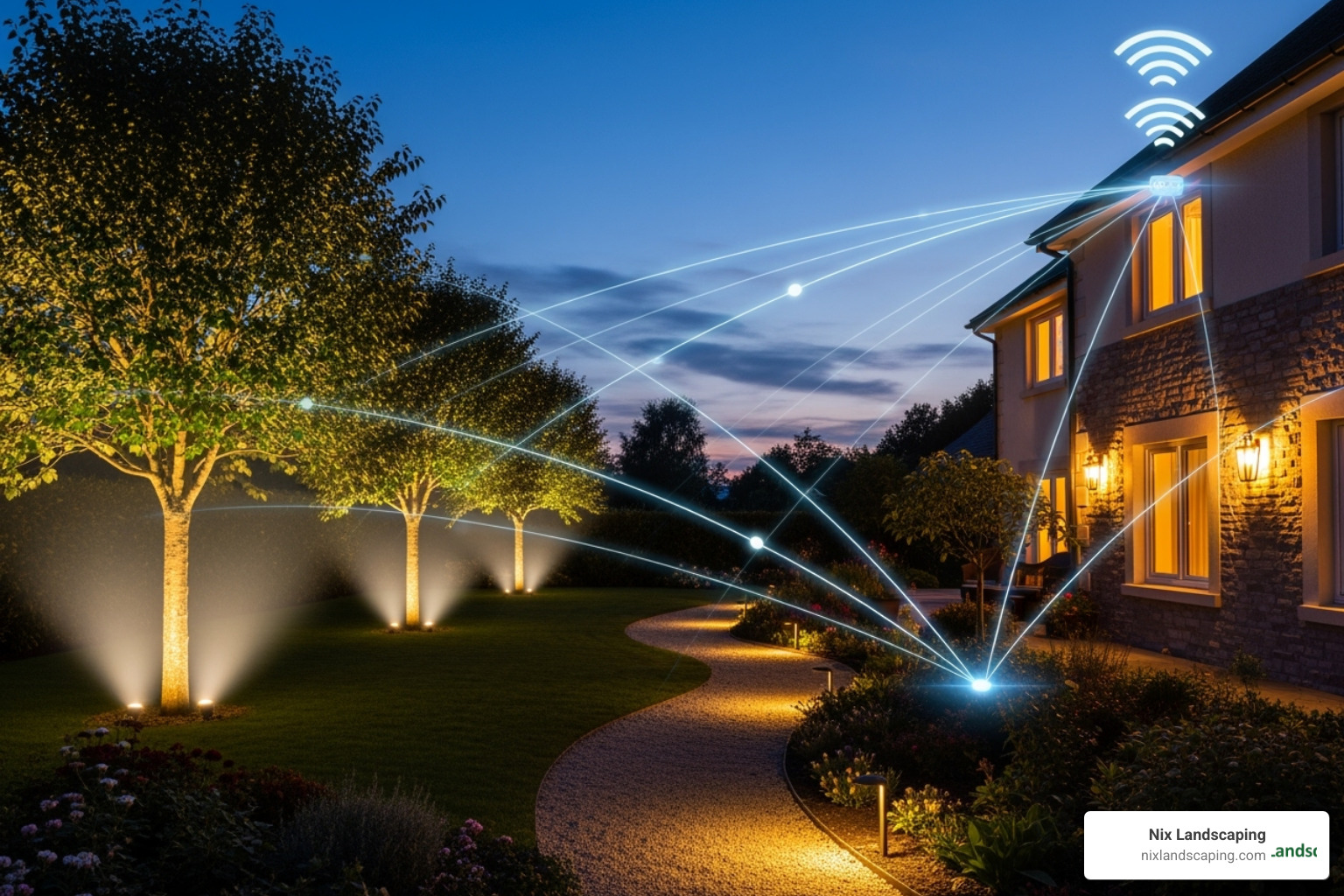
At its core, a wireless system has a central hub (or gateway) that connects to your home’s internet. This hub acts as the brain, communicating wirelessly with individual smart fixtures or bulbs. You interact with the system through a control interface, usually a smartphone app. When you send a command, the app tells the hub, which then relays the instruction to the correct lights, making the change almost instantly.
Understanding the Core Components
To appreciate the power of wireless lighting control for outdoor lights, it helps to know the main players:
- Gateway or Hub: This is the central brain of your system. It connects your home’s Wi-Fi to the wireless protocol your lights use (like Bluetooth Mesh or Zigbee), enabling remote control and management of your entire lighting network.
- Smart Bulbs & Fixtures: These are the lights themselves, with built-in wireless communication technology. They receive signals from the hub to turn on/off, dim, or change color.
- Sensors (Motion & Photocell): These are the system’s “eyes and ears.” Motion sensors trigger lights with movement for security and convenience. Photocell (dusk-to-dawn) sensors detect natural light, automatically turning lights on at dusk and off at dawn to save energy.
- User Interface (App/Platform): This is how you interact with the system. A user-friendly smartphone app lets you control lights, set schedules, create scenes, and monitor energy use. Many also integrate with voice assistants like Alexa and Google Home.
Exploring Common Wireless Technologies
The “wireless” in wireless lighting control for outdoor lights refers to several technologies, each with its own strengths. Understanding them helps in choosing the right system for your property.
| Technology | Range | Scalability | Power Consumption | Key Characteristics |
|---|---|---|---|---|
| Wi-Fi | Good (up to 100m) | High | High | Common and familiar, but can have range limitations outdoors and may crowd your home network. |
| Bluetooth Mesh | Good (up to 200m) | Excellent | Low | Ideal for local control. Each light extends the network, creating a robust system perfect for residential properties. |
| Zigbee | Good (up to 100m) | Excellent | Very Low | A reliable, low-power mesh network widely used in smart homes. Creates a self-healing network. |
| LoRaWAN | Excellent (kilometers) | Very High | Very Low | Best for extremely long-range applications like street lighting over vast areas. Not for real-time control. |
| Proprietary | Varies | Very High | Varies | Custom protocols (e.g., Synapse SimplySnap) optimized by manufacturers for superior performance, range, and reliability. |
Key Features to Look for in a System
When choosing a wireless lighting control for outdoor lights system, we look for features that offer immediate convenience and long-term value. It’s about finding the perfect fit to make your outdoor space truly shine.
Here are the key features to consider:
Scalability and Future-Proofing: A great system should grow with you. Whether you start with a few path lights or plan to add more later for a garden or outdoor kitchen, a scalable system expands easily. This “future-proofing” means you won’t have to start over as your landscaping dreams get bigger, accommodating anything from a few lights to thousands across a large property.
Zone Control: This must-have feature lets you control different parts of your yard separately. You can create a “zone” for your patio, another for flower beds, and a third for security lights, allowing you to set the perfect mood for each area and save energy.
Dimming and Color Tuning: Modern systems let you adjust brightness from a soft glow to full illumination. For more creativity, some offer RGBW (Red, Green, Blue, White) and tunable white lighting, giving you millions of colors and varied warmth of white light to paint your yard for any occasion.
Smart Scheduling and Scene Creation: Go beyond simple timers with an astronomical clock that adjusts to local sunrise and sunset times year-round. You can also create custom scenes for different activities, like a “Welcome Home” scene that brightens the driveway, all recalled with a single tap or voice command.
Smart Home Integration: For a truly connected home, look for systems that work with platforms like Amazon Alexa and Google Home. This allows you to control your outdoor lights, indoor lights, and other smart devices with simple voice commands.
Energy Monitoring and Alerts: Some systems show you how much power your lights are using, helping you track savings. Real-time alerts can notify you if a light fails or there’s a connection problem, allowing for quick fixes.
Durability and Weatherproofing: Outdoor products must be tough. Look for ratings like IP65 (water and dust protection) and durable enclosures (like NEMA 3R) to ensure your system can withstand rain, sun, and temperature changes for years to come.
More info about hardscaping design
Applications for Businesses and Municipalities
For businesses and municipalities, wireless lighting control for outdoor lights is a game-changer, delivering efficiency, safety, and cost savings across vast environments like corporate campuses, sports complexes, and city streets.

These systems enable centralized management of large-scale lighting networks. Facility managers can easily schedule lighting for parking lots and corporate campuses, dimming areas during off-peak hours while keeping key egress points lit for security. For sports facilities, wireless controls allow for dynamic lighting effects and precise light levels for different events, reducing operational costs. In public parks and recreational areas, lighting can adjust to foot traffic, creating a safe and inviting atmosphere. For street lighting, municipalities can manage entire networks from a single platform, monitoring performance, detecting faults, and saving energy.
Calculating Cost vs. ROI
While there’s an initial investment, the return on investment (ROI) for wireless lighting control for outdoor lights is rapid and compelling. Installation costs are often lower than traditional wired systems because there is no need for complex trenching. The most significant return comes from energy savings, which can exceed 80% when using LED lights with smart controls. Maintenance costs plummet thanks to real-time monitoring and predictive alerts, which reduce the need for manual patrols and costly callouts. Furthermore, many jurisdictions offer rebates and incentives for DLC-listed systems, which can significantly offset the initial investment.
Find qualified products on the DLC list
Real-World Success and Sustainability
The impact of wireless lighting control for outdoor lights is tangible, driving both operational efficiency and environmental sustainability. A major benefit is improved public safety, as studies have shown that controllable outdoor lighting can cut crime by 39%. Operationally, centralized management platforms simplify the control of large lighting networks, empowering managers to oversee entire campuses or cities from one interface. These systems are designed to meet modern energy codes (DLC, IECC) and contribute to a reduced carbon footprint by drastically cutting energy consumption. Adopting smart outdoor LED lighting is a vital tool for any organization committed to its sustainability goals.
Conclusion
Wireless lighting control for outdoor lights is revolutionizing how we experience our outdoor spaces. It’s a smart investment that brings incredible value by making your property safer, more beautiful, and more convenient. We’ve seen how these systems provide improved security, stunning curb appeal, and the sheer convenience of control from your phone. The significant energy savings are good for your wallet and the planet, while dynamic ambiance control makes your outdoor area a true extension of your home.
Embracing this technology is straightforward. Modern systems are designed with intuitive apps and simple setups, making the path to smarter outdoor lighting accessible for homeowners and large organizations alike. The future of outdoor lighting is wireless, integrated, and intelligent.
Here at Nix Landscaping, based in Fishers, IN, we are passionate about helping our clients bring these visions to life. Our expertise isn’t just about installing lights; it’s about providing personalized design and ongoing maintenance to ensure your project runs smoothly. We focus on your unique needs to create a captivating, efficient, and enjoyable outdoor space.
Ready to illuminate your landscape with intelligence and elegance?

